
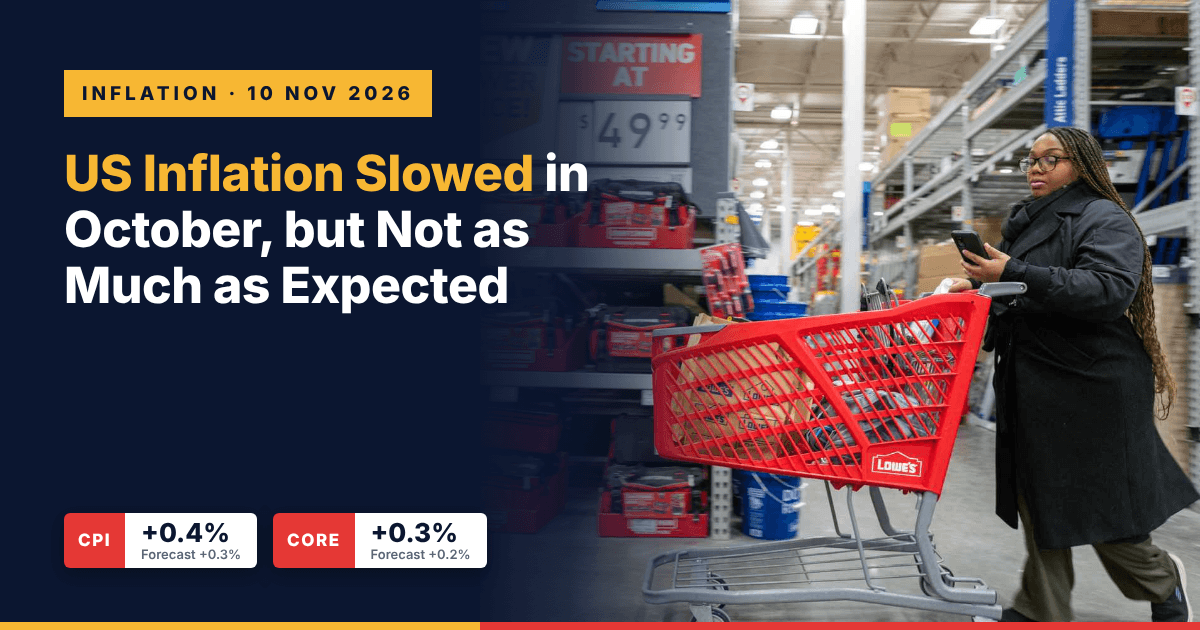
If you filled up your tank or bought groceries last month, you probably already guessed this. Prices kept going up in October. The good news is they went up slower than in September. The bad news is they still went up faster than most economists thought they would, and the Fed noticed.
The Bureau of Labor Statistics put out the October consumer price index (CPI) on Tuesday, 10 November 2026, at 8:30 a.m. ET. Here’s what it showed.
The October CPI numbers
| Measure | October | Forecast | September |
|---|---|---|---|
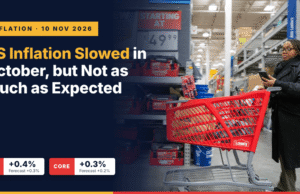
| Headline CPI (month over month) | +0.4% | +0.3% | +0.6% |
| Core CPI, no food or energy (month over month) | +0.3% | +0.2% | +0.3% |
Forecasts are from the Dow Jones survey of economists, as reported by CNBC and StockTitan. September figures are from the BLS September release.
So headline inflation cooled from 0.6% to 0.4%. That’s a real drop. But 0.4% a month is still a lot. If prices kept rising at that pace for a full year, you’d be looking at roughly 5% inflation, well above the Fed’s 2% target.
Core inflation is the number the Fed watches more closely, because food and gas prices bounce around a lot. Core stayed at 0.3%, the same as August and September, and beat the 0.2% forecast.
Why there’s no yearly inflation rate this time
You might be looking for the usual “inflation is X% over the past year” figure. There isn’t one this month.
The government was shut down in October 2025, so the BLS never collected prices that month. Without an October 2025 number, it can’t work out a 12-month change for October 2026. The BLS said it “will not publish 12-month percent changes for October 2026 for indexes where October 2025 data are not available,” as StockTitan quoted from its shutdown notice.
The last yearly numbers we have are from September: headline CPI was up 3.7% over 12 months and core was up 2.6%, according to the BLS.
What pushed prices up
September was mostly a gas story. Gasoline jumped 9.1% that month and was behind more than half of the whole increase, the BLS said.
October was more spread out. According to StockTitan’s breakdown of the BLS data:
- Gasoline rose 1.0%, a much smaller jump than September’s 9.1%. Energy overall rose 0.7%.
- Food rose 0.5%, with both grocery and restaurant prices higher.
- Shelter (rent and housing costs) rose 0.3%, down from 0.4% in September. Shelter made up more than 30% of the monthly increase.
- Car insurance rose 0.7% and hospital services rose 0.8%.
- Used cars and trucks fell 1.2%, one of the few things that got cheaper.
So if you felt it at the grocery store more than at the pump last month, the numbers back you up.
What this means for interest rates
This is where it gets serious for anyone with a mortgage, car loan or credit card balance.
The Fed is raising rates again. It held its range at 3.75% to 4% at its 28 October meeting after a quarter-point hike in September, StockTitan reported. The next decision is due on 9 December.
A few hours before the CPI report came out, Fed Governor Christopher Waller gave a speech in London that laid out his thinking pretty bluntly. On September he said: “Let’s just say it. September’s inflation data were bad. There was no silver lining.”
He also said that “even if, as I expect, the monthly rate of inflation improves in October, I am leaning toward supporting an increase in our policy rate of 25 basis points at the FOMC’s December meeting.”
Then he set a line. If core CPI for October came in “around 0.3 percent or even higher,” he said a stronger move may be needed: “In that case, I believe a 50 basis point hike in the policy rate should be considered at the December meeting.” He added: “Hiking only 25 basis points would put our credibility at risk, a risk I am not eager to take.”
Core came in at 0.3%. That’s exactly his line. So a half-point hike in December is now on the table.
How markets reacted
Investors didn’t like it. Right after the release, Nasdaq 100 futures fell 1.15% and S&P 500 futures dropped 0.5%, CoinDesk reported. Bond yields went up fast: the 10-year Treasury yield rose 6.5 basis points to 4.93%, and the 2-year yield jumped 14 basis points to 4.69%. Bitcoin slipped about 1% to $73,600.
That’s a sharp turn from Monday, when the S&P 500 had its best day since April, which we covered in our article on US stocks surging despite Nvidia’s spy scandal.
What it means for your wallet
A few practical things to keep in mind:
- Borrowing will likely get more expensive. If the Fed hikes in December, credit card rates and adjustable loans usually follow within one or two billing cycles. If you’re carrying a balance, paying it down now saves you money later.
- Savings accounts may pay a bit more. High-yield savings accounts and CDs tend to go up after a rate hike.
- Gas is calmer, food isn’t. Gas went up 1% in October versus 9% in September. Groceries and eating out kept climbing.
What to watch next
- 13 November: producer price index (PPI) for October
- 4 December: November jobs report
- 9 December: Fed rate decision
- 10 December: November CPI report
If November’s CPI shows core inflation dropping back to 0.2%, the Fed might go easier. If it stays at 0.3% or higher, expect more hikes into 2027.