
Ask anyone who has tried to plan a renovation while lumber prices kept jumping. You don’t start until you know what the bill will be. Canada’s top diplomat in Washington says American businesses are doing the same thing with tariffs, and it’s costing the U.S. new factories and jobs.
Mark Wiseman, Canada’s ambassador to the United States, told a room full of business leaders on Wednesday, 11 November 2026, that President Donald Trump’s tariffs are pushing up costs and making companies sit on their money instead of building in America.
“Uncertainty increases your cost of capital,” Wiseman said.
Who said it and where
Wiseman spoke at the B20 summit in Washington, D.C., hosted by the U.S. Chamber of Commerce. He has been Canada’s ambassador since February 2026. Before that he was an executive at BlackRock, the world’s largest asset manager, so he has spent a career deciding where big money gets invested.
His point was simple. A company thinking about whether to build a new plant, add a new ship or spend money on R&D needs to know what its costs will be a few years out. Tariffs that can change with one announcement make that math harder. In his words, “the more certainty you have, the more likely you’re going to do that.”
Less certainty means higher borrowing costs and fewer projects. Fewer projects means fewer jobs on the U.S. side of the border too.
What Canada wants
Canada wants the tariffs gone, and soon. Asked about timing, Wiseman said: “The sooner, the better.”
He pointed to the history. “We’ve had comprehensive free trade with the United States since 1988,” he said, going back to the original Canada-U.S. Free Trade Agreement. Ottawa’s goal now is to get back “as close as we can to free trade.”
Specifically, Wiseman called for the U.S. to drop the tariffs it has put on Canada under Section 232 and Section 338 of U.S. trade law. Section 232 is the national security tariff tool the White House has used on steel, aluminum and cars, which are the industries Canada cares most about.
The numbers behind the warning
Wiseman’s argument is easier to judge when you look at what tariffs have actually done to trade between the two countries. Here’s what the data says, as reported by CNBC:
| Measure | Figure | Source |
|---|---|---|
| U.S.-Canada goods trade, first nine months of 2026 | about $570 billion | U.S. Census Bureau |
| U.S. customs duties collected on Canadian imports, 2024 | $400 million | Congressional Research Service |
| U.S. customs duties collected on Canadian imports, 2025 | $10 billion | Congressional Research Service |
| Share of tariff costs paid by U.S. importers | nearly 90% | New York Fed study, October 2026 |
| U.S. consumer prices, October 2026 | up 0.4% in one month, higher than expected | Labor Department |
A few things jump out.
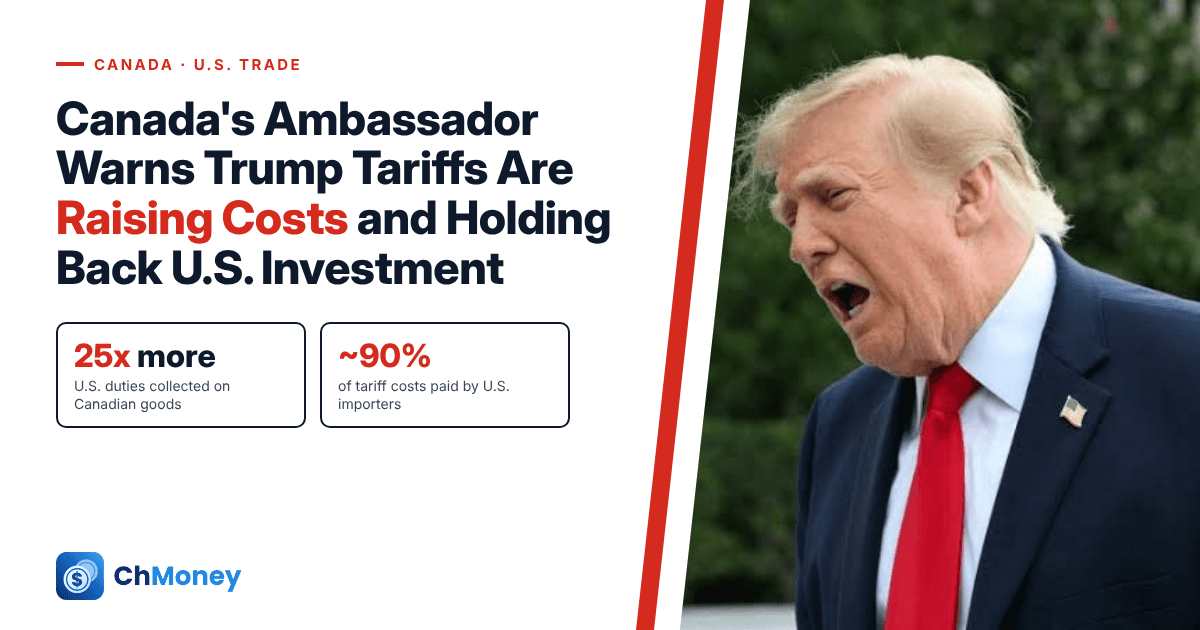
Duties on Canadian goods went from $400 million to $10 billion in one year. That’s 25 times more. And that money doesn’t come from Canada. The New York Fed found U.S. importers paid close to 90% of tariff costs, and about a quarter of those increases have already shown up in the prices of things you buy at the store. The same study expects more price pressure in 2027.
Trade has held up better than some feared. The $570 billion in goods traded so far this year is higher than the same stretch of 2025. But it’s still lower than the same nine months in each of the three years before that.
Some Canadian products now face U.S. duties of up to 50%. Canada hit back with its own measures on billions of dollars of American exports, and on 9 November Ottawa extended its relief program for Canadian firms that import tariffed U.S. goods, changing which products qualify.
Other ambassadors said the same thing
Wiseman wasn’t the only diplomat at the summit making this case.
Germany’s ambassador to the U.S., Jens Hanefeld, said companies can adapt to tariffs, but they struggle with an “ever-changing regulatory environment” that has them paying more for lawyers.
France’s ambassador, Aurélien Lechevallier, wanted the conversation to move on to AI and energy. “We’ve spent, I think, a lot of time the last years working and dealing with regulations, tariffs,” he said. “Businesses are eager to do more business.”
Three of America’s close trading partners, on one stage in Washington, said roughly the same thing. Tariffs hurt, but the constant changes hurt more.
What Trump says
Trump has defended the tariffs as necessary to protect American manufacturers and workers. He has accused Canada of trade practices that put U.S. exporters at a disadvantage.
Where the trade talks stand
Talks between Ottawa and Washington broke down in August 2026 and have since restarted. The focus now is on cutting tariffs on Canadian steel and autos.
There are signs things could move faster. Prime Minister Mark Carney said on Tuesday that the Trump administration is still Canada’s main negotiating partner. And Pete Hoekstra, the U.S. ambassador to Canada, predicted last week that the two countries could reach a deal before the end of 2026.
Politics in Washington is shifting too. Republicans took heavy losses in the midterm elections, and Democrats plan to challenge Trump’s tariffs once they control Congress in January.
What this means for you
If you run a business that buys Canadian steel, aluminum, auto parts or lumber, you’ve probably already paid more this year. The New York Fed numbers say you, the importer, carry most of the tariff, not the Canadian supplier.
If you’re an investor, watch the Canada talks and any news on Section 232 duties for steel and autos. A deal would help U.S. carmakers, steel buyers and construction firms that have been dealing with higher input costs. No deal, and the uncertainty Wiseman talked about sticks around into 2027.
And if you’re just a shopper, that 0.4% jump in October prices is part of the same story. Some of it is tariffs working their way to the shelf.
FAQ
Who is Canada’s ambassador to the United States? Mark Wiseman. He took the job in February 2026 after working as an executive at BlackRock.
What did Mark Wiseman say about tariffs? At the B20 summit in Washington on 11 November 2026, he said tariff uncertainty raises the cost of capital and makes companies less likely to build plants, buy equipment or spend on R&D in the U.S. He called for the tariffs to be removed “the sooner, the better.”
Who pays for Trump’s tariffs on Canada? Mostly U.S. companies. A New York Fed study from October 2026 found nearly 90% of tariff costs fell on U.S. importers, and about a quarter of the increases reached consumer prices.
How much has the U.S. collected in tariffs on Canadian goods? About $10 billion in 2025, up from $400 million in 2024, according to the Congressional Research Service.
Will Canada and the U.S. reach a trade deal? Talks restarted after collapsing in August 2026. U.S. Ambassador Pete Hoekstra has said a deal could come before the end of 2026, with steel and autos at the center of it.