
A week ago most of Wall Street had one opinion on Nvidia: buy it. That opinion hasn’t flipped, but it has cracked. Since the weekend, one big broker downgraded the stock, two banks pulled it off their best ideas lists, at least four firms cut their price targets, and a sitting US senator said Jensen Huang “has got to go.”
The common thread in what analysts are writing is simple. Nvidia is going to be watched very closely for a while, by its board, by Congress, by regulators and by its own shareholders. And nobody knows yet how long that lasts.
Here’s who said what, and why they think the scrutiny is coming.
The quick background
If you are just catching up: on Sunday, 8 November 2026, Nvidia CEO Jensen Huang admitted to an affair with Alice Huang (no relation), a former executive at Singapore data centre company Megaspeed. US intelligence reportedly believes she was passing information to China. Nvidia’s board opened an independent investigation the same day and said it had “no reason to believe that either national security or NVIDIA secrets were compromised.”
Then President Trump said the FBI was looking into it “in terms of something else,” which we covered in our article on Trump and the FBI Nvidia probe. We also wrote up the investor pitch Alice Huang allegedly made for Nvidia chips.
None of the spy claims have been proven in public, and no charges have been filed. China has called the reports a smear.
Baird cuts its target by 60%
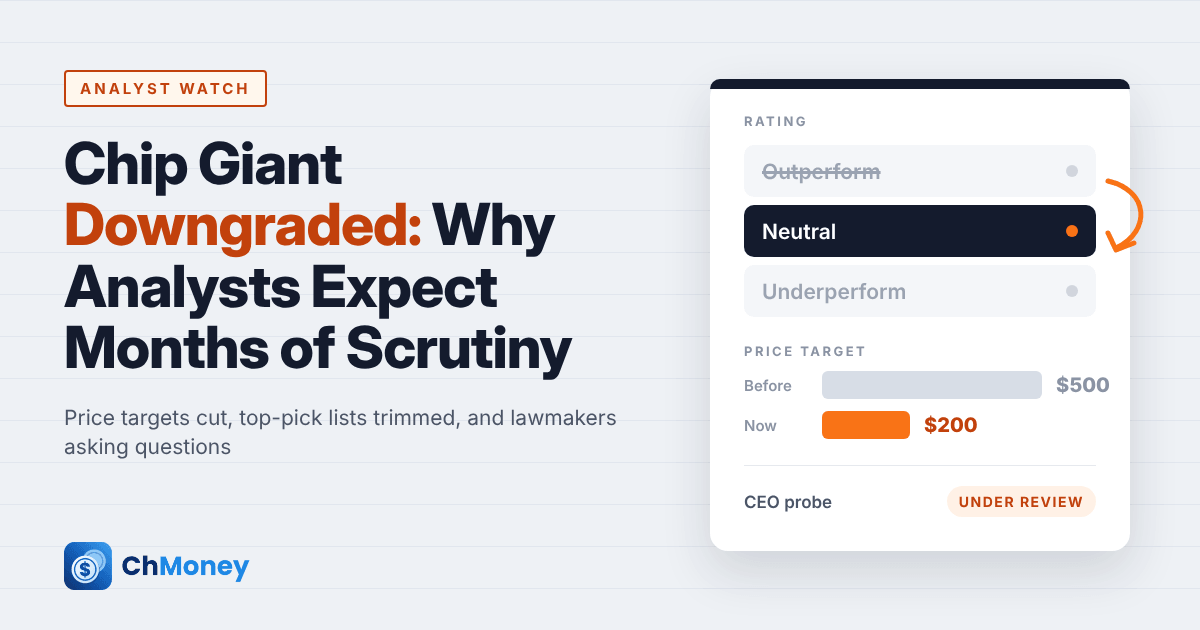
The biggest move came on Wednesday, 11 November. Baird analyst Tristan Gerra downgraded Nvidia from Outperform to Neutral and cut his price target from $500 to $200, according to American Bazaar.
His reasons go past the scandal itself:
- Uncertainty over whether Huang stays as CEO
- Limited visibility into Nvidia’s data centre business in 2027
- A possible slowdown in AI spending, with cloud companies’ AI infrastructure budgets growing about 40% or a bit less in 2027
- China export restrictions
- Possible enforcement against data centre operators in Southeast Asia
That last point matters because of Megaspeed. If US officials start going after the Southeast Asian companies that buy Nvidia chips, a chunk of demand could get a lot harder to sell into.
Two banks drop Nvidia from their top lists
Morgan Stanley took Nvidia off its top picks list. Analyst Joseph Moore kept his Overweight rating and $300 target, so this isn’t a downgrade. The firm has a rule: if a top pick falls more than 25% from the day it was named, it comes off. Nvidia made the list on 2 October and has fallen more than that since.
Moore still thinks long-term demand for AI infrastructure is strong, but he said uncertainty around Huang could weigh on investor confidence in the near term, per American Bazaar.
Bank of America did something similar. It cut Nvidia, Micron and Lam Research from its “US 1 List,” Yahoo Finance reported. Both banks still rate Nvidia a Buy.
Price target cuts keep coming
Here are the changes reported so far this week:
| Firm | Analyst | Rating | Price target |
|---|---|---|---|
| Baird | Tristan Gerra | Outperform to Neutral | $500 to $200 |
| Wells Fargo | Aaron Rakers | Buy (kept) | $315 to $300 |
| Citigroup | Not named | Buy (kept) | $315 to $285 |
| Mizuho | Not named | Not stated | Cut to $250 |
| Morgan Stanley | Joseph Moore | Overweight (kept) | $300 (kept), removed from top picks |
| Aletheia Capital | Not named | Downgraded to Hold | Not stated |
| Seaport | Not named | Sell | $180 |
Sources: American Bazaar, TipRanks, IBTimes and Yahoo Finance. Seaport’s Sell rating was already in place before the scandal.
Wells Fargo’s Rakers trimmed his target but stayed calm on the business. “We see little/no risk to demand destruction/fundamental impact at this point,” he wrote, per TipRanks. He still expects the CEO investigation, and the risk of losing Huang, to hang over the stock for a while.
Why analysts expect scrutiny to be harsh
Read through the notes and four reasons keep coming up.
1. Congress is getting involved
This is the part that moved fastest this week. Senator Kevin Cramer of North Dakota, a senior Republican on the Senate Banking Committee, said late on Tuesday that Huang should step down. “I just think he’s got to go,” he said, according to 24/7 Wall St. via Yahoo Finance. He pointed to extortion risk, since Nvidia’s chips are so sensitive, and called the board’s internal review “fine” but not nearly enough.
On the House side, Representative John Moolenaar, who chairs the House China committee, said on Wednesday that Huang is likely to be subpoenaed. Representative Brian Mast said he is ready to issue a subpoena if Huang doesn’t agree to a private briefing. Three House committee chairs asked Huang to appear on 18 November. As of Wednesday afternoon, no subpoena had gone out and Huang hadn’t replied.
When lawmakers from the president’s own party are talking subpoenas, you can expect this to drag on.
2. China sales and export rules
US export controls have limited China’s access to Nvidia’s top AI chips since 2022. Nvidia’s own guidance for this quarter, $108 billion in revenue give or take 2%, already leaves out China data centre sales.
The worry now is that Washington gets stricter, not looser. A note summarised by CapWolf suggested the US government could reconsider Nvidia’s licence to ship certain chips to China-based customers and close loopholes for Southeast Asian data centres. CapWolf didn’t name the analyst, so take that one with some caution. Gerra’s Baird note made a similar point about Southeast Asia enforcement, and his name is on it.
3. Leadership and succession
Huang co-founded Nvidia in 1993 and has run it ever since. That’s a lot of risk sitting on one person.
“There is clearly risk that Jensen could be removed as CEO depending on the Board investigation,” Dan Ives wrote in a note quoted by IBTimes. He called it “a black eye moment for Jensen,” and estimated the board’s review could take four to six weeks.
Daniel Newman, CEO of Futurum Group, told Bloomberg: “There is no known succession plan.” Jeffrey Sonnenfeld of the Yale School of Management made the same point to Data Center Knowledge: “There’s been a failure to develop just a succession plan for a crisis, let alone for the future.”
Some investors say they would walk if Huang leaves. Founder ETFs told Axios it would sell its Nvidia shares if he exits, and said, “We don’t really believe there is such thing as succession in these massive founder-led companies,” per IBTimes.
On prediction market Polymarket, traders gave better than a 1 in 4 chance on Wednesday morning that Nvidia announces Huang’s exit by the end of March, Yahoo Finance reported.
4. Lawsuits and the board probe
A class action shareholder lawsuit has been filed in federal court in San Jose, IBTimes reported. The board’s independent directors hired lawyer Joon H. Kim and the law firm Wachtell, Lipton, Rosen & Katz to run their review. There’s no public timeline for when it ends.
Stephen Innes of SPI Asset Management summed up why this goes past gossip. He wrote that the scrutiny on Huang “reaches far beyond a personal scandal,” because it touches US tech leadership, China and national security, per the Associated Press.
Not every analyst is worried
Plenty of people on Wall Street think the sell-off went too far.
Patrick Moorhead of Moor Insights & Strategy told Yahoo Finance he doesn’t expect Huang to be pushed out unless the investigation finds more. Steven Dickens of HyperFrame Research said Huang’s customer relationships “are ridiculously hard to replicate,” which is a reason the board may want to keep him. Giuseppe Sette of Reflexivity said there would be “limited impact on NVIDIA by the Huang honeytrap story.”
Dan Niles of Niles Investment Management, who told Yahoo Finance he has known Huang for 30 years, went with a history lesson: “Would you want a drunkard and a womanizer leading you in World War II? Answer is absolutely. That was Winston Churchill.”
And most ratings haven’t changed. Bloomberg data cited by Yahoo Finance shows 77 of 82 analysts still call Nvidia a Buy. Reuters counted 59 of 64 brokerages at Buy or Strong Buy with a median target of $314. Cathie Wood’s ARK Invest bought 90,443 Nvidia shares during the drop, IBTimes reported.
What it has done to the stock
Nvidia closed at $186.64 on Friday, 6 November. By Tuesday’s close it was at $168.89, after a 4.27% fall on Monday and a 5.47% fall on Tuesday. That wiped out about $429 billion in market value in two sessions, per 24/7 Wall St. Hotter-than-expected October inflation data also weighed on stocks Tuesday.
On Wednesday the stock bounced, trading around $177.46 in the early afternoon, up about 5%.
Bloomberg data shows Nvidia is on a six-week losing streak, its longest since 2012, and sits about 29% below its 6 October peak. The stock now trades at under 12 times forward earnings, the lowest since 2013, according to IBTimes. Yahoo Finance’s own calculation puts it at about 11 times next year’s expected earnings, compared with about 18 times for the S&P 500.
So the stock is cheaper than it has been in over a decade, and the average analyst target sits about 87% above Tuesday’s close. That’s the widest gap in at least two years of monthly readings, Yahoo Finance reported. A gap that wide tells you analysts haven’t caught up with the price yet, or the price hasn’t caught up with them. One side will move.
What to watch next
- 17 November: Nvidia reports third-quarter fiscal 2027 results after the market closes. It’s the first time analysts get to question management on a call since the scandal broke. Expect questions on the investigation, China and whether Huang is staying.
- 18 November: The closed-door House briefing that lawmakers asked Huang to attend. Watch for a subpoena if he doesn’t agree.
- The board’s report: No timeline has been given. Ives estimated four to six weeks.
- Any FBI or Justice Department statement: So far, the only public word on FBI involvement came from Trump.
If you own Nvidia, the earnings call is the next real test. Numbers that beat guidance will help, but analysts have made it clear the questions this time won’t only be about chips.
We’ll update this page after the 17 November results. Want the rest of the story? See how the US stock market surged despite the Nvidia scandal, or check our list of top stock losers in the USA. Spotted an error or have a tip? Send us a message through our Contact Us page.
This article is for information only and is not investment advice.