
We all know that feeling when someone hands you a cashier’s check for $8,000 after buying your car and you think, great, it’s basically cash. Then you walk into a bank, the teller asks if you have an account there, and suddenly you’re not sure where to go, what it costs, or when you actually get the money. And if the buyer was someone you met on Facebook Marketplace, a little voice in your head asks if the check is even real.
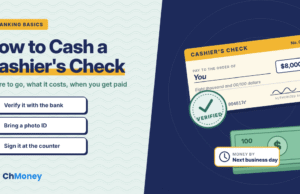
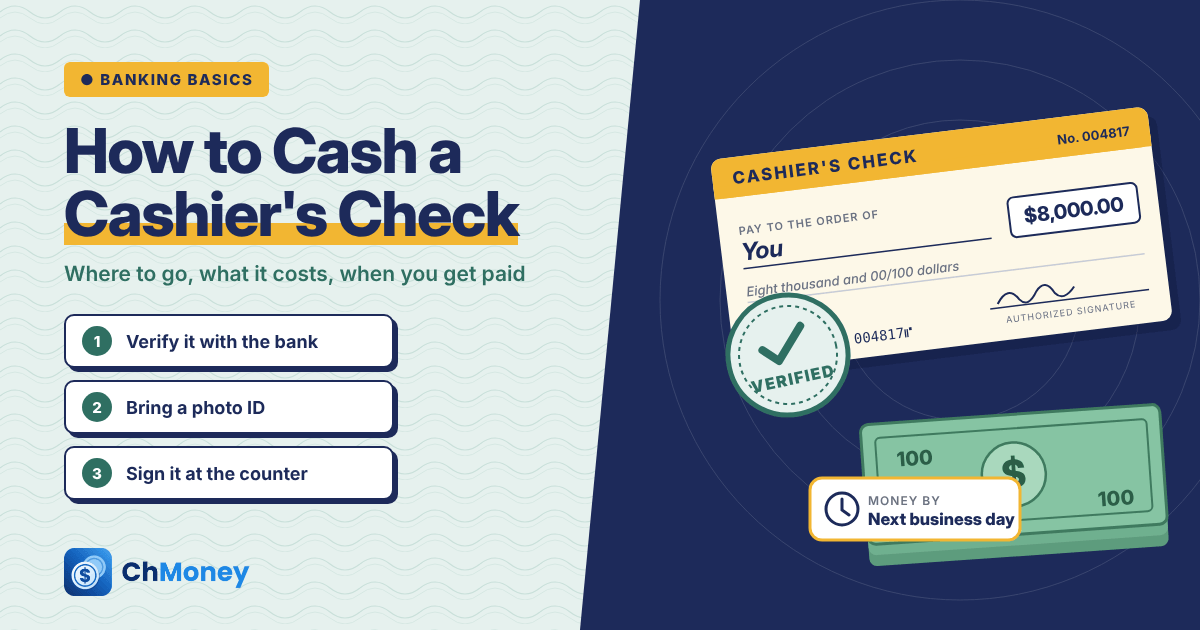
Here’s the short answer. To cash a cashier’s check, take it to the bank that issued it or to your own bank, bring a government photo ID, and sign the back in front of the teller. The issuing bank can usually hand you cash the same day. If you deposit it with a teller at your own bank, federal rules say you get at least the first $6,725 by the next business day.
This guide walks you through every option, what each one costs, how long the money takes, and how to make sure the check is real before you spend a dollar of it.
Your options at a glance
| Where you cash it | Typical cost | Max amount | How fast you get money | Need an account? |
|---|---|---|---|---|
| Bank that issued the check | Usually free; some banks charge non-customers a fee | Branch cash on hand; call ahead for big checks | Same day, in cash | No (most banks pay their own checks) |
| Your own bank or credit union (teller) | Free | No limit | First $6,725 next business day; the rest a few days later | Yes |
| Your bank’s ATM | Free | Your ATM’s deposit limit | Second business day (for the first $6,725) | Yes |
| Your bank’s mobile app | Free | Your app’s daily limit, often a few thousand dollars | Your bank’s own policy, often 1 to 2 business days | Yes |
| Walmart | $4 up to $1,000; $8 above that (call first, cashier’s checks aren’t on its list) | About $5,000 | Same day, in cash | No |
| H-E-B | From $3 (call first) | Ask the Business Center | Same day, in cash | No |
| Check cashing store (ACE Cash Express and others) | Posted in store, varies by state | Varies, ACE says it cashes large checks | Same day, in cash | No |
| Venmo (Cash a Check) | 5% for most checks, $6 minimum; free if you wait 10 days | $5,000 a day, $15,000 a month | Minutes if you pay the fee | No bank account, but a Venmo account |
How do you cash a cashier’s check?
Take the check and a valid government photo ID to the bank that issued it or to your own bank. Don’t sign the back until the teller asks you to. The teller checks your ID, confirms the check with the issuing bank, and either hands you cash or deposits it into your account. Expect to pay nothing at your own bank.
Here are the steps:
- Look at the check. Make sure your name is spelled right in the “Pay to the order of” line, the amount in numbers matches the amount in words, and the issuing bank’s name is printed on it.
- Verify it with the issuing bank. Find the bank’s phone number on its official website, not on the check, and call to confirm the check number and amount. More on this below.
- Pick where to cash it. The issuing bank gets you cash fastest. Your own bank is free and safer if the check is large.
- Bring ID. A driver’s license, state ID, US passport or military ID works almost everywhere. It has to be current, and the name has to match the check.
- Endorse it at the counter. Sign the back exactly as your name appears on the front. Signing early means anyone who finds the check can try to cash it.
- Choose cash or deposit. For big amounts, deposit it. You avoid carrying a stack of cash and you get a receipt.
- Keep your receipt until the money shows in your account and stays there for a couple of weeks.
Where can you cash a cashier’s check?
You can cash a cashier’s check at the bank that issued it, at your own bank or credit union, at some retailers like Walmart and H-E-B, at check cashing stores like ACE Cash Express, or through an app like Venmo. Banks are cheapest. Stores and apps charge a fee and cap how much you can cash.
The bank that issued the check
The bank name printed on the check is the bank that owes you the money. Because it’s the bank’s own obligation, it can confirm the check on the spot and hand you cash. Most banks pay their own cashier’s checks even if you don’t have an account there. Some charge non-customers a fee, and some ask for a thumbprint along with your ID. Call the branch first if the check is over a few thousand dollars, since a small branch may not keep $15,000 in the drawer.
Your own bank or credit union
This is the cheapest and safest route. You pay nothing, you get the federal hold protections explained below, and the bank does the checking for you. The catch is time: you might not get all of the money that day.
Walmart, H-E-B and other stores
Walmart’s check cashing page lists a $4 fee for checks up to $1,000, and other guides report $8 for checks from $1,000.01 up to $5,000. Walmart’s page names payroll, government and tax refund checks, and doesn’t list cashier’s checks, so call your store before you go. H-E-B charges from $3 at its Business Center, and its page also doesn’t list cashier’s checks. Both work for smaller checks if you don’t have a bank account.
Check cashing stores
ACE Cash Express and local check cashers post their fees on a board in each store, and rates change by state. Many charge a percentage of the check. Do the math before you hand it over: at 3%, a $5,000 check costs you $150. At your own bank it costs $0.
Apps
Venmo’s Cash a Check feature (not available in New York) charges 2% for payroll and government checks and 5% for all other checks, with a $6 minimum. Cashier’s checks fall in the 5% group, so a $2,000 check costs $100 for instant money. You can skip the fee if you wait 10 days. Limits are $5,000 per check, $5,000 a day and $15,000 a month.
How long does a cashier’s check take to clear?
If the check is made out to you and you deposit it in person with a teller, federal Regulation CC says your bank must make the money available by the next business day. At an ATM, it’s the second business day. Your bank can hold the part above $6,725 a few days longer.
The next-day rule (12 CFR 229.10(c)) has three conditions:
- You are the payee. The check is made out to you and goes into your account.
- You hand it to a bank employee. Teller deposits count. ATM deposits get the money by the second business day instead.
- You use the special deposit slip if your bank requires one. Ask the teller.
Then come the exceptions (12 CFR 229.13):
- Large deposits. Since July 1, 2025, the bank can hold the amount over $6,725 deposited in one day (it was $5,525 before). Federal rules treat up to five extra business days as a reasonable hold.
- New accounts. For the first 30 days after you open an account, only the first $6,725 gets next-day treatment. The rest can wait until the ninth business day.
- Doubt about the check. If the bank has reasonable cause to think the check won’t be paid, it can hold all of it.
Example: you sell your car for $20,000 and deposit the cashier’s check at the teller window on Monday. You can use $6,725 on Tuesday. The other $13,275 should be there within about a week. The bank has to tell you in writing if it’s placing an exception hold.
Can you deposit a cashier’s check with mobile deposit?
Usually yes, but check your app first. Many banks accept cashier’s checks by mobile deposit up to a daily limit, often a few thousand dollars. Mobile deposits don’t get the next-day guarantee for in-person deposits, so your bank’s own hold policy applies. Some banks refuse cashier’s checks in the app.
To do it:
- Sign the back and write “For mobile deposit only at [your bank’s name]” under your signature. Many banks require this wording.
- Take clear photos of the front and back on a dark surface.
- Keep the paper check for at least 14 days, then shred it.
If the check is bigger than your mobile limit, take it to a teller.
How do you cash a cashier’s check without a bank account?
Go to the bank that issued the check with a government photo ID. That’s usually the cheapest option. If that bank is far away, use Walmart or H-E-B for smaller checks, a check cashing store, or an app like Venmo. Expect a fee and an upper limit of about $5,000 at stores and apps.
You’re not alone. The FDIC’s 2023 survey found that 4.2% of US households, about 5.6 million, don’t have a bank or credit union account. If you get checks often, a free checking account pays for itself fast. Two $3,000 checks at a 3% check casher cost you $180 a year that a bank wouldn’t charge.
How do you know if a cashier’s check is real?
Look up the issuing bank’s phone number on its website, call it, and confirm the check number, amount and payee. Never use the phone number printed on the check, because scammers print their own. Be careful if a buyer you met online sends more than the price and asks you to send back the difference.
Fake cashier’s checks look real. Use this checklist:
- Call the issuing bank using a number you found yourself.
- Check the bank’s name and address. Search them. A real bank has a real branch.
- Look for security features: a watermark when you hold it to light, microprinting on the signature line, and a padlock icon on many checks.
- Watch for overpayment. A buyer who sends a $2,500 check for a $1,000 couch and asks you to Zelle back $1,500 is running a scam. Every time.
- Meet at the buyer’s bank for big sales like cars, and watch the teller print the check.
What happens if the cashier’s check turns out to be fake?
You pay the money back. Banks must make deposited money available quickly, but the FTC warns that it can take weeks to find out a check is fake. When the check comes back, the bank takes the full amount out of your account and can charge you a returned item fee.
The FTC puts it plainly: “Even if you see the funds in your account, that doesn’t mean it’s a good check.” If you already sent money to the buyer, it’s gone. Report the scam at ReportFraud.ftc.gov and tell your bank right away. This is why “it cleared” doesn’t mean “it’s safe.” Wait until the issuing bank confirms the check before you send anything back or hand over the car keys.
How do you cash a large cashier’s check?
Deposit it at your own bank instead of cashing it. Stores and apps stop at around $5,000, and a check casher’s percentage fee gets expensive fast. If you want more than $10,000 in cash, the bank files a routine Currency Transaction Report with FinCEN and may need a day or two to get the cash.
A few things to know with big checks, like a home sale, an insurance settlement or a car sale:
- Fees add up. At 5%, a $50,000 check costs $2,500. At your bank, $0.
- Cash over $10,000 gets reported. Federal rules (31 CFR 1010.311) require banks to report cash transactions of more than $10,000. It’s routine paperwork, and you don’t need to worry about it.
- Never split it to dodge the report. Taking out $9,500 on Monday and $9,500 on Tuesday on purpose to avoid the report is called structuring, and it’s a federal crime (31 CFR 1010.314) even if the money is clean.
- Call ahead. Branches keep limited cash. Give them a day or two for a large withdrawal.
- Put it to work. Once it’s deposited, move the money somewhere it earns interest.
How do you endorse a cashier’s check?
Sign the back of the check in the endorsement area exactly as your name appears on the front, and do it in front of the teller. For mobile deposits, add “For mobile deposit only at [bank name].” If your name is misspelled, sign it the way it’s written, then sign your correct name under it.
Two-party checks are common with insurance payouts, where the check names you and your mortgage lender or body shop:
- “Pay to John Smith AND Wells Fargo” means both have to sign.
- “Pay to John Smith OR Wells Fargo” means either one can cash it.
Can you sign it over to someone else? Technically, a check can be endorsed to a third person (“Pay to the order of [name],” then your signature). Most banks won’t accept that for a cashier’s check, though, so the easier route is to cash or deposit it yourself and send them the money.
What if a cashier’s check is lost, stolen or expired?
Contact the issuing bank and fill out a declaration of loss. Under UCC 3-312, the bank can pay your claim 90 days after the date printed on the check. An old or expired cashier’s check still has value, because the bank still owes the money. Call the issuing bank to reissue it.
- Lost or stolen: if you’re the payee, call the issuing bank, sign a declaration of loss under penalty of perjury, and wait out the 90 days. Some banks ask for an indemnity bond, which costs money, to pay you sooner.
- “Void after 90 days” printed on it: many banks print this, but the money doesn’t vanish. The bank can refuse to cash it at the counter and reissue it instead.
- Years old: after a few years (the exact period depends on your state), the bank sends unclaimed money to your state’s unclaimed property office. You can search for it free at MissingMoney.com.
Cashier’s check vs certified check vs money order
| Cashier’s check | Certified check | Money order | |
|---|---|---|---|
| Whose money | The bank’s own funds | The buyer’s account, guaranteed by the bank | Prepaid at the seller (USPS, Walmart, Western Union) |
| Usual size | Large amounts | Large amounts | Usually $1,000 or less each |
| Where to cash | Issuing bank, your bank, some stores | Issuing bank, your bank | Post office (for USPS), issuer, your bank |
| Next-day availability | Yes, teller deposit to payee’s account | Yes, same rule | Yes for USPS money orders, same rule |
| Can be faked? | Yes | Yes | Yes |
Frequently asked questions
Can I cash a cashier’s check at any bank?
You can deposit it at your own bank. To get cash without an account, go to the bank that issued it. Other banks usually won’t cash a check for someone who isn’t a customer.
Does Walmart cash cashier’s checks?
Some stores do, but Walmart’s check cashing page doesn’t list cashier’s checks, so call your store first. The fee is $4 up to $1,000 and about $8 above that, up to around $5,000.
Can someone else cash my cashier’s check?
Not easily. You can sign it over to another person, but most banks won’t accept a third-party cashier’s check. Cash it yourself and pass the money on.
Do cashier’s checks expire?
The money doesn’t, but many checks print “void after 90 days.” After that, the issuing bank may want to reissue it. After a few years, unclaimed money goes to your state.
Can a cashier’s check bounce?
A real one won’t. A fake one will, and it can come back weeks after the money shows up in your account. You then owe the bank the full amount.
Can I cash a cashier’s check at an ATM?
You can deposit one at your own bank’s ATM, but you won’t get cash for it on the spot. The first $6,725 is usually available by the second business day.
Will the IRS know if I cash a big cashier’s check?
If you take more than $10,000 in cash, the bank files a Currency Transaction Report with FinCEN. A deposit doesn’t need one. The check itself isn’t taxed, but the sale or payout behind it might be.
How much does it cost to cash a cashier’s check?
Nothing at your own bank, and usually nothing at the issuing bank. Walmart charges $4 to $8, H-E-B from $3, and Venmo 5% with a $6 minimum.
A cashier’s check is one of the safer ways to get paid, but only once you know it’s real. Call the issuing bank with a number you looked up yourself, deposit it with a teller at your own bank when you can, and don’t send money back to anyone until the bank confirms the check. If you don’t have a bank account, the issuing bank is your cheapest stop, and stores and apps work for checks under $5,000.