
We all know someone who put off life insurance because “I only need it for a little while.” Maybe you just signed for a $150,000 business loan that you’ll pay off in 18 months. Maybe you left your job last Friday and the life insurance from work went with it. Or you’re waiting on a big policy to get approved and the underwriter keeps asking for more doctor records. In all of these cases you want cover for months, not 30 years, and that’s where short term life insurance comes in.
Here’s the short answer. Short term life insurance covers you for one year or less. It comes in three forms: temporary coverage while your full application is reviewed, annual renewable term that you renew every year at a higher price, and a one-year policy you buy on its own. For most healthy people, a 10-year term that you cancel early costs the same or less.
This guide shows you what each type does, what it costs in real dollars, who sells it, and when you’re better off buying something else.
Short term life insurance at a glance
| Type | How long it lasts | Medical exam? | Typical coverage | What it costs |
|---|---|---|---|---|
| Temporary life insurance (TIA) | Until your full policy is approved or declined, usually 60 to 90 days | No, but you need to pass basic health questions | Often the amount you applied for, capped by the insurer | Often free or one month’s premium, credited to your policy |
| Annual renewable term (ART) | One year, renewable each year | Only when you first apply | Varies by insurer | Starts low, goes up every year |
| One-year term (RAPIDecision Life One) | 12 months | No, five health questions | $50,000 to $200,000 | From $12 a month for up to $100,000 |
| 10-year term, cancelled early | As long as you keep paying | Often, for larger amounts | $100,000 to $2 million or more | About $9 to $12 a month for $250,000 at ages 30 to 40 |
What is short term life insurance?
Short term life insurance is a life insurance policy that covers you for one year or less. If you die during that time, your beneficiary gets the death benefit. It has no cash value, so if you outlive it you get nothing back. People buy it to cover a gap, a short debt, or the wait for a bigger policy to start.
The name confuses a lot of people because insurers use it for three different products. Some sites even call a 20-year term “short-term” because it’s shorter than whole life, which only makes it worse. Here’s what each one means:
- Temporary life insurance, also called a temporary insurance agreement or TIA. You can’t buy it alone. You get it when you apply for a regular term or whole life policy, and it covers you while the insurer reviews your application. If they approve you, your real policy takes over. If they decline you, the temporary cover ends.
- Annual renewable term (ART). A one-year policy that you can renew every year without a new medical exam. The catch is the price goes up each time you renew because you’re a year older. Only 6% of term policies sold in 2023 were annual renewable term, according to LIMRA.
- One-year term you buy on its own. The best-known one in the US is RAPIDecision Life One from Fidelity Life, sold through Progressive. You answer a few health questions online and, if approved, you’re covered in minutes for 12 months.
One more thing. Short term life insurance has nothing to do with short-term health insurance. Short-term health plans pay medical bills for a few months. Short term life insurance pays your family if you die.
How does short term life insurance work?
You apply, answer health questions, and pay your first premium. If the insurer approves you, coverage starts right away and runs for the term, usually 12 months or less. When it ends you can renew if the policy allows it, buy a new policy at your new age, or let the coverage go.
Here’s how it goes step by step:
- Pick the type. If you’re already applying for a long policy, ask the insurer for temporary coverage. If you need a full year, compare a one-year policy against a 10-year term.
- Answer the health questions. One-year policies ask a handful. Expect questions about tobacco, recent hospital stays, and conditions like cancer, heart disease or diabetes.
- Pay the first premium. Temporary coverage often starts the day you pay or sign the agreement.
- Name your beneficiary. This can be a person, a trust or a charity.
- Watch the end date. Put the end date in your calendar. When it ends, you’re uninsured unless you renew or buy something new.
Two rules apply here like any other life policy. The contestability period is usually two years, so if you got a health answer wrong and you die in that window, the insurer can review the claim and deny it. The suicide clause usually runs two years too. Both rules vary a little by state.
How much does short term life insurance cost?
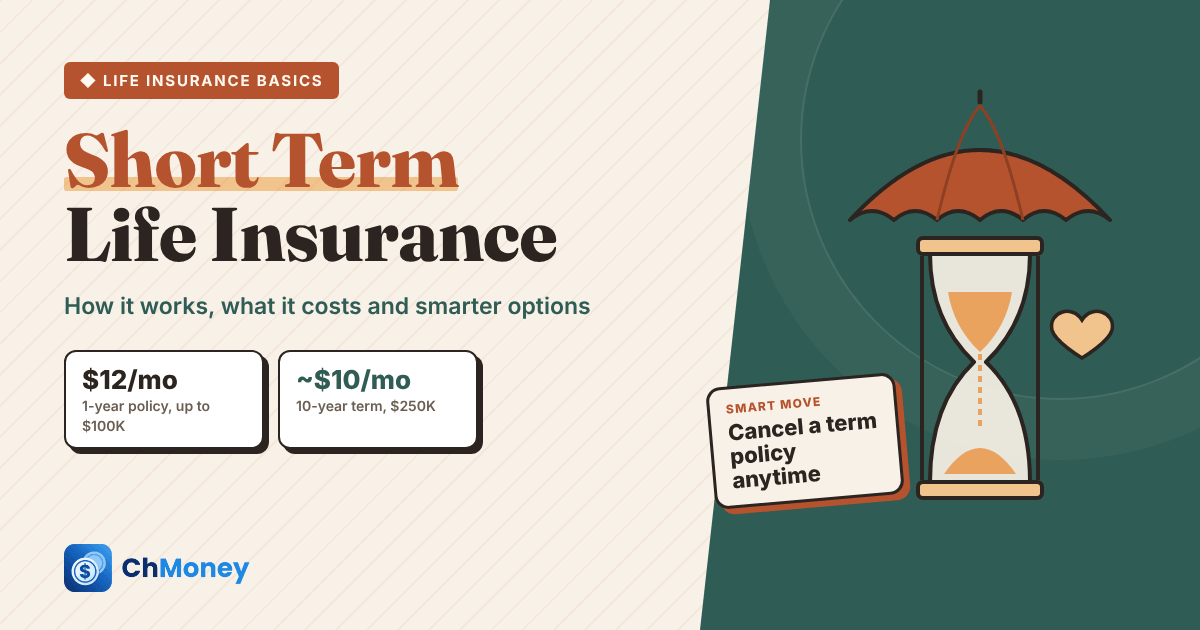
A one-year policy from Progressive and Fidelity Life starts at $12 a month for up to $100,000 of coverage. A 10-year term for $250,000 costs about $9 to $12 a month for a healthy 30 to 40-year-old. So a longer policy often gives you more than twice the coverage for about the same money.
Here are sample monthly prices for a 10-year term with $250,000 of coverage, from PinnacleQuote’s national sample rates (September 2026):
| Age | Man | Woman |
|---|---|---|
| 30 | $9.68 | $8.60 |
| 40 | $11.83 | $10.86 |
| 50 | $23.46 | $19.76 |
And a 20-year term with $250,000 of coverage, from Insurify (October 2026):
| Age | Man | Woman |
|---|---|---|
| 35 | $13 | $12 |
| 45 | $26 | $21 |
| 55 | $60 | $45 |
These are sample rates, not quotes. Your price depends on your health, tobacco use, weight, family history, job and state.
Look at the jump between 40 and 50 in the first table. The same policy almost doubles for a man. That’s the problem with annual renewable term. Every renewal prices you at your new age, so if you renew year after year you end up paying the age-50 price at 50, the age-51 price at 51, and so on. A level term locks in the price you got when you bought it.
Is a 10-year term a better short term option?
For most healthy people, yes. You can cancel a term life policy any time with no penalty. You stop paying and the coverage ends. So you can buy a 10-year term, keep it as long as you need it, and drop it. You often pay the same as a one-year policy, get more coverage, and keep a locked price if your need runs longer.
Here’s a real-life example. Say you’re a 35-year-old man with an 18-month, $150,000 business loan, and your bank wants life insurance on it.
- One-year policy: the max is $200,000, so it covers the loan. But it ends after 12 months and you still owe 6 months of payments. You’d have to buy again at 36 and answer the health questions again.
- 10-year term for $250,000: around $10 to $12 a month at sample rates. Keep it 18 months, roughly $200 in total, then cancel. If the loan gets extended, or you have a baby, you already have cover at your 35-year-old price.
There’s no surrender fee on a term policy. The only exception is return of premium term, where cancelling early means you lose the refund that policy promises. Plain term doesn’t have that problem.
The one-year policy still wins in a few cases. You can get it in minutes with no exam, which helps if you need cover by Friday. And a one-year policy makes sense if a longer term would need a medical exam you can’t fit in before your deadline.
Where can you buy short term life insurance?
You can buy a one-year policy, RAPIDecision Life One, online through Progressive, underwritten by Fidelity Life. You get temporary coverage by asking for it when you apply for a regular policy with most large insurers. Annual renewable term is sold by fewer companies, so ask an independent broker which ones offer it in your state.
What we know about the Progressive and Fidelity Life one-year policy:
- Coverage from $50,000 up to $200,000.
- No medical exam and no phone interview. You answer five health questions.
- Prices start at $12 a month for up to $100,000, according to Progressive’s page.
- At the end of the year you can buy another one-year policy, a longer term, or a permanent policy.
- It isn’t sold in every state, and availability varies. Check eligibility when you quote. When Policygenius tested it in 2021, they couldn’t get a quote for anyone over 55.
If you need more than $200,000, the one-year policy won’t cover you. That’s when a regular term with temporary coverage during underwriting is the better route.
When does short term life insurance make sense?
Short term life insurance makes sense when your need ends within a year and you can’t or don’t want to wait for a longer policy. The most common cases are waiting for a big policy to get approved, losing work coverage between jobs, a short loan, a temporary risky job, and getting healthier before you apply for long-term cover.
Here’s how each one plays out:
- Waiting for approval. A fully underwritten policy can take 4 to 8 weeks. Ask for temporary coverage so your family is protected while the insurer pulls your medical records.
- Between jobs. More than half of working Americans (55%) have life insurance through work, according to LIMRA’s 2025 Insurance Barometer Study. Lose the job and you usually lose that cover too. See the next section.
- A short loan. A business loan, a bridge loan while you sell your house, or a co-signed car loan with $40,000 left on it. Match the coverage to what’s owed.
- A risky job for a few months. A contract on an oil rig or a season of commercial fishing can push up your price on a long policy. Some people cover the contract period and buy long-term coverage after.
- You’re quitting smoking. Most insurers want you tobacco-free for 12 months before they give you non-smoker rates, according to Zander Insurance. Some people buy a short policy to get through that year, then apply for a 20 or 30-year term at the lower price. Another option is buying the long policy now and asking the insurer for a rate review once you’ve been tobacco-free for a year.
What happens to your work life insurance when you leave a job?
Your group life insurance usually ends when your job ends. You generally have 31 days to keep it, either by converting it to an individual whole life policy with no medical questions or by porting it to a term policy. COBRA doesn’t help here because it only continues health plans, not life insurance.
MetLife’s employee page lays out the two choices:
- Conversion turns your group cover into individual whole life. It’s guaranteed, with no health questions, as long as you apply within the window. The downside is that whole life costs a lot more than term.
- Portability keeps your coverage as term life. Medical questions only come in if you want better rates or more coverage.
Here’s an example. Your job ends March 31 and you have $100,000 of group life. You have until about May 1 to convert or port it. If you’re healthy, a new 10-year term bought on your own usually costs less than converted whole life. If you have a health condition that would get you declined, conversion might be the only option you get with no questions asked.
This is also a good time to check your other benefits.
How much short term coverage do you need?
Match your short term coverage to the specific gap you’re covering. For a loan, buy enough to pay off the balance. Between jobs, cover the months of income your family would lose. The “10 to 15 times your income” rule is for long-term needs, not a few months.
Some quick math:
- Co-signed car loan: $40,000 balance, so $50,000 of coverage does it.
- Six months between jobs: $5,000 a month in take-home pay, so about $30,000, plus any debts you want cleared.
- Business loan: the full balance. Your lender may set a minimum.
If you’re not sure, buy a little more. The price difference between $100,000 and $250,000 on a 10-year term is often just a few dollars a month.
What are the alternatives to short term life insurance?
The main alternatives are a regular term policy you cancel early, accidental death and dismemberment (AD&D) insurance, credit life insurance from your lender, extra supplemental life through your employer, and an emergency fund. Each one fits a different need, so pick by what you want covered.
| Option | What it covers | Good for | Watch out for |
|---|---|---|---|
| 10-year term, cancelled early | Death from any cause, except suicide in the first 2 years | Most short needs | May need a medical exam for big amounts |
| AD&D insurance | Death or injury from an accident only | Cheap add-on, risky trips | Pays nothing for illness, which causes most deaths |
| Credit life insurance | Your loan balance, paid to the lender | People who can’t qualify elsewhere | Coverage shrinks as the loan shrinks, and it’s often pricier per dollar |
| Employer supplemental life | Extra group cover during open enrollment | Easy sign-up | Ends when the job ends, unless you port it |
| Emergency fund | Whatever you need, no claim needed | Small gaps of a few thousand dollars | Takes time to build |
What happens when your short term policy ends?
When your short term policy ends, your coverage stops unless you act. You can renew it if it’s renewable, buy a new policy at your current age and health, convert it if your policy has a conversion option, or let it go. If your health changed during the year, renewing may be easier than applying again.
Look at your options about 30 days before the end date. If you developed a health condition during the year, a guaranteed renewable policy lets you keep coverage without new questions, at a higher price. If you’re healthier, you’ll probably get a better rate applying fresh.
And if you get turned down, you still have options: simplified issue policies (health questions, no exam), guaranteed issue policies (no questions, low coverage, usually a two-year waiting period), or a broker who works with high-risk applicants.
A few things buyers miss
- Free look period. Every state gives you at least 10 days, and many give up to 30, to cancel a new life policy for a full refund.
- Grace period. Miss a payment and you usually get about a month to pay before the policy lapses.
- Your family doesn’t inherit your debts. In most cases, debts get paid from your estate, not by your relatives. Family members usually have to pay only if they co-signed, shared the account, or live in a community property state. Short term life insurance helps your family keep what’s in the estate.
- Honest answers. A wrong answer on a health question can get a claim denied in the first two years, even on a one-year policy.
FAQ
Can I get life insurance for just one month?
Not as a standalone product. The shortest policy you can buy on its own is one year. Temporary coverage during underwriting can last a few weeks, but it only comes with a full application. You can also buy a term policy and cancel after one month.
Do I need a medical exam for short term life insurance?
Usually not. The Progressive and Fidelity Life one-year policy asks five health questions and no exam. Temporary coverage relies on your application answers. Larger regular term policies may need an exam.
Can I get short term life insurance over 60?
It’s harder. Insurers set their own age limits and some don’t publish them. Ask for eligibility when you quote, and compare a simplified issue term policy, which many insurers sell to people in their 60s.
Can I cancel term life insurance any time?
Yes. Stop paying or tell the insurer in writing, and the coverage ends. Plain term has no cancellation fee. Return of premium term is different, since cancelling early means you lose the refund.
Is short term life insurance the same as short-term health insurance?
No. Short-term health insurance pays medical bills for a few months. Short term life insurance pays a death benefit to your beneficiary if you die during the term.
Does short term life insurance have cash value?
No. Like all term life, it only pays out if you die during the term. If you outlive it, you get nothing back.
What happens if I’m declined while I have temporary coverage?
Your temporary coverage ends, usually on the date the insurer declines you. You can then try a simplified issue or guaranteed issue policy, or work with a broker who handles high-risk cases.
Is short term life insurance worth it?
It’s worth it if you need coverage fast, for under a year, and can’t wait for a regular policy. For most healthy people, a 10-year term that you cancel early gives more coverage for about the same price.
The bottom line
Short term life insurance does one job: it covers a gap of a year or less. Temporary coverage while you wait for approval is often free, so always ask for it. A one-year policy from Progressive is quick and needs no exam, but it caps at $200,000 and gets pricier if you keep buying it. For most people, a 10-year term at about $10 a month for $250,000 does the same job better, and you can drop it the day you don’t need it.