
You know that feeling when your grocery bill goes up a little less than last month and you almost feel relieved, until you remember it’s still way more than last year? That’s pretty much what today’s PPI report looks like.
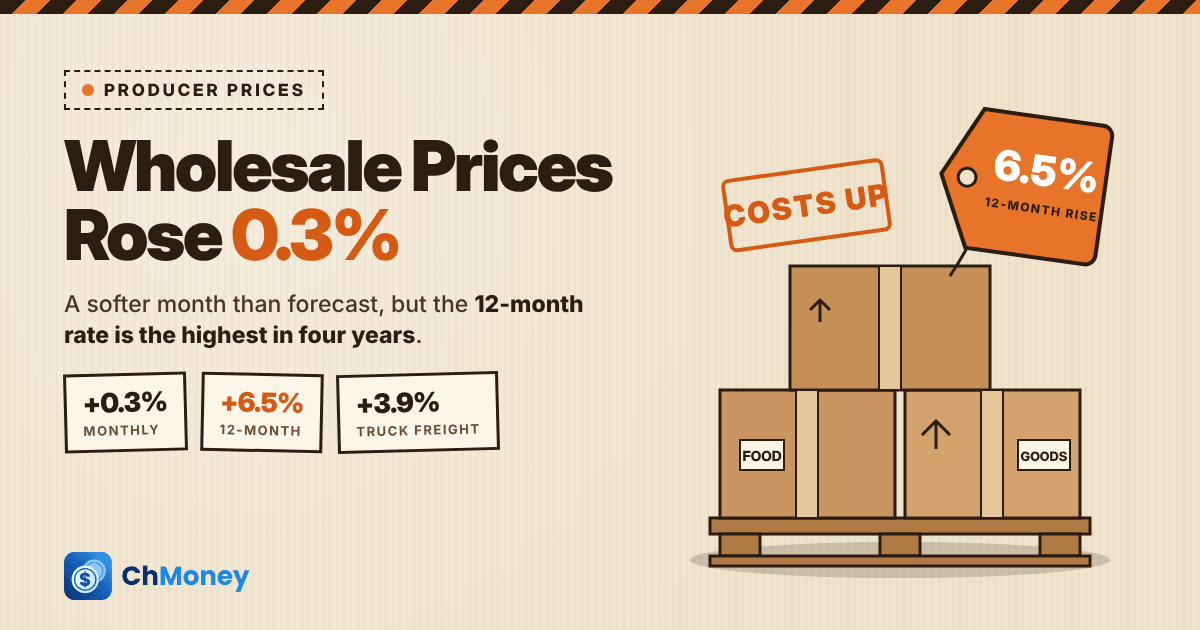
The Bureau of Labor Statistics released its October producer price index (PPI) on Friday, 13 November 2026, at 8:30 a.m. ET. Prices that businesses get paid for their goods and services rose 0.3% in October. That’s a big step down from September’s 1.4% jump, and it came in under the 0.4% that economists expected, according to the Dow Jones forecast cited by Briefs Finance.
But look at the yearly number. Producer prices are up 6.5% from October 2025, the BLS says, the largest 12-month rise since November 2022, when it was 7.4%. So the monthly pace slowed, the yearly pace got worse.
The October PPI numbers
| Measure | October | Forecast | September |
|---|---|---|---|
| PPI final demand, month over month | +0.3% | +0.4% | +1.4% |
| PPI final demand, 12 months | +6.5% | +6.6% | +6.3% |
| Core PPI (no food, energy or trade), month over month | +0.5% | n/a | +0.5% |
| Core PPI (no food, energy or trade), 12 months | +4.9% | n/a | +5.0% |
PPI figures are from the BLS release. The 0.4% monthly forecast is the Dow Jones estimate, per Briefs Finance. The 6.6% yearly forecast is from IBTimes, which didn’t name the survey. September’s 1.4% is the revised number; it was first reported as 1.3%.
The BLS also revised June through September data for late reports, so if you compare against older articles, some numbers won’t match.
What pushed prices up
Goods prices rose 0.5% and services rose 0.2%. Here’s where the money went.
Food jumped 1.3%. That’s on top of 1.1% in September. Fresh and dry vegetables and processed young chickens (the chicken you buy at the store) were among the items that went up, the BLS says. Pork went down.
Trucking got a lot more expensive. Transportation and warehousing services rose 2.0%, and truck freight alone climbed 3.9%. According to the BLS, truck freight was responsible for over 80% of the whole services increase. When it costs more to haul stuff, that cost usually shows up later on store shelves.
Factory inputs kept climbing. Basic organic chemicals rose 3.9%. More than 60% of the goods increase came from goods outside food and energy, which rose 0.5%. Jet fuel, gas fuels and navigational instruments also went up.
Energy finally cooled down. Energy prices fell 0.1% after a 10.0% surge in September. Diesel fuel dropped 7.9% and crude petroleum fell 10.3%. That’s the main reason the headline number came in below forecast.
Store and wholesaler margins shrank a bit. Trade services, which track the markup retailers and wholesalers get, fell 0.2%. Margins for machinery and vehicle wholesaling fell 4.2%. Airline passenger services and system software publishing also dropped.
Why the yearly number is the scary one
The monthly number tells you if things got worse this month. The yearly number tells you how much more expensive everything is compared to a year ago. And that number keeps going up.
Goods prices are up 10.2% over the past year. Processed goods that companies buy to make other things are up 14.6%. Services sold between businesses are up 6.8%, the most since November 2022, per the BLS.
These are costs that businesses pay before you ever see a price tag. A bakery paying more for flour, packaging and trucking has two choices: eat the cost or raise prices. Most raise prices eventually.
Heather Long, chief economist at Navy Federal Credit Union, said it plainly on X, as quoted by the Daily Caller: “Another day, another worrying US inflation statistic. PPI (basically business inflation) is +6.5% in the past year.”
It came right after a hot CPI report
This wasn’t the only inflation news this week. On Tuesday, the consumer price index showed consumer prices rose 0.4% in October, down from 0.6% in September but above the 0.3% forecast. Core CPI rose 0.3%, also above forecast. We covered that in our October CPI article.
So you’ve got consumer prices running hotter than expected and producer prices running at a four-year high on a yearly basis. That combination is what has the Fed worried.
What the Fed is likely to do
The Fed held its target rate at 3.75% to 4.00% at its 28 October meeting, according to the Federal Reserve. Its next meeting is 8 and 9 December, and the conversation now is about how much to raise rates, not whether to.
Futures markets point to a quarter-point hike in December, with a small chance of a half-point move, Briefs Finance reports.
Several Fed officials have been loud about it this week:
- Christopher Waller, Fed governor, told CNBC: “hiking only 25 basis points would put our credibility at risk, a risk I am not eager to take,” according to IBTimes. He said a half-point hike isn’t off the table.
- Susan Collins, Boston Fed president, told Bloomberg TV that “some additional firming tightening of policy is appropriate,” per Yahoo Finance.
- John Williams, New York Fed president, said Thursday: “Inflation is far too high, and it continues to be high even in the latest data,” Yahoo Finance reports.
- Austan Goolsbee, Chicago Fed president, told CNBC that “in categories that are not driven by oil prices and not driven by tariffs, you’re still seeing stalled progress,” according to Briefs Finance.
That last quote matters. The Fed usually looks past price spikes from things like an oil shock or tariffs, because those tend to fade. Goolsbee is saying prices are rising even where oil and tariffs aren’t the reason.
Economists mostly agree with the quarter-point call. “The Fed is likely to maintain its hawkish stance heading into the December 9 meeting,” Jeffrey Roach, chief economist at LPL Financial, told Yahoo Finance. “We should expect a 25-basis-point rate hike.” Thomas Ryan of Capital Economics went further and said “consecutive hikes in December and January look like the most likely path for policy.”
Chris Zaccarelli, chief investment officer at Northlight Asset Management, told CNBC that today’s PPI “is unlikely to change the Fed’s approach in December because the CPI data was already outside their comfort zone,” as quoted by IBTimes.
How markets reacted
Stock futures went up after the release, since the monthly number came in softer than expected. Dow futures rose about 0.5% and S&P 500 futures about 0.6% in early trading, Brisk Markets reports.
Bond traders were less relaxed. The 10-year Treasury yield moved to about 5.15%, according to a CNBC headline. A 10-year yield above 5% pushes up mortgage rates, car loans and credit card rates, so if you’re shopping for a house or refinancing, that’s the number to watch.
What it means for you
Here’s the short version.
- Prices at the store aren’t coming down soon. Food costs rose 1.3% at the producer level, and trucking costs jumped. Those usually reach shoppers within a few months.
- Borrowing will likely get more expensive. A December rate hike looks close to locked in. If you have a variable-rate loan or credit card debt, paying it down now saves you money later.
- Savers get a better deal. Higher rates mean better yields on high-yield savings accounts, CDs and Treasury bills.
- Gas and diesel gave a small break. Diesel fell 7.9% at the producer level in October, which could take a little pressure off fuel and shipping costs if it holds.
The next big date is 25 November, when the PCE inflation data comes out. That’s the Fed’s preferred inflation gauge. The November PPI report is scheduled for Tuesday, 15 December 2026, which lands after the Fed’s December decision.
If you want to protect your portfolio while rates rise, check out our guide to defensive stocks in an AI bull market and our list of top banking stocks in the USA.