
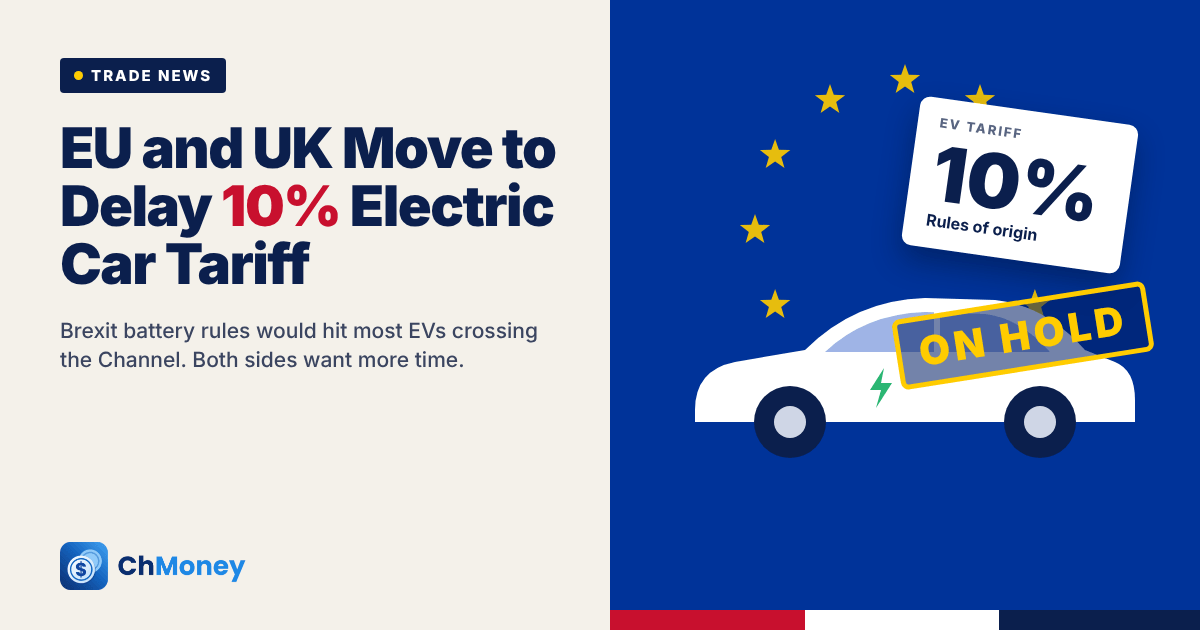
If you’ve shopped for an electric car in Britain or Europe lately, you probably looked at the sticker price, the range and the charging time. You probably didn’t think about where the battery cells were made. Starting 1 January 2027, that detail could add 10% to what a carmaker pays to ship an EV across the Channel.
Now it looks like that bill is getting pushed back again. The European Union is set to delay a 10% tariff on electric cars traded with the UK, according to the Financial Times, and the British government backs the idea. Brussels is consulting carmakers on how to do it. Nothing is signed yet, and Reuters said it could not confirm the FT story on its own.
Here’s what the tariff is, why it’s coming, and what a delay would mean.
Where the 10% tariff comes from
When the UK left the EU, the two sides signed the Trade and Cooperation Agreement. Cars can cross the border with zero tariffs, but only if enough of the car was made in the UK or the EU. Those are the “rules of origin.” A car that fails them pays a 10% tariff.
For EVs the hard part is the battery. Most cells still come from Asia, mainly China and South Korea, and the battery is the most expensive part of an electric car. So an EV assembled in Sunderland or Zwickau can still fail the test if its cells came from abroad.
The rules get stricter on 1 January 2027. Here’s what a car will need to qualify for zero tariffs:
| Part | Share that must come from the UK or EU from 2027 |
|---|---|
| Whole vehicle (by value) | 55% |
| Battery cells and modules | 65% |
| Battery packs | 70% |
Reuters says that under these rules about 70% of battery electric and plug-in hybrid models traded between the UK and the EU would face the 10% tariff.
This already got delayed once
These stricter rules were supposed to start in 2024. Battery factories in Europe weren’t ready, so at the end of 2023 both sides agreed to keep the easier transition rules until the end of 2026. Electrive reports that the 2023 decision said no more delays were planned [single source]. Three years later, here we are again.
That’s the awkward part for Brussels. Agreeing to a second delay means admitting Europe’s battery plants still can’t supply enough cells.
What the delay could look like
Neither side has said how long the delay would be. Two options are on the table, according to the FT as reported by electrive and EV Powered:
- A one-year delay. The current rules stay until the end of 2027.
- A two-year offset scheme. Carmakers could balance out cars that fail the rules with sales of cars that pass in their home market. One industry representative called this “unusual but potentially workable” [single source: electrive].
Serious talks are expected after the EU-UK summit on 20 November. Electrive reports that the European Commission may pick shorter periods than carmakers asked for.
So if you see a headline saying the delay is done, it isn’t. It’s likely, and London supports it, but both sides still need to agree the details.
What carmakers say it would cost
The numbers from the industry groups explain why both governments want to avoid this.
ACEA, the European carmakers’ association, expects about 520,000 electric cars and vans to be exported from the EU to the UK in 2027, worth €17.9 billion. It says about 82% of them, roughly 426,000 vehicles, would fail the rules and pay the tariff. The extra cost would be about €1.47 billion in 2027 alone [single source: electrive, citing ACEA].
The UK side has its own figure. In June, the Society of Motor Manufacturers and Traders (SMMT) warned that EV makers would pay £1.4 billion (about $1.86 billion) in tariffs without a fix.
Mike Hawes, SMMT’s chief executive, said: “The UK and EU are bound by €80 billion in annual automotive trade and millions of jobs.” He called for “a pragmatic solution for the rules of origin from 2027.”
Sigrid de Vries, ACEA’s director general, said: “The close ties between the EU and UK automotive industries are a strength we cannot afford to undermine.” [single source: EV Powered]
What ACEA actually wants
ACEA didn’t ask for one more year. In September it proposed a phased timeline [single source: electrive]:
- Keep the current battery pack assembly rule until the end of 2029
- Require cells made in the UK or EU from 2030
- Require the active cathode materials inside the cells to be local from 2032
That’s a much longer runway than the one-year option Brussels is reportedly looking at.
Who doesn’t want a delay
Not everyone in Europe is on board. European chemical companies oppose another delay [single source: electrive]. They spent money building plants for cathode materials, the chemicals that go into battery cells, on the promise that local content rules would create buyers. Every delay pushes that demand further out.
The UK has its own tension here. A study commissioned by SMMT found about €72 billion has gone into battery and EV production in the UK since 2017, yet Britain still imports about two-thirds of the lithium-ion batteries it needs [single source: electrive]. Money has gone in, but cells aren’t coming out of UK factories fast enough yet.
How this ties to “Made in Europe”
The EU is also working on “Made in Europe” rules under its Industrial Accelerator Act, which would favour products built inside the bloc. UK carmakers want in. Hawes said: “Our collective response must strengthen both sectors, with the UK included in ‘Made in Europe’ measures.”
Some German states agree. Electrive reports that the leaders of Baden-Württemberg, Bavaria and Lower Saxony, home to Mercedes-Benz, Porsche, BMW, Audi and Volkswagen, want the UK, EEA and EFTA countries included [single source: electrive].
What this means for you
If you’re buying an EV in the UK: Most electric cars sold in Britain are built in the EU or Asia. A 10% tariff on EU-built EVs would likely show up in prices, or in smaller discounts. A delay keeps 2027 prices closer to what you see today.
If you’re buying in the EU: Fewer cars flow the other way, but UK-built EVs like the new Nissan Leaf from Sunderland would face the same 10% hit without a fix.
If you invest in carmakers: Watch the 20 November summit. A deal before 1 January removes roughly €1.5 billion in extra costs for European carmakers next year, by ACEA’s estimate. No deal, and that cost lands on margins or on buyers.
FAQ
Has the EU delayed the 10% tariff on UK electric cars? Not officially yet. The Financial Times reported on 12 November 2026 that the EU is set to delay it, with UK backing. Talks are expected after the EU-UK summit on 20 November.
When does the 10% EV tariff start? 1 January 2027, unless the EU and UK agree a delay before then.
Why would electric cars face a 10% tariff between the UK and EU? Under Brexit rules of origin, a car must have enough UK or EU content to cross tariff-free. From 2027 that means 55% of the car’s value, 65% of battery cells and modules, and 70% of battery packs. Most EVs use Asian cells and would fail.
How much would the tariff cost carmakers? SMMT estimated £1.4 billion. ACEA estimated about €1.47 billion in 2027 for EU exports to the UK alone.
Has this tariff been delayed before? Yes. The tighter rules were first due in 2024. At the end of 2023 the EU and UK pushed them to 2027.