
Ask anyone who lives near a new data center what changed first, and they’ll probably say the power bill. The second thing they notice is the noise, then the water trucks, then the land that used to be a farm. A week after Republicans took one of their worst midterm beatings in decades, some people on the right are saying that list is part of why.
A handful of conservative voices, including Missouri Sen. Josh Hawley and activist Amy Kremer, have pointed at AI data centers and the Big Tech companies building them. Most Republican leaders, including President Donald Trump and Vice President JD Vance, have pointed somewhere else: the war with Iran.
Here’s who said what, and what the numbers show.
How bad was the loss?
Democrats won control of both the House and the Senate in the 3 November 2026 midterms. The Guardian, as of 10 November, put Democrats at a 54-seat Senate majority and a 254-seat House majority, and called it the worst midterm for a party since Watergate in 1974.
The Senate number grew on 11 November, when the AP called Mississippi for Democrat Scott Colom over Sen. Cindy Hyde-Smith. Colom won by 4,669 votes out of 962,237 counted. He had campaigned on pausing new data centers in the state.
Other Republican incumbents fell in races where data centers were a campaign issue. In Ohio, Sherrod Brown beat Sen. Jon Husted. Brown ran an ad that opened with, “Did you know that one of the largest data centers in the world is being built right here in Wood County?” and accused Husted of giving away $2.5 billion to “out-of-state corporations and billionaires.” In Texas, Democrat Gina Hinojosa unseated Gov. Greg Abbott after promising a data center moratorium.
Who is blaming Big Tech and data centers
Josh Hawley. On 9 November, the first day back at the Capitol after the election, the Missouri senator told reporters: “Congress spent months talking about how we can cut Medicaid to the bone,” and then “they’re finding ways to fund data centers. Big mistake.” Two days later, Politico reported that Hawley had become the highest-ranking Republican to back a nationwide moratorium on new data centers.
Amy Kremer. Kremer chairs Humans First, a conservative group focused on AI. She told Fox News Digital that opposition to data centers helped drive deep-red counties away from Republicans. Her group ran a “Data Center Revolt” bus tour before the election with 35 stops in 27 states.
Ted Cruz. The Texas senator called the results a “Watergate-level repudiation” and mostly blamed tariffs, the Iran war and the cost of living. According to Newsweek, he also said data center construction was turning “billionaires into centibillionaires” while electricity bills went up. His wider point was that voters had “very real pain,” and “too many Republican politicians seem like they didn’t understand or they didn’t care.”
The FT’s report suggests more people inside the movement are making the same argument in private. So far, Hawley and Kremer are the clearest names on the record.
What the Humans First numbers say
Kremer’s group put out an analysis of 1,540 counties across 16 states. Here’s what it found, as reported by Fox News:
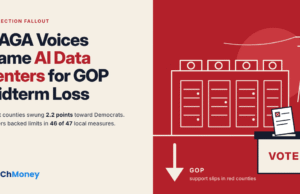
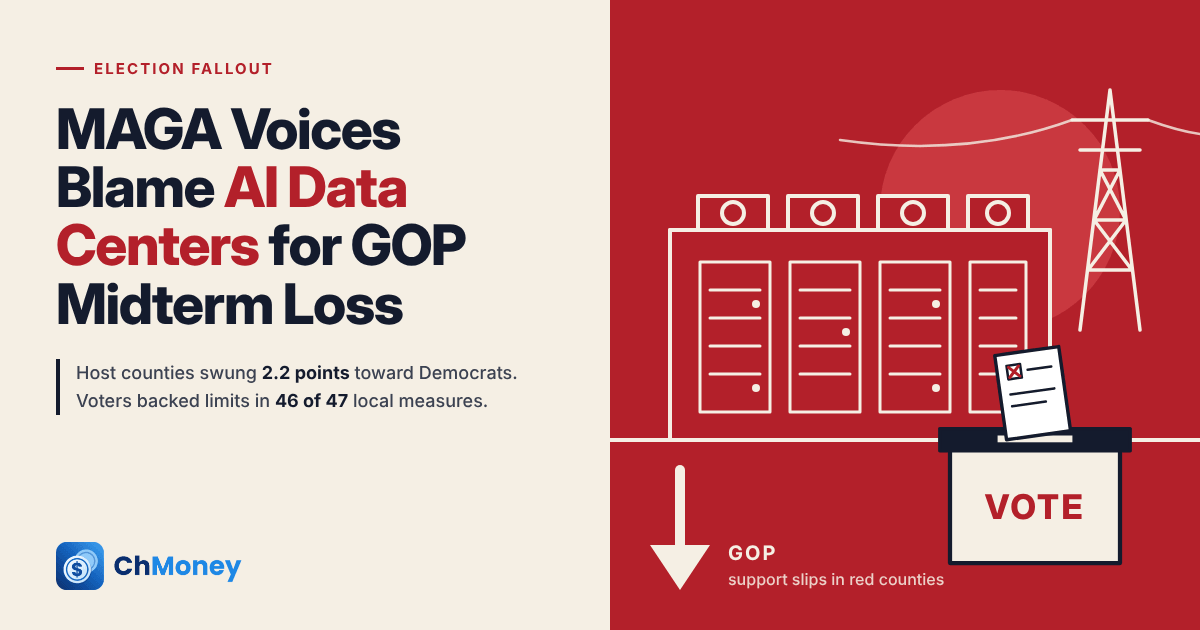
- Counties hosting data centers shifted 2.2 points toward Democrats compared with counties without them in the same states.
- The pattern showed up in 14 of the 16 states and 25 of 27 governor and Senate races.
- In deep-red counties, the ones Trump won by 20 points or more in 2024, the gap was 1.1 points after controlling for other factors.
- Voters backed limits on data centers in 46 of 47 local ballot measures.
The memo itself says the numbers show “association, not causation.” In other words, red counties with data centers swung more, but that doesn’t prove the data centers caused the swing. Keep that in mind before you treat it as the final word.
Other outlets counted the ballot measures differently. SFGATE, cited by Startup Fortune, counted 40 of 41 measures going against the industry, with the only industry win in Harwood, North Dakota, a town of about 800 people. In Alhambra, California, an outright ban passed with 81.84% of the vote.
What voters said
Time reported that 56% of voters in exit polling said AI data centers were a major factor in their vote for Congress. Gallup has found about seven in 10 Americans oppose a data center being built in their own area.
The issue cut through party lines. Pew found 47% of Republicans oppose new data center construction, compared with 75% of Democrats and 60% of independents.
In Texas, Spectrum News talked to voters who switched. Tom Weeks, a lifelong Republican, said: “Voting Democrat was one of the hardest things I’ve ever done, but I had to do it because I’ve had no support.” Clayton Tucker, the Democrat who won the Texas Agriculture Commissioner race, called the data center fight “the straw that broke the camel’s back.”
Campaigns saw this coming. AdImpact data reported by NBC found more than $380 million in TV ads that mentioned data centers, and Democrats outspent Republicans on the topic by more than 3 to 1.
Most Republican leaders blamed the war
If you only read the data center coverage, you’d miss that most of the GOP’s top names gave a different reason.
Vance put it plainly on X: “The reason we lost is the war. The president himself said so last night.” Trump told reporters the Iran war was “largely” to blame because it pushed gas prices up, and added on Truth Social, “I wasn’t on the Ballot and if I was, we would have won IN A LANDSLIDE!”
Former Sen. Mitt Romney listed “erratic tariffs, impulsive Iran war, blanket pardons.” Florida Gov. Ron DeSantis called the result “a rebuke of the president and the Congress.” Rep. Chip Roy of Texas went after the party establishment for backing “corrupt people at the top of the ticket.”
None of them mentioned data centers. So the honest picture is this: Big Tech is one explanation going around the right, and a smaller one than the war, tariffs and prices.
Trump is sticking with data centers
Trump has not backed away. In August he wrote on Truth Social that the only reason communities shouldn’t want data centers “is if they want to end up being backwards and poor.”
After the election, the stock market had a rough day. On 5 November the Nasdaq fell 5.5%, the S&P 500 dropped 4.4% and the Dow lost more than 1,800 points. Nvidia fell about 9%. Trump blamed Democrats for the drop, writing, “The Stock Market crashed today because the Dumocrats had a big Tuesday.”
The next day he doubled down: “As President, I am 100% in favor of Super Intelligence (SI),” adding, “They are GOLD, and only foolish leadership will say ‘NO’ to the riches they bring!”
That puts Trump on one side and Hawley on the other, with a Democratic Congress arriving in January that ran heavily against the build-out.
What to watch next
If you’re a voter in a county with a planned data center, expect more local fights. Moratorium bills could come up in state legislatures early next year, and Hawley’s support gives the idea some Republican cover in Washington.
If you hold AI or chip stocks, watch spending plans from the big cloud companies. Dan Ives of Yorkville Ives & Co. now expects Big Tech capital spending growth to peak in 2027, earlier than he forecast before the election.
And if you’re just trying to figure out why your power bill keeps going up, that question is now on both parties’ list.
FAQ
Did MAGA leaders blame Big Tech for the 2026 midterm loss? Some did. Sen. Josh Hawley said funding data centers while cutting Medicaid was a “big mistake,” and Humans First chair Amy Kremer said data center opposition drove red counties away from Republicans. Trump and JD Vance blamed the Iran war instead.
Did data centers cost Republicans the midterms? There’s no proof either way yet. A Humans First analysis found counties with data centers swung 2.2 points more toward Democrats, but the group itself says that shows association, not causation.
How many data center ballot measures passed in 2026? Counts vary by source. Humans First says voters backed limits in 46 of 47 local measures. SFGATE counted 40 of 41 going against the industry.
What is Trump’s position on AI data centers? He still supports them. After the election he wrote that he is “100% in favor of Super Intelligence” and called data centers “GOLD.”
Which senators lost in races where data centers were an issue? Jon Husted in Ohio lost to Sherrod Brown, and Cindy Hyde-Smith in Mississippi lost to Scott Colom, who campaigned on a data center pause.