
If you own Nvidia, this week has been rough. If you own an S&P 500 index fund, you felt it too, whether you noticed or not.
Nvidia shares were already sliding before Thursday. Then the company said Jensen Huang had resigned as CEO, and the stock dropped again at the open. Here’s what the numbers look like so far, which analysts changed their minds, and what you should watch next.
For the background, read our pieces on who runs Nvidia now that Huang is gone and how the scandal unfolded day by day.
How far the stock fell
Nvidia closed Wednesday, 11 November, at $173.73, according to TheStreet. That was already well down from $213.66 on 29 October, the day the New York Times first reported on Huang’s ties to Alice Huang.
Thursday went like this:
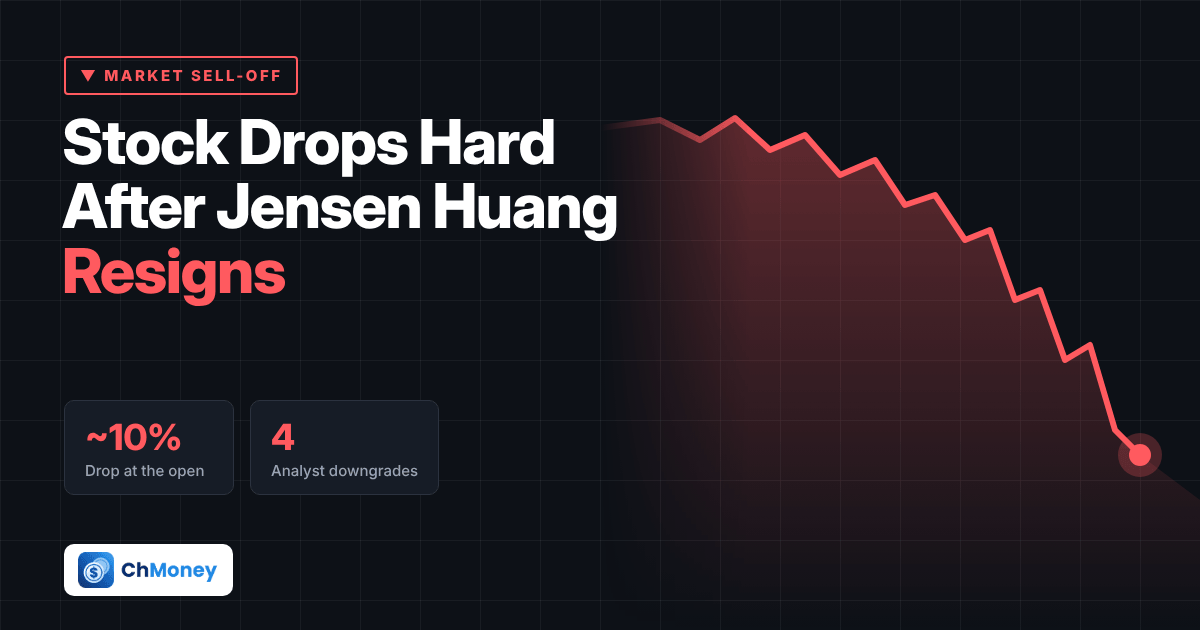
- Premarket: down 5.6%, per Yahoo Finance. Reuters, quoted by TheStreet, reported a drop of more than 10% at one point before the bell.
- Shortly after the open: down 7.7% at $160.28, per Tech Times. That’s the only exact price we found from the opening minutes.
- City AM reported the stock “plunged 16 per cent as Wall Street opened.” We couldn’t match that to any price, so treat it with care.
So depending on when you looked, Nvidia was down somewhere between about 6% and 16%. Most outlets settled on “around 10%.” At $160.28, the stock sat about 33% below its record close of $239.24 on 6 October.
How much value disappeared
This is where the numbers get big. City AM said the drop wiped out “nearly $600bn (£460bn)” of Nvidia’s value and called it “one of the largest single-day losses in stock market history.” SiliconANGLE, citing Yahoo Finance, gave a similar $600 billion figure but measured it from the previous Thursday, not just one day.
Yahoo Finance expected Nvidia to open below $4 trillion in market value, which would put it behind Apple and Microsoft, according to Tech Times. Not long ago Nvidia was a $5 trillion company.
To put that in plain terms: a 7.7% drop on a company this size is roughly $300 billion. That’s more than the entire market value of most companies in the S&P 500, gone in one morning.
Why the whole market felt it
Nvidia makes up roughly 6% of the S&P 500, according to City AM and TheStreet. When a stock that big drops 8% or more, index funds take the hit too. If you hold a basic S&P 500 fund, Nvidia’s fall alone would pull it down about half a percent, before anything else moves.
Before the open, S&P 500 futures were down 0.4% and Nasdaq-100 futures were down 0.8%, while Dow futures stayed slightly positive, per Yahoo Finance. City AM reported both the Nasdaq and the S&P 500 opened lower. We didn’t find reliable point moves for the indexes yet.
It wasn’t only Nvidia’s problem either. Inflation came in hotter than expected on Tuesday, and Yahoo Finance noted that analysts are now leaning toward more Fed rate hikes. That’s bad timing for any stock trading on future growth.
Other chip stocks
The damage was uneven:
- Fell: Intel and Micron (Yahoo Finance), CoreWeave down 6% and TSMC down about 1.7% (City AM).
- Rose: AMD, per Yahoo Finance.
AMD going up makes some sense. Oppenheimer wrote that AMD and Broadcom “could potentially benefit” from bigger changes at Nvidia, according to Finbold. If big customers worry about Nvidia’s leadership, AMD is the obvious second supplier.
The wider chip sector was already weak. Yahoo Finance said its basket of 62 chip stocks had won back less than a third of what it lost since early October, and the PHLX Semiconductor Index was still below its 200-day moving average.
Which analysts changed their calls
At least four firms downgraded Nvidia this week, and several more cut their price targets.
| Firm | Analyst | What changed | Price target |
|---|---|---|---|
| Bernstein | Stacy Rasgon | Outperform to Market Perform | $400 to $200 |
| Oppenheimer | Rich Schafer | Outperform to Perform | Target removed |
| William Blair | Not named | Outperform to Market Perform | Not given |
| Stifel | Ruben Roy | Buy kept | $315 to $205 |
| Citi | Not named | Not stated | $285 to $225 |
| Baird | Tristan Gerra | Outperform to Neutral (11 Nov) | $500 to $200 |
| Wells Fargo | Not named | Not stated | $315 to $300 |
| Yorkville | Dan Ives | Not stated | $300 to $225 |
| Morgan Stanley | Not named | Overweight kept | $300, no change |
| Bank of America | Not named | Rating kept | $350, no change |
| Raymond James | Simon Leopold | Strong Buy kept | Not given |
Sources: TheStreet, Finbold, Tech Times, Yahoo Finance.
Rasgon’s call got the most attention because he’s one of the best-known chip analysts on Wall Street. Halving his target to $200 still leaves room above Thursday’s price, which tells you he thinks the company is fine and the stock is facing a leadership discount.
Oppenheimer’s Schafer put it bluntly in a note quoted by Yahoo Finance: “We see massive shoes to fill and no obvious successor.”
Not everyone is bailing. Raymond James kept its Strong Buy and said it doubts “the distraction created by the CEO’s indiscretions alters the fundamentals,” per Yahoo Finance. Morgan Stanley and Bank of America also stuck with their ratings.
The earnings call on 17 November is the next big test
Nvidia reports third-quarter fiscal 2027 results on Tuesday, 17 November. The release comes around 4:20 p.m. Eastern and the call starts at 5 p.m. Eastern. It will be Colette Kress’s first call as interim CEO.
Here’s what the company guided for, according to TheStreet:
- Q3 revenue of $108 billion, plus or minus 2%
- Gross margin around 74%
- For comparison, Q2 revenue was $96.2 billion, up 106% from a year earlier, with $89 billion from data centres
Stifel expects “a modest earnings beat,” per Finbold. Oppenheimer expects some upside to the quarter and the outlook but thinks near-term sentiment will stay weak.
So what should you look for on the call?
- Did orders change? If Microsoft, Amazon, Google or Meta paused orders this month, that matters more than anything about Huang.
- China and export rules. Any change to how Nvidia sells chips into Southeast Asia, given the Megaspeed investigation.
- Who signs the books. Kress is now both CEO and CFO. Tech Times points out Nvidia hasn’t said how it will handle the Sarbanes-Oxley certifications that the CEO and CFO each sign, or whether it will name an acting CFO.
- The CEO search. Any timeline or shortlist would help settle the stock.
Other risks hanging over the stock
There’s more than the earnings call. A proposed class action lawsuit covers investors who bought Nvidia between 9 October and 8 November, according to Tech Times. House Republicans asked for a closed-door briefing on 18 November. And Huang still owns about 3.6% of the company, per the Wall Street Journal via Tech Times. If he decides to sell some of that, it could put more pressure on the price.
Should you buy the dip?
We can’t tell you that, and anyone who says they know is guessing. What you can do is look at the facts. Most analysts still rate Nvidia a Buy, the business was growing more than 100% a year as of last quarter, and nothing in the scandal so far has been about the chips themselves. On the other side, the company just lost its founder, its CFO is doing two jobs, and Congress and the FBI are both asking questions.
If you’re thinking about it, waiting until after the 17 November call costs you very little and gives you a lot more information.