
Most CEO scandals take months to play out. This one took about two weeks from the first newspaper report to the exit, and the last five days moved faster than anyone on Wall Street expected.
On Thursday, 12 November 2026, Nvidia said Jensen Huang had resigned as CEO and left the board. If you want the details on who runs the company now, we covered that in our piece on Colette Kress stepping in as interim CEO. This article is about the scandal itself: what Huang admitted, what is still only alleged, and how it got to the point where the founder of a company worth trillions had to leave.
It started with a business contact, not an affair
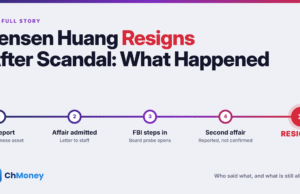
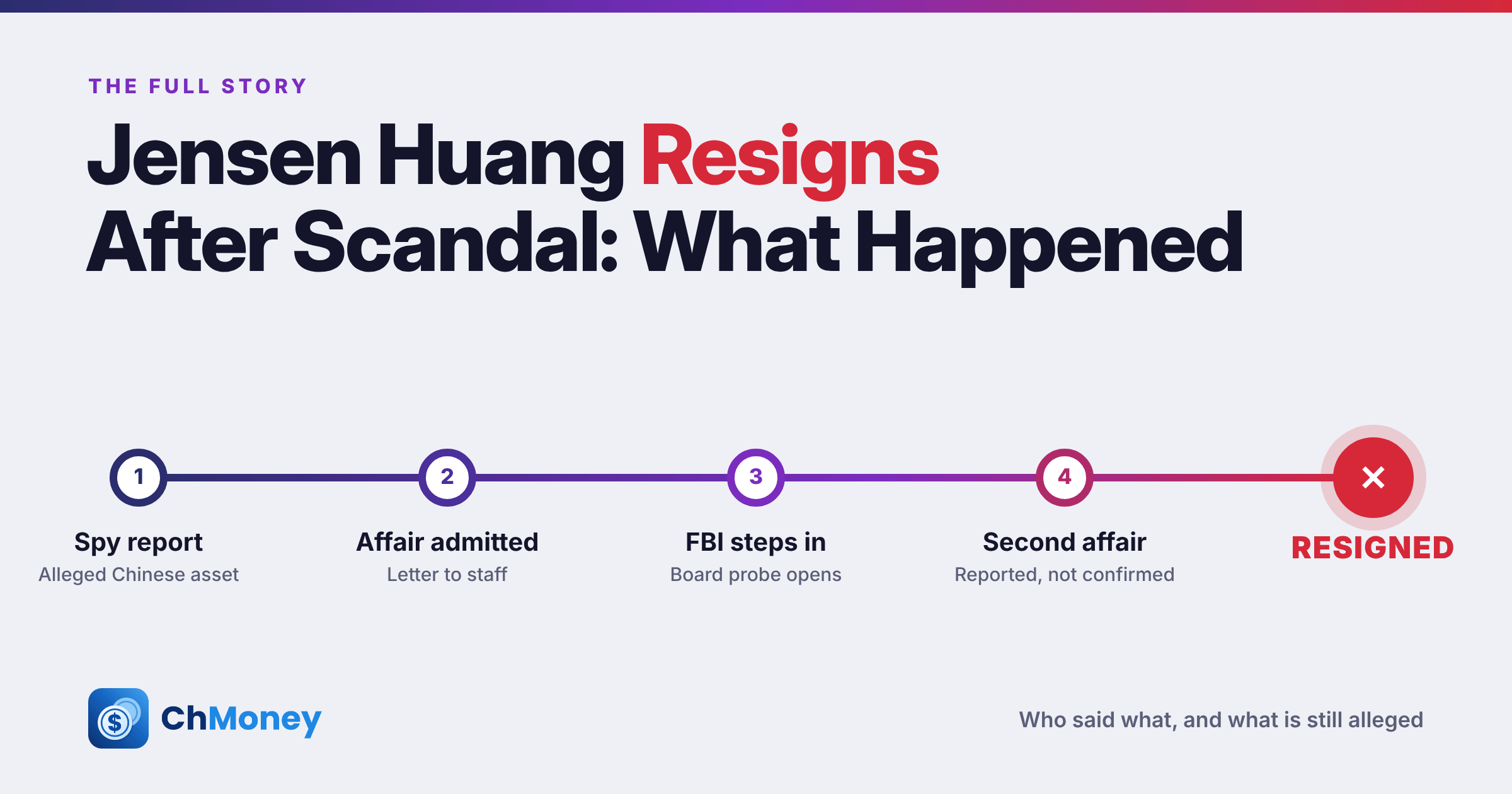
The first report didn’t say anything about romance. On 29 October the New York Times reported that Huang had a close relationship with Alice Huang, a Chinese citizen and an executive at Megaspeed, a Singapore data centre company. She is no relation to him. According to the Times, as summarised by TechCrunch, US officials had been looking at her for more than a year and believed she was passing information to Beijing.
Nvidia played it down at first. Spokesperson John Rizzo said, “Jensen’s interactions with Ms. Huang are not unusual or unexpected,” per TechCrunch. And that line made some sense at the time. Megaspeed was an Nvidia customer and a cloud partner, so a meeting between its executive and Nvidia’s CEO wouldn’t raise eyebrows on its own.
The problem was what Megaspeed was doing with the chips. The Times reported it bought around $4.8 billion of Nvidia hardware over two years. Tom’s Hardware reported it is under investigation over claims it smuggled about $2 billion worth of export-controlled AI chips into China, and TechCrunch, citing the Times, says the Justice Department has now taken over the federal case. Megaspeed denies breaking any rules.
The memo, the Congress letter and the admission
Things sped up in early November.
On 5 November, three House Republican committee chairs (John Moolenaar of the China Committee, Brian Mast of Foreign Affairs and Rick Crawford of Intelligence) asked Huang for a closed-door briefing. “Recent reports raise significant national security concerns,” their letter said, according to TechCrunch.
A day later the Financial Times reported on a US government memo that described a romantic relationship between Huang and Alice Huang, and said US intelligence believed China’s Ministry of State Security had recruited her.
Then on the weekend of 7 and 8 November, Huang sent a letter to Nvidia employees. He didn’t name her, but he tied his apology to “the national security concerns raised in news reports.” The lines most people quoted were these:
“I was unfaithful to my wife. My actions hurt her and our children. There is no excuse for what I did. I am deeply sorry.”
He also wrote, “I support the investigation and will cooperate fully.” Nvidia’s board opened an independent investigation the same day and later hired Joon H. Kim, the former acting US Attorney for the Southern District of New York, to lead it.
At this point the board’s position was that Huang would stay. A spokesperson said he planned to keep running the company, and the board said it had “no reason to believe” company secrets or national security had been compromised. We wrote about that stage in our article on the investor pitch Alice Huang allegedly made for Nvidia chips.
Trump backed him, then the FBI got involved
President Trump’s comments that Sunday sounded supportive. “I just know he’s a fine person, but you never know what’s going on,” he said, according to TechCrunch. Asked whether Huang should stay as CEO, he said, “I think so. Oh yeah, sure.”
On Monday, Trump said the FBI was looking into the allegations, and added, “I think that he’ll be in good shape,” per the Associated Press as quoted by SiliconANGLE.
That support didn’t help as much as you might think. TechCrunch, citing the Times, reports Trump was briefed in late 2025 on intelligence about the relationship and didn’t act on it. That turned part of the story into a question about what the White House knew, which kept it on the front pages.
Huang also pulled out of two public appearances that Monday, the ElevenLabs Summit and an Anthropic CEO forum, according to TechCrunch.
The second affair is what ended it
By Tuesday, analysts were already writing about succession. What pushed the board over the edge came on Wednesday, 11 November.
The New York Times, citing five Nvidia employees, reported that Huang also had a relationship with Kimberly Powell, Nvidia’s vice president of health care, who reported directly to him. The Times said the two were filmed being affectionate at a hotel during a company conference earlier this year. Tom’s Hardware says that was at Nvidia’s GTC conference in San Jose and that a bystander was allegedly offered a non-disclosure agreement. Neither Nvidia, Huang nor Powell had confirmed the report as of Thursday.
This mattered for a simple reason. The first affair was a personal and security issue. A relationship with a direct report is a governance issue, and most large US companies have rules against it. Boards have pushed out CEOs for that alone. Intel’s Brian Krzanich resigned in 2018 over a past consensual relationship with an employee, and McDonald’s fired Steve Easterbrook in 2019 for the same reason.
The Wall Street Journal reported that night that Nvidia’s board was meeting to decide whether to oust Huang. On Thursday morning the company announced he had resigned. TechCrunch reports Nvidia’s SEC filing says the board accepted the resignation on Wednesday, a day before the public announcement. We’ve only seen that detail in one place.
Congress isn’t letting it go
Leaving Nvidia doesn’t end Huang’s problems in Washington.
Huang hadn’t formally replied to the House chairs’ Wednesday deadline for the briefing, ABC7 reported. Moolenaar told Fox Business on 11 November that if Huang didn’t agree, “he’ll likely be subpoenaed,” per TechCrunch.
Senator Elizabeth Warren said Thursday that the resignation “does not absolve him,” according to Seeking Alpha, and that Huang and other Nvidia executives still owe Congress answers on chip exports to China.
The questions lawmakers want answered are practical ones. How did Megaspeed become an approved Nvidia partner days after a corporate reshuffle? Did Nvidia check where its chips ended up? And why did Nvidia’s top lawyer, Tim Teter, contact a Commerce Department official about the detention of Alice Huang in Singapore, as Bloomberg reported (via TechCrunch)? Those questions are about the company, so they don’t go away with the CEO.
How the market took it
Nvidia stock swung hard all week. It rose nearly 5% at one point on Wednesday, then fell about 7.5% to 8% after hours once the Powell report came out, according to ABC7 and TechCrunch. On Thursday it dropped again after the announcement. Reports of the size differ a lot depending on when they were written: SiliconANGLE said more than 6% in early trading, Yahoo Finance and Tom’s Hardware said around 10%, and a later headline from The Hill said 14%. SiliconANGLE, citing Yahoo Finance, put the market value lost since the previous Thursday at over $600 billion.
Huang still owns about 3.6% of Nvidia, according to SiliconANGLE. So the stock drop hit his own wealth hard too.
What is proven and what isn’t
It’s easy to lose track, so here’s where things stand:
- Admitted by Huang: he was unfaithful to his wife.
- Reported, not confirmed by Nvidia or Huang: the relationship with Kimberly Powell.
- Alleged by US officials, through anonymous sources and memos: that Alice Huang worked for Chinese intelligence. No charges have been filed, and China has denied it.
- Under investigation: whether Megaspeed moved restricted chips into China, and whether any Nvidia information was exposed.
There’s no evidence in public yet that Huang handed over company secrets. Nvidia’s own board said it saw no sign of that. The Kim investigation, the FBI and Congress may change the picture.