
You know when you hand in an assignment, get a good grade, and then a month later the teacher says “actually, you skipped half the question, do it again”? Norway’s government just got that call, except the assignment was three oilfields in the North Sea and the teacher was the country’s Supreme Court.
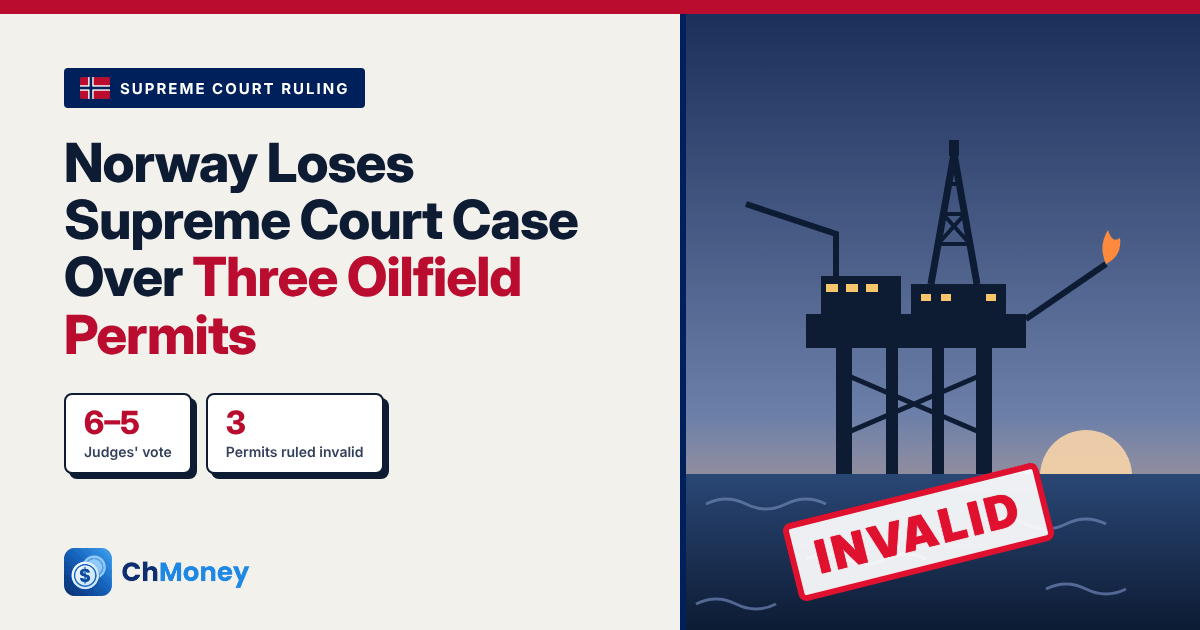
On Friday, 13 November, Norway’s Supreme Court ruled that the government’s approvals for three oil and gas fields, Breidablikk, Tyrving and Yggdrasil, are invalid. The vote was 6 to 5, Reuters reports. The reason: when the state signed off on these fields, it looked at the emissions from pumping the oil out, but not at the emissions from people burning it later.
Here’s the twist though. The oil keeps flowing, at least for now.
What the court decided
The case came from two climate groups, Greenpeace Nordic and Natur og Ungdom (Nature and Youth, known in English as Young Friends of the Earth Norway). They argued the Energy Ministry broke the rules when it approved the development plans for the three fields.
The Supreme Court agreed. In its statement, quoted by AFP, the court said “the combustion emissions resulting from petroleum production must be subject to an impact assessment” before approval. These are what the industry calls Scope 3 emissions: the CO2 that comes out of car exhausts, power plants and furnaces after the oil and gas are sold.
The case was heard by 11 judges sitting together in plenary, a format Norway’s top court saves for its most important cases, according to AFP. Six sided with the green groups and five with the state. That’s about as close as it gets.
Why the oil still flows
If you read the headline and pictured rigs shutting down, that’s not what happens next.
The oil companies were not parties to the case, so the ruling does not force them to stop producing, Reuters reports. The court also said the permits don’t automatically stop applying. Instead, the Energy Ministry has to go back and redo the approvals properly.
“However, the Energy Ministry must re-examine the matter, ensuring that the correct procedural requirements are followed,” the court said, per Reuters.
So for now, here is where each field stands:
| Field | Operator | Status |
|---|---|---|
| Breidablikk | Equinor | Producing |
| Tyrving | Aker BP | Producing |
| Yggdrasil | Aker BP | Under development; the largest of the three |
Aker BP told Reuters it still expects Yggdrasil to start as planned next summer. Equinor and Aker BP both repeated that they were not parties to the case and said they would cooperate with the authorities.
What the government says
Energy Minister Terje Aasland said the government would fix the shortcomings “as soon as possible,” Reuters reports. He said he doesn’t expect the ruling to affect production or development at the fields.
He was also honest that approvals will get harder from here. “The basis to make decisions will become more extensive and stricter,” Aasland told Reuters.
Norway’s Attorney General Fredrik Sejersted was just as direct. “The verdict means the state has a duty to reprocess the case and we will do so,” he told Reuters, according to a rewrite of the Reuters report.
What the climate groups say
The campaigners are, not surprisingly, thrilled. “This is a fantastic news for the climate,” said Greenpeace Norway leader Haldis Tjeldflaat Helle. “This changes Norwegian oil policy forever.”
They aren’t done either. Their lawyer, Jenny Sandvig, said the groups will consider suing the oil companies directly to halt output, Reuters reports. That would be a new fight, because this case was only against the state.
How the case got here
This didn’t come out of nowhere. The campaigners have now won in all three levels of Norway’s courts. Here’s the short version:
- 2023: Greenpeace Nordic and Nature and Youth sue the state over the three approvals.
- January 2024: Oslo District Court rules the approvals invalid because combustion emissions weren’t assessed, according to Greenpeace. The ministry appeals.
- Summer 2024: The Borgarting Court of Appeal sends legal questions to the EFTA Court, which rules on how European Economic Area law applies in Norway.
- 21 May 2025: The EFTA Court says emissions from burning extracted oil and gas must be assessed before an extraction project is approved. It also says that if a project was approved without a lawful assessment, national authorities must fix it, for example by suspending or revoking the consent, according to Norway’s national human rights institution.
- 14 November 2025: Borgarting rules against the state and orders the ministry to reprocess the applications, Norwegian law firm Schjødt reports. The state appeals to the Supreme Court.
- 13 November 2026: The Supreme Court rules the approvals invalid, 6 to 5.
One more thing worth knowing. Norway did win a different climate case recently. On 28 October 2025, the European Court of Human Rights ruled unanimously that Norway didn’t violate human rights when it handed out 10 oil exploration licences in the Barents Sea in 2016, Reuters reported. So the state isn’t losing everything. It’s losing on paperwork, specifically on what has to go into an environmental assessment.
Why the burning part matters so much
Norway produces a lot of oil and gas, but most of it gets burned somewhere else, mainly in Europe. So the emissions from drilling are small next to the emissions from the fuel itself. Greenpeace has put the burning part at about 95% of the climate impact for these projects, though that’s the group’s own calculation.
Until now, Norway could approve a field by looking at the smaller number. After this ruling, it has to look at the bigger one too. That doesn’t mean every future field gets rejected. It means every future approval has a longer checklist, and every one of those checklists can be challenged in court.
Before the ruling, Jasper Teulings, a legal specialist at the Climate Litigation Network, told AFP: “We could be looking at an emerging norm that makes it really difficult for governments to issue such licences.”
What it means for you
If you hold Equinor (it trades in New York as EQNR) or follow European energy stocks, the short-term answer is: not much changes today. Two fields keep pumping, and Aker BP still plans to start Yggdrasil next summer. The ministry has to redo its homework, and the minister has already said he wants the shortcomings fixed “as soon as possible.”
The bigger risk is slower. Stricter permits mean new Norwegian projects could take longer to approve, and every approval is now open to the same kind of lawsuit. Watch for two things: how fast the ministry reissues the three permits, and whether the green groups actually sue Equinor and Aker BP to stop production.
For more on how energy news hits your portfolio, check out our guide to defensive stocks in an AI bull market and our story on Scott Bessent and the Iran sanctions fight.