
We all know that one friend who says “I’ll start saving next month” every single month. Rent came in higher, the car needed tires, there was a wedding. And then there’s the other friend who somehow has six months of expenses sitting in a savings account and still goes on trips. The difference usually isn’t their salary. It’s that the second friend decided on a number per paycheck and moved it out before they could spend it.
So what’s the right number?
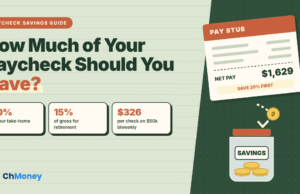
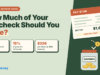
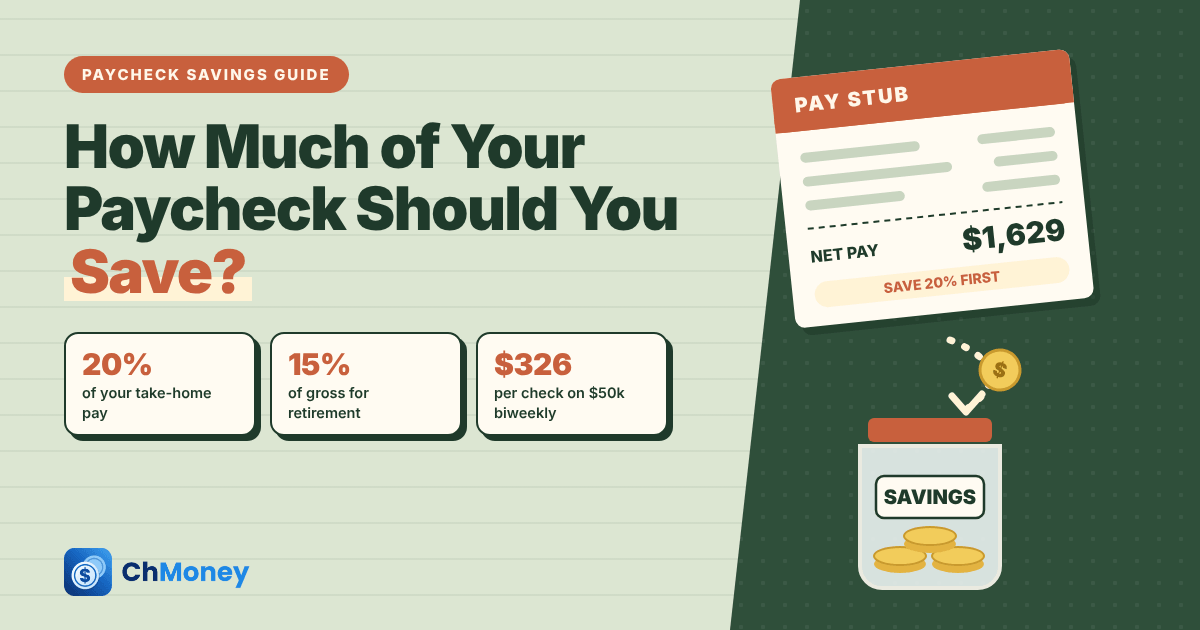
The short answer: save 20% of your take-home pay if you can, with at least 15% of your gross pay going to retirement (your employer match counts toward that 15%). On a $50,000 salary paid every two weeks, 20% of take-home is about $326 a check. If 20% isn’t possible yet, start at 5% and add 1% every time you get a raise.
Below you’ll find the exact dollars per weekly and biweekly paycheck at four salaries, what order to save in, the 2026 401(k) and IRA limits, and what to do when 20% just isn’t happening right now.
How much of your paycheck should you save?
Aim for 20% of your take-home pay, split between retirement, an emergency fund and other goals. Fidelity suggests at least 15% of your pre-tax income for retirement, including any employer match, plus 10% of take-home for short-term savings. If your budget is tight, any fixed amount you save every paycheck beats waiting for a better month.
Nine of the ten top Google results for this question land on the same 20% figure. It comes from the 50/30/20 budget: 50% of take-home pay for needs, 30% for wants, 20% for savings and extra debt payments.
Here’s the honest part. Most Americans save nowhere near that. The BEA’s personal saving rate was 3.8% in September 2026 (released October 29, 2026). So if you’re saving 10% right now, you’re already saving more than twice what the average household does. 20% is the goal, not the starting line.
How much is that per paycheck?
On a $50,000 salary, 20% of take-home pay is about $326 per biweekly paycheck or $163 per weekly paycheck. On $75,000, it’s about $474 biweekly or $237 weekly. On $100,000, it’s about $609 biweekly or $305 weekly. These figures assume a single filer in a state with no income tax.
Most articles stop at “save 20%” and leave the math to you. Here’s the math. Take-home pay below is after federal income tax and FICA (Social Security and Medicare), for a single filer with no state income tax and nothing else taken out.
| Salary | Take-home per year | Biweekly check (26/yr) | Weekly check (52/yr) | Save 10% per check (biweekly / weekly) | Save 20% per check (biweekly / weekly) |
|---|---|---|---|---|---|
| $35,000 | $30,302 | $1,165.48 | $582.74 | $116.55 / $58.27 | $233.10 / $116.55 |
| $50,000 | $42,355 | $1,629.04 | $814.52 | $162.90 / $81.45 | $325.81 / $162.90 |
| $75,000 | $61,592 | $2,368.94 | $1,184.47 | $236.89 / $118.45 | $473.79 / $236.89 |
| $100,000 | $79,180 | $3,045.38 | $1,522.69 | $304.54 / $152.27 | $609.08 / $304.54 |
Your real check will be smaller if you pay state income tax, health insurance premiums or other deductions. The easiest fix is to skip the table and use your own pay stub: take the “net pay” number and multiply by 0.20. If your net pay is $1,480, 20% is $296.
Is the 20% based on gross pay or take-home pay?
The 50/30/20 rule uses take-home pay, the amount that hits your bank account. Retirement guidelines like Fidelity’s 15% use gross pay, before taxes. The two give different dollar amounts. On a $50,000 salary, 15% of gross is $7,500 a year, while 20% of take-home is about $8,471.
This is where a lot of people get mixed up, and most ranking pages don’t explain it. Here’s how it works on a $50,000 salary:
- 15% of gross for retirement: $7,500 a year, or $288.46 per biweekly paycheck.
- 20% of take-home for all savings: about $8,471 a year, or $325.81 per biweekly paycheck.
There’s a catch that works in your favor. Money you put in a traditional 401(k) comes out before income tax. So a $288.46 contribution doesn’t shrink your paycheck by $288.46. In the 12% federal bracket, it shrinks it by about $254, because you skip roughly $35 of income tax on that money. (FICA still applies.)
Does your employer’s 401(k) match count toward what you save?
Yes. Fidelity’s 15% retirement target includes your employer’s match. If your employer adds 3% of your pay, you only need to put in 12% yourself to reach 15%. Always contribute at least enough to get the full match, because any match you skip is pay you don’t collect.
Say you earn $50,000 and your employer matches 50 cents on every dollar you put in, up to 6% of your pay. That’s a common formula, but check your plan documents for yours.
- You put in 6%, which is $3,000 a year or $115.38 per biweekly check.
- Your employer adds half of that: $1,500 a year, which is 3% of your pay.
- You’re now at 9% total. To reach 15%, you’d add another 6% yourself ($115.38 more per check), not another 15%.
If you put in only 3%, your employer adds only 1.5%. You’d leave $750 a year on the table. Over 10 years that’s $7,500 of free money, before any growth.
What’s the 50/30/20 rule, and what are the alternatives?
The 50/30/20 rule splits take-home pay into 50% needs, 30% wants and 20% savings. If your rent eats more than half your pay, Fidelity’s 60/30/10 split (plus 15% of gross for retirement) or the 70/20/10 rule may fit better. Pay yourself first works for anyone who hates tracking categories.
No single rule fits everyone. If you live in a high-rent city, 50% for needs might not be realistic. Here’s how the common ones compare on a $50,000 salary with $3,530 a month take-home:
| Rule | How it splits take-home pay | Monthly savings on $3,530 take-home | Good for |
|---|---|---|---|
| 50/30/20 | 50% needs, 30% wants, 20% savings and extra debt payments | $706 | Most people with moderate rent |
| Fidelity 60/30/10 + 15 | 60% must-haves, 30% wants, 10% short-term savings, plus 15% of gross to retirement | $353 short-term, plus $625 retirement from gross pay | People who want retirement handled separately |
| 70/20/10 | 70% spending, 20% savings, 10% debt payoff | $706 | People paying off credit cards or loans |
| 80/20 | 80% everything, 20% savings | $706 | People who don’t want to sort needs from wants |
| Pay yourself first | Pick a fixed amount, move it on payday, spend the rest | Whatever you set, say $150 a check = $325 a month | Anyone who hates budgeting |
| Zero-based | Every dollar gets a job, savings included | Varies | Detail-minded people with irregular bills |
Notice something? The 50/30/20, 70/20/10 and 80/20 rules all save 20%. They only differ in how they slice the rest. If you’re not sure which to pick, pick 80/20. It’s the one you’ll actually stick to.
What should you save for first?
Save in this order: a starter emergency fund, then enough in your 401(k) to get the full match, then pay off debt above about 8% interest, then grow your emergency fund to 3 to 6 months of essential expenses, then raise retirement savings to 15%. After that, save for a house, car or travel.
Here’s the order with numbers for a $50,000 earner saving $162.90 per biweekly check (10% of take-home) plus a 401(k) contribution.
- Starter emergency fund. Fidelity suggests $1,000 or one month of essential expenses, whichever is more. If your must-haves cost $2,100 a month, save $2,100. At $162.90 a check, that takes 13 paychecks, about six months.
- Full employer match. Turn this on from day one, even while you build step 1. Missing the match costs more than almost anything else on this list.
- High-interest debt. Credit card debt at 20%+ grows faster than any savings account pays. Pay it down before you save beyond the starter fund. Student loans are a closer call; our guide on whether to pay off student loans goes rate by rate.
- Full emergency fund. Grow it to 3 to 6 months of essential expenses. More on this below.
- 15% for retirement. Raise your 401(k) or add an IRA until you hit 15% of gross, match included.
- Everything else. House down payment, next car, travel, kids’ college.
How big should your emergency fund be?
Keep 3 to 6 months of essential expenses: rent, groceries, insurance, transportation, minimum debt payments and childcare. If those cost $2,100 a month, your target is $6,300 to $12,600. Pick the higher end if you’re self-employed, a single earner or work in an industry with layoffs.
The Federal Reserve’s household survey, published in May 2026, found that 63% of adults would cover a $400 emergency with cash or its equivalent. That number hasn’t moved in three years and is down from 68% in 2021. So more than a third of adults would need to borrow, sell something or skip a bill for a $400 car repair.
Here’s how long it takes to fill a 3-month fund of $6,300 at different amounts per biweekly paycheck:
| Saved per biweekly check | Paychecks to $6,300 | About how long |
|---|---|---|
| $100 | 63 | 2 years, 5 months |
| $162.90 | 39 | 1 year, 6 months |
| $250 | 26 | 1 year |
| $325.81 | 20 | 9 to 10 months |
Keep this money in a high-yield savings account, not checking. Top accounts paid 4.35% to 4.40% APY as of November 13, 2026, so a $6,300 fund earns about $274 a year instead of a few dollars.
How much can you put in a 401(k) and IRA in 2026?
For 2026, you can put up to $24,500 in a 401(k), plus $8,000 in catch-up contributions at age 50 or older, or $11,250 at ages 60 to 63. The IRA limit is $7,500, plus $1,100 at 50 or older. These limits come from IRS release IR-2025-111.
| Account | 2026 limit | Age 50+ catch-up | Per biweekly check to max out (under 50) |
|---|---|---|---|
| 401(k), 403(b), most 457 plans | $24,500 | $8,000 ($11,250 at ages 60 to 63) | $942.31 |
| Traditional or Roth IRA | $7,500 | $1,100 | $288.46 |
| Roth IRA income phase-out | $153,000 to $168,000 single, $242,000 to $252,000 married filing jointly |
You don’t need to max anything out to be on track. For a $50,000 earner, 15% of gross is $7,500, which is exactly the IRA limit or less than a third of the 401(k) limit. The limits matter mostly for people earning well above $100,000.
What if you can’t save 20% of your paycheck?
Start with any fixed amount, even $25 or $50 a paycheck, and set it to move automatically on payday. Then raise it by 1% of pay every time you get a raise or pay off a debt. Moving from 5% to 15% this way takes about 10 raises, and you never feel the cut in your take-home pay.
20% is hard if rent takes half your check, or you’re paying off a card, or you have kids. That’s normal. The habit matters more than the percentage at first.
A few ways to find the money without a full budget overhaul:
- Save the raise. If you get a 3% raise, put 1% of it toward savings and keep 2%. Your take-home still goes up.
- Save the extra paychecks. Biweekly workers get two months a year with three paychecks. On a $50,000 salary, saving both extra checks is $3,258 a year, and you never budgeted for them. Weekly workers get four months with five paychecks.
- Save refunds and windfalls. Tax refund, bonus, cash gift. Put at least half straight into savings before it hits your checking account.
- Cut one bill, move the exact amount. Cancel a $15 streaming service and set a $15 transfer on payday. Otherwise the $15 just disappears into groceries.
Starting early matters here. Fidelity’s 15% target assumes you save from age 25 to 67. Start at 35 and you’d need to save a bigger share of each check to end up in the same place.
What do small amounts per paycheck grow to?
At a 6% average yearly return, $100 per biweekly paycheck grows to about $100,000 in 20 years and about $218,000 in 30 years. You’d put in $52,000 and $78,000 of that yourself. The rest is growth. Returns aren’t guaranteed, and stock markets drop some years.
Here’s what steady deposits every two weeks could become. We assumed a 6% average yearly return. Real returns will be higher some years and negative in others.
| Per biweekly check | You put in over 30 years | Value after 10 years | After 20 years | After 30 years |
|---|---|---|---|---|
| $50 | $39,000 | $17,785 | $50,170 | $109,137 |
| $100 | $78,000 | $35,571 | $100,340 | $218,275 |
| $200 | $156,000 | $71,141 | $200,679 | $436,550 |
| $288.46 (15% of $50,000) | $225,000 | $102,607 | $289,440 | $629,636 |
The gap between $50 and $200 a check is $150, roughly a takeout dinner for two every other week. Over 30 years, that $150 is worth about $327,000.
How do you set up savings on a weekly or biweekly paycheck?
Split your direct deposit so savings goes straight to a separate account on payday, before the money reaches checking. Set your 401(k) percentage with HR or your plan’s website. Then set one calendar reminder a year to raise both amounts. The whole setup takes about 30 minutes.
- Find your net pay. Look at your last pay stub for the “net pay” line.
- Pick your number. Multiply net pay by 0.20, or by 0.05 if you’re starting small. Round to an even number, like $300 or $50.
- Set your 401(k) to at least the match. Log in to your plan website or ask HR. This comes out before taxes, so it doesn’t count against the number in step 2 unless you want it to.
- Split your direct deposit. Most payroll systems let you send a fixed dollar amount to one account and the rest to another. Send your number from step 2 to a high-yield savings account.
- Name the account. “Emergency fund” or “House 2029” makes it harder to raid than “Savings 2.”
- Raise it once a year. Put a reminder on the day your raise usually hits. Add 1%.
If your employer can’t split deposits, set an automatic transfer in your bank app for the morning after payday. Same result, one extra step.
Frequently asked questions
Is saving 20% of my paycheck good?
Yes. 20% of take-home pay is the standard 50/30/20 target and more than five times the 3.8% the average American household saved in September 2026, according to the BEA. If you’re saving 20% and getting your full 401(k) match, you’re ahead of most people.
How much should I save per paycheck if I make $50,000?
About $326 per biweekly paycheck or $163 per weekly paycheck to hit 20% of take-home pay, assuming a single filer with no state income tax. For retirement alone, 15% of $50,000 is $288.46 per biweekly check, and your employer match counts toward that.
Should I save 15% or 20%?
Both. 15% is a retirement target based on gross pay, including your employer match. 20% is an overall savings target based on take-home pay. If you can only do one, cover your employer match first, then build a starter emergency fund, then work toward 15% for retirement.
Is it better to save a percentage or a fixed dollar amount?
A percentage grows on its own when your pay goes up, so it’s better for retirement. A fixed dollar amount is easier to plan around, so it works well for an emergency fund. Many people use both: a 401(k) percentage plus a fixed transfer on payday.
How much should I save if I live paycheck to paycheck?
Start with $25 or $50 per paycheck in a separate savings account, set to move automatically. Build to $1,000 or one month of essential expenses first. Even $25 every two weeks is $650 a year, more than enough for the $400 emergency that 37% of adults said they couldn’t cover with cash or savings.
Does my 401(k) count as savings?
Yes. Your 401(k) contributions and your employer’s match count toward both the 15% retirement target and the 20% overall savings target. They don’t count toward your emergency fund, because withdrawing early usually means income tax plus a 10% penalty.
Should I save or pay off debt first?
Build a starter emergency fund and get your full employer match first. Then pay off any debt above about 8% interest, like credit cards, before saving more. For low-rate debt like a 3% car loan or mortgage, keep saving and pay the minimum.