
We all know someone who got a term life quote, looked at it, and said “so I pay for 20 years and if I don’t die I get nothing back?” Then they closed the tab. Maybe that’s you right now. You just had a baby, or signed a mortgage, and a friend told you whole life is “an investment” while another friend told you it’s a rip off.
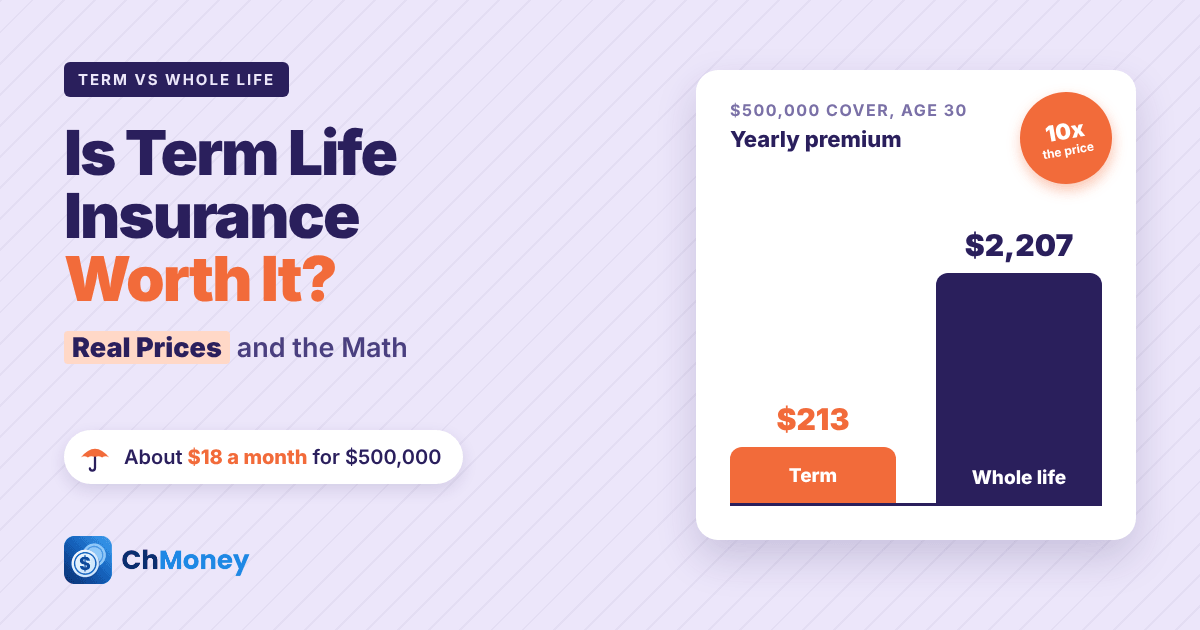
Here’s the short answer. Term life insurance is worth it if someone depends on your income or you have debts they’d have to pay. A healthy 30-year-old man pays about $213 a year for $500,000 of 20-year cover, about one tenth of the whole life price. It’s not worth it if nobody relies on your money.
This guide shows you the real prices, the “buy term and invest the difference” math in dollars, who should skip it, and what happens when your term runs out.
Term life insurance at a glance
| Question | Answer |
|---|---|
| What it is | Life cover for a set period, usually 10, 20 or 30 years. Pays your beneficiaries if you die in that period |
| Typical price | $213 a year for $500,000, 20-year term, healthy 30-year-old man (NerdWallet, Oct 2026) |
| Whole life for the same man | $2,207 a year (NerdWallet) to about $4,800 a year (MoneyGeek, $400 a month) |
| Cash value | None. You can’t cash it out |
| If you outlive it | Coverage ends. You can renew at a higher price, convert if your policy allows it, or let it go |
| Cancel early? | Yes, any time, no fee on plain term |
| Best for | Parents, homeowners, anyone with a spouse or kids who rely on their income |
| Not needed for | Single people with no dependents and no co-signed debt, retirees with enough savings |
Is term life insurance worth it?
Yes, for most people with kids, a spouse or a mortgage. Term life gives the biggest death benefit for the least money: about $18 a month buys $500,000 for a healthy 30-year-old man. If he dies in the next 20 years, his family gets the full amount. If nobody depends on your income, you probably don’t need it.
The test is simple. Ask yourself one question: if I died tomorrow, would someone struggle to pay the bills?
For a lot of US families the answer is yes. In the 2026 Insurance Barometer by LIMRA and Life Happens, 47% of adults said they’d have trouble paying living expenses within 6 months if a main earner died. Only 29% said they’d stay financially secure for more than two years.
Even so, only 52% of American adults have any life insurance at all, and 38% (about 92 million people) say they need it or need more. The top reason people give for not buying is that they think it’s too expensive. Steve Wood, a research director at LIMRA, said in May 2026 that younger and healthier people often overestimate the price by as much as 10 times.
How much does term life cost compared to whole life?
Whole life costs about 10 times more than term for the same coverage. NerdWallet’s October 2026 averages put a $500,000, 20-year term at $213 a year for a healthy 30-year-old man, and whole life at $2,207. At 40 it’s $321 vs $3,180. The gap pays for whole life’s cash value and lifelong cover.
Here are annual prices for $500,000 of coverage, non-smokers in good health, from NerdWallet (rates valid October 1, 2026):
| Age | 20-year term, men | 20-year term, women | Whole life, men | Whole life, women |
|---|---|---|---|---|
| 30 | $213 | $182 | $2,207 | $1,929 |
| 40 | $321 | $278 | $3,180 | $2,849 |
| 50 | $810 | $636 | $4,983 | $4,317 |
| 60 | $2,335 | $1,640 | $8,335 | $7,304 |
Whole life quotes vary more than term. MoneyGeek’s November 2026 rates for the same $500,000 whole life policy are higher: $400 a month for a 30-year-old man ($4,800 a year) and $537 a month at 40. So treat the whole life column above as the low end.
Smoking changes everything too. A 40-year-old man who smokes pays about $1,448 a year for the same 20-year term, per NerdWallet, which is 4.5 times the non-smoker price.
Your own price depends on your health, weight, family history, job, hobbies (pilots and scuba divers pay more) and state. These are averages, not quotes.
Is term life insurance a waste of money if you outlive it?
No more than car insurance is a waste if you never crash. A 30-year-old man pays about $4,260 over 20 years for $500,000 of cover. If he lives, he paid for 20 years of protection his family didn’t need to use. If he dies, they get $500,000 tax free. That trade is the whole point.
Here’s the math on that $213 a year:
- 20 years x $213 = $4,260 in total premiums
- Death benefit if he dies during those 20 years = $500,000
- That’s about $117 of cover for every $1 of premium
Most people who buy term never file a claim, because they live past the end of the term or cancel once the kids are grown. That’s the outcome you want. You bought it for the years when your death would hurt your family the most, and those years passed.
If you still hate the idea of getting nothing back, look at return of premium term. It refunds your premiums if you outlive the policy, but it costs a lot more than plain term, and you lose the refund if you cancel early. For most people, investing the extra money yourself gives a better result, which is the next section.
Does “buy term and invest the difference” really work?
On paper, yes. A 30-year-old man who buys term for $213 a year instead of whole life for $2,207 saves $1,994 a year. Invested for 20 years at 6%, that grows to about $73,350, and to about $175,800 by age 65 with no new deposits. It only works if you actually invest the gap every year.
Here’s the step by step, using NerdWallet’s prices for a healthy 30-year-old man with $500,000 of coverage:
- Whole life premium: $2,207 a year
- 20-year term premium: $213 a year
- Difference: $1,994 a year, or about $166 a month
- Invest $1,994 a year for 20 years at 6%: about $73,350 at age 50
- Same thing at 7%: about $81,745
- Stop adding money at 50 and leave it alone at 6% until 65: about $175,800
The 6% and 7% are assumptions for a mix of stocks and bonds, not a promise. Markets go up and down, and some years you’ll lose money.
What if he dies in year 10? His family gets $500,000 from the term policy plus about $26,300 in the investment account. With whole life, they’d get the $500,000 death benefit. So the term buyer’s family ends up with more in that case too.
Where to put the money. At $166 a month, the difference fits inside a Roth IRA, where the limit is $7,500 for 2026.
The catch. Whole life forces you to save, because you have to pay the bill. Buy term and invest only works if you set up an automatic transfer on payday and leave it alone. If you know that $166 a month would end up as takeout and concert tickets, whole life’s forced savings might suit you better, even with the lower return.
Who is term life insurance worth it for?
Term life is worth it for anyone whose death would leave someone else short of money for a set number of years: parents of young kids, people with a mortgage, a spouse who earns less, a co-signer on a loan, and stay-at-home parents whose childcare would cost money to replace.
Real-life cases where it pays off:
- New parents. A 20 or 30-year term covers you until your youngest finishes college.
- New homeowners. Match the term to your mortgage, so your family can pay it off or keep making payments.
- The main earner in a couple. If your partner earns $40,000 and you earn $90,000, your income is carrying the household.
- Stay-at-home parents. You don’t earn a paycheck, but your partner would have to pay for daycare, school pickups and housework. Price out daycare in your zip code and you’ll see why a $250,000 to $500,000 policy makes sense.
- Co-signers and business owners. If you co-signed your kid’s student loan or have a business loan with a personal guarantee, the debt doesn’t disappear when you die. Term cover can pay it.
When is term life insurance not worth it?
Term life isn’t worth it if nobody depends on your income and nobody would inherit your debts. That includes most single people without kids, retirees whose savings already cover a spouse, and people over 60 who mainly want money for a funeral, where a small final expense policy or savings costs less.
Skip it, or buy less, if:
- You’re single with no kids and no co-signed debts. In most cases your debts get paid from your estate, not by your parents or siblings. If you want to leave money for a funeral, a savings account does that.
- You’re retired and your savings can support your spouse. Once your 401(k), IRA and Social Security survivor benefits cover your partner, the need for term often goes away.
- You’re 60 or older and only want burial money. A $500,000 20-year term costs a 60-year-old man about $2,335 a year (NerdWallet). That’s a lot for a funeral fund.
- Your need is short. If you only need cover for a year or two, read our guide to short term life insurance. A regular term policy that you cancel early is often the cheaper option.
When does whole life make more sense?
Whole life makes sense when you need cover until the day you die, at any age. That includes parents of a child with a lifelong disability, estates big enough to owe federal estate tax, business partners funding a buy-sell agreement, and high earners who already max out their 401(k) and IRA.
Some honest cases for whole life:
- A lifelong dependent. If your child will need care after you’re gone, at any age, term coverage could end before you die. Whole life pays whenever you die.
- Large estates. In 2026 the federal estate tax exemption is $15 million per person. Families above that sometimes use whole life to pay the tax so heirs don’t have to sell a business or land.
- Business buy-sell agreements. Partners buy whole life on each other so the survivor can buy out the family.
- You’ve maxed out every tax account. If you already put the full amount into a 401(k), an IRA and an HSA, whole life cash value grows tax deferred and can be a place for more savings.
Read the fine print before you buy. The NAIC’s Life Insurance Buyer’s Guide warns that some cash value policies have low cash values in the early years. If you cancel in the first few years, you can get back much less than you paid in.
LIMRA’s 2025 sales numbers show how much money goes into permanent cover. Whole life brought in $6.4 billion of new premium in 2025 (37% of the market), while term brought in $3.1 billion (17%). Term policies are cheaper, so the same number of buyers adds up to far fewer dollars.
Is life insurance through work enough?
Usually not. Work coverage is often one or two times your salary, which won’t replace your income for long, and it often ends when you leave the job. In LIMRA’s 2026 study, 47% of people with life insurance had coverage through work. Treat it as a bonus, not your main policy.
Two problems with relying only on work coverage:
- The amount is small. If you earn $70,000 and your employer gives you one times salary, your family gets $70,000. That covers about one year of your income.
- You lose it when you leave. Get laid off, change jobs or retire early, and the cover usually goes with you. You might be able to convert it to an individual policy within a short window, but the price is often high. Our short term life insurance guide explains the conversion window.
Buy your own term policy while you’re young and healthy, and keep the work cover as extra.
How much term life insurance do you need, and for how long?
A common rule is 10 to 12 times your income, the range Ramsey Solutions recommends, on a term that lasts until your youngest child is grown or your mortgage is paid off. A more exact way is to add your debts, years of income, mortgage and college costs, then subtract your savings.
Here’s how to work it out, using a 35-year-old who earns $70,000 a year, has two kids and a $280,000 mortgage:
- Debts: car loan and credit cards = $15,000
- Income: $70,000 x 10 years = $700,000
- Mortgage balance: $280,000
- Education: $50,000 per kid x 2 = $100,000
- Add it up: $1,095,000
- Subtract what you already have: $50,000 in savings and $70,000 of work cover = $120,000
- Coverage to buy: about $975,000, so round up to $1 million
The 10 to 12 times rule would say $700,000 to $840,000, so the two methods land in the same area. Pick a term of 20 years, which covers the kids until they’re grown and most of the mortgage.
Term length changes the price. For a healthy 40-year-old man buying $500,000, NerdWallet’s averages are $200 a year for 10 years, $321 for 20 years and $574 for 30 years. Don’t pay for 30 years if you only need 20.
What happens when your term ends?
When the term ends, coverage stops and you stop paying. You can usually renew year by year at a much higher price based on your new age, convert to permanent cover if your policy has a conversion option, buy a new policy, or let it go if you no longer need it.
Your options at the end of a 20-year term:
- Let it lapse. If the kids are grown and the mortgage is paid, this is often the right move. You got 20 years of cover.
- Renew. The NAIC says most term policies can be renewed even if your health has changed, but the premium is higher and some policies stop renewing at a set age. Ask your insurer what the highest premium could be.
- Convert. Many term policies let you switch to permanent cover without a medical exam before a set date. Look for the conversion deadline on your policy.
- Buy a new policy. If you’re still healthy, a new, shorter term may cost less than renewing.
You also don’t have to wait for the end. Plain term has no cancellation fee, so you can drop it any time. That’s why a 20-year term works even if you might only need 15 years.
How to buy term life insurance without overpaying
Get quotes from at least three insurers on the same day, for the same amount and term, and compare insurer ratings from A.M. Best. Apply while you’re healthy, answer every health question honestly, and use the free look period, usually 10 days, to cancel for a full refund if something’s wrong.
- Work out your number using the steps above.
- Pick the term that matches your longest need (kids or mortgage).
- Get three or more quotes. Use an independent broker or quote site and an insurer’s own site. Prices for the same person can differ a lot.
- Check the insurer’s rating. Look for A.M. Best ratings of A or better.
- Answer health questions honestly. For the first two years (the contestability period in most states), the insurer can deny a claim if it finds a wrong answer.
- Use the free look period. The NAIC says you can usually return a new policy within 10 days for a full refund. The exact period is on the first page of your policy.
- Name your beneficiaries carefully. The NAIC advises against naming a minor child directly. Use a trust or name a guardian.
- Keep an emergency fund too. A life policy pays when you die. It won’t help with a job loss or a car repair.
FAQ
Is term life insurance a waste of money?
No. You pay for protection during the years your family would struggle without your income. A 30-year-old man pays about $4,260 over 20 years for $500,000 of cover. If you outlive it, your family didn’t need the payout, which is the outcome you want.
Is term life insurance worth it at 50?
Often yes, if you still have a mortgage, kids at home or a spouse who relies on you. A 20-year, $500,000 term costs a healthy 50-year-old man about $810 a year (NerdWallet, Oct 2026). Consider a 10 or 15-year term if your need ends sooner.
Is term life insurance worth it for a single person?
Usually not, unless someone depends on your income or you co-signed a loan. Most debts get paid from your estate, not by family. A small policy can make sense if you expect to have kids soon and want to lock in a low price while you’re young.
Can you cash out term life insurance?
No. Term life has no cash value, so there’s nothing to cash out. If you cancel, coverage ends and you don’t get money back, except during the free look period. Return of premium term is the exception, and only if you keep it to the end.
Is the term life insurance payout taxable?
Usually not. Your beneficiaries generally don’t pay federal income tax on a life insurance death benefit. Interest paid on a delayed payout can be taxable, and very large estates can owe estate tax.
Is 20 or 30-year term better?
Pick the one that matches your longest need. A 30-year term costs more: about $574 a year vs $321 for 20 years for a healthy 40-year-old man buying $500,000. If your youngest is 5 and your mortgage has 20 years left, 20 years is enough.
Is return of premium term life insurance worth it?
Usually not. It refunds your premiums if you outlive the policy, but it costs much more than plain term, and you lose the refund if you cancel early. Buying plain term and investing the extra usually leaves you with more money.
Should I buy whole life instead of term?
Only if you need cover for your entire life, such as for a child with a lifelong disability or a large estate. For most families, term costs about one tenth as much, and investing the difference usually leaves you with more money.
The bottom line
Term life insurance is worth it when someone would be in trouble without your paycheck. For a healthy 30-year-old, $500,000 of 20-year cover costs about $18 a month. Whole life costs about 10 times that. If you invest the gap every month, you end up with both the protection and a growing account. If nobody depends on you, keep your money and build savings instead.