
We all know that one friend who has a credit card for everything. One for fuel, one for flights, one for Swiggy, and somehow they still pay a ₹2,500 annual fee on half of them. Then there’s the rest of us, who want one card that costs nothing and gives something back.
That’s the IDFC FIRST Millennia. It’s lifetime free, it’s easy to get with ₹3 lakh a year in income, and since September 2026 it has no forex markup. But IDFC changed a lot on this card in 2026, and most review pages haven’t caught up. Some still say points never expire. Some still say you pay 3.5% abroad. Even IDFC’s own product page still lists a benefit that ended in October.
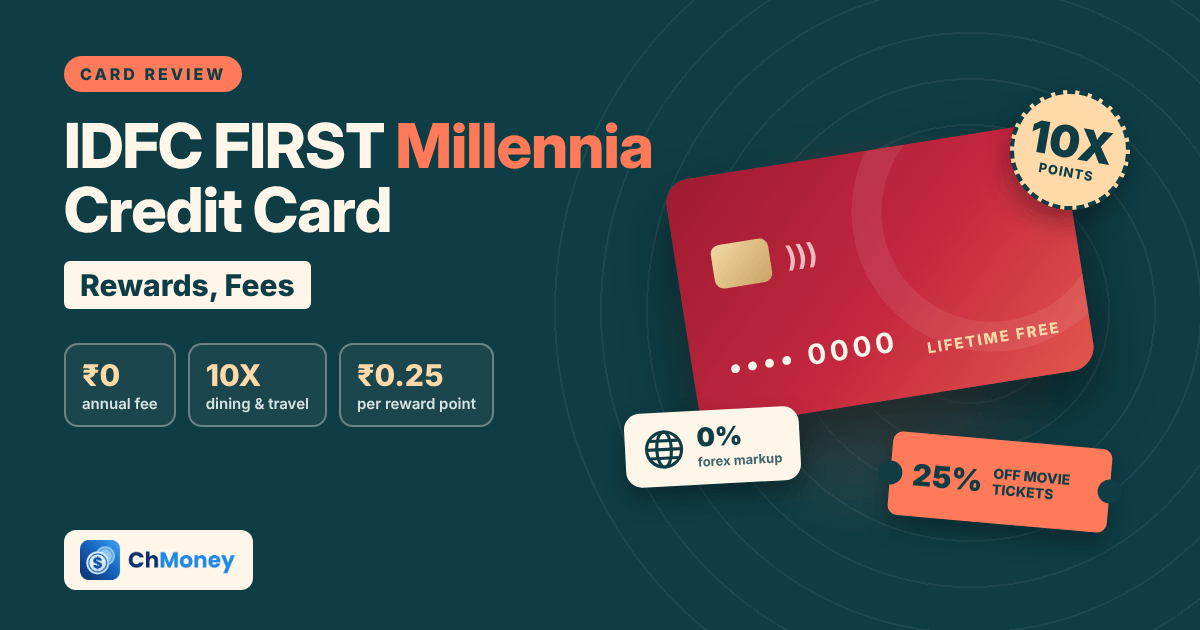
The short answer: the IDFC FIRST Millennia is a lifetime free Indian credit card. It earns 10X points on dining, travel and your birthday (about 1.25% back), 3X on most other spends (about 0.375%) and 1X on bills. Each point is worth ₹0.25. It has zero forex markup, but spends abroad earn no points since October 26, 2026.
IDFC FIRST Millennia at a glance
| IDFC FIRST Millennia | |
|---|---|
| Issuer | IDFC FIRST Bank (India only) |
| Network | Visa |
| Joining and annual fee | Nil, lifetime free |
| Add-on card | ₹499 + GST |
| UPI (RuPay add-on) | ₹199 + GST |
| Welcome benefit | ₹500 voucher on ₹5,000 spend in 30 days, plus 5% cashback (up to ₹1,000) on your first EMI in 30 days |
| 10X points (1.25% back) | Dining, travel, spends on your birthday |
| 3X points (0.375% back) | Most other spends |
| 1X points (0.125% back) | Utilities, insurance, railways, FASTag |
| No points | Fuel, EMI, cash withdrawals, international spends |
| Point value | ₹0.25 |
| Redemption fee | ₹99 + GST each time |
| Points expire | 24 months after you earn them |
| Forex markup | Zero (since September 9, 2026) |
| Lounges | 4 railway lounge visits a quarter, no airport lounges |
| Movie offer | 25% off up to ₹100, once a month, on District by Zomato |
| Interest (APR) | 8.5% to 46.2% a year |
| Income needed | ₹3 lakh a year |
One thing to clear up first. The HDFC Millennia is a different card from a different bank. If you search “Millennia credit card” you’ll see both. Everything here is about the IDFC FIRST one.
What changed on the IDFC Millennia in 2026?
IDFC made five changes to this card in 2026. From June 18, 10X on dining and travel starts from your first rupee, but points only count up to your credit limit each cycle. Points now expire after 24 months. From September 9, forex markup dropped to zero, and from October 26, spends abroad earn no points.
| Before | Now | Effective | |
|---|---|---|---|
| 10X on dining and travel | Only after ₹20,000 spend in a month | From the first eligible transaction | June 18, 2026 |
| Reward cap | No cap | Points only on spends up to your credit limit per billing cycle | June 18, 2026 |
| Point expiry | No expiry | 24 months (old balance valid until July 2028) | July 2026 statement cycle |
| Forex markup | 3.5% + GST | Zero | September 9, 2026 |
| Points on international spends | 10X | None | October 26, 2026 |
The first change is good news. Before June, you had to spend ₹20,000 in a month before dining and travel hit 10X, so a ₹1,500 dinner on the 3rd of the month earned 3X. Now that same dinner earns 10X straight away.
The expiry rule is the one to watch. If you have points from before July 2026, they’re safe until July 2028. Anything you earn from the July 2026 statement onward expires 24 months later. So don’t sit on points for years, which a lot of people did when they never expired.
The forex and international changes came together. IDFC’s September letter applied zero markup to every IDFC credit card and, in the same letter, stopped international points on most of them. Millennia lost them. Only Ashva, Mayura, Gaj, FIRST Private, FIRST WOW!, FIRST WOW! Black and IndiGo still earn abroad.
How do IDFC Millennia reward points work?
You earn points in blocks of ₹200. Dining, travel and spends on your birthday earn 10 points per ₹200. Most other spends earn 3 points per ₹200. Utilities, insurance, railways and FASTag earn 1 point per ₹200. Fuel, EMI, cash withdrawals and international spends earn nothing.
| Where you spend | Points per ₹200 | Value at ₹0.25 a point | Return |
|---|---|---|---|
| Dining and restaurants | 10 | ₹2.50 | 1.25% |
| Travel (flights, hotels, cabs booked as travel) | 10 | ₹2.50 | 1.25% |
| Anything on your birthday | 10 | ₹2.50 | 1.25% |
| Shopping, groceries, online orders, most other spends | 3 | ₹0.75 | 0.375% |
| UPI over ₹2,000 (RuPay add-on) | 3 | ₹0.75 | 0.375% |
| UPI up to ₹2,000 | 1 | ₹0.25 | 0.125% |
| Electricity, phone, insurance, railways, FASTag | 1 | ₹0.25 | 0.125% |
| Fuel, EMI, cash withdrawals, international | 0 | ₹0 | 0% |
Because points come in ₹200 blocks, a ₹199 coffee earns nothing and a ₹390 lunch earns the same as a ₹200 one. Small spends leak a bit.
The birthday 10X is the trick most people use. If you were going to buy a ₹40,000 phone this year anyway, buy it on your birthday. That’s 2,000 points, worth ₹500, instead of 600 points (₹150) on a normal day.
The credit limit cap catches people with a new card and a small limit. Say your limit is ₹50,000 and you spend ₹60,000 in one billing cycle by paying off part of the bill early. The last ₹10,000 earns zero points. If you’re close to your limit every month, ask for a limit increase in the app.
IDFC’s product page doesn’t list rent or education payments in any category. If you plan to pay rent on this card, check the current Schedule of Charges in the IDFC FIRST app first, because many Indian banks now charge a fee on rent through apps.
How much is an IDFC Millennia reward point worth?
One IDFC Millennia point is worth ₹0.25. You redeem points in the IDFC FIRST app against flights, hotels, merchant offers or products. Every redemption costs ₹99 + 18% GST, which is about ₹117, so it makes sense to collect points and redeem them in one go.
| Points | Value at ₹0.25 | After one ₹117 redemption fee |
|---|---|---|
| 1,000 | ₹250 | ₹133 |
| 2,500 | ₹625 | ₹508 |
| 5,000 | ₹1,250 | ₹1,133 |
| 10,000 | ₹2,500 | ₹2,383 |
Look at the first row. Redeem 1,000 points and almost half the value goes to the fee. Wait until you have at least 5,000 points, or redeem once a year.
There’s also a travel section in the app called FIRST Rewards Gallery. IDFC says flights booked there get 10% bonus value and hotels get 20%. If you travel once or twice a year, booking through it is a better use of points than vouchers.
How much can you get back from the IDFC Millennia in a year?
At ₹25,000 a month (₹3 lakh a year), with ₹5,000 on dining, you earn about 6,240 points, worth ₹1,560, or ₹1,443 after one redemption fee. That’s about 0.5% back. Use the movie offer every month and add another ₹1,200. There’s no annual fee to subtract.
Let’s run two real budgets. Both redeem once a year.
Budget 1: ₹25,000 a month (about $285)
| Spend per month | Points per month |
|---|---|
| ₹5,000 dining and restaurants (10X): 5,000 ÷ 200 × 10 | 250 |
| ₹3,000 electricity, phone and insurance (1X): 3,000 ÷ 200 × 1 | 15 |
| ₹17,000 groceries, shopping and online (3X): 17,000 ÷ 200 × 3 | 255 |
| Total | 520 points a month |
| Over a year | Value |
|---|---|
| 520 × 12 = 6,240 points at ₹0.25 | ₹1,560 |
| One redemption fee | –₹117 |
| Movie offer, ₹100 × 12 | ₹1,200 |
| Annual fee | ₹0 |
| Total back | ₹2,643 |
You’d also unlock railway lounges any month you spend ₹20,000 or more.
Budget 2: ₹10,000 a month (about $115)
| Spend per month | Points per month |
|---|---|
| ₹2,000 dining (10X) | 100 |
| ₹8,000 shopping and groceries (3X) | 120 |
| Total | 220 points a month |
| Over a year | Value |
|---|---|
| 220 × 12 = 2,640 points at ₹0.25 | ₹660 |
| One redemption fee | –₹117 |
| Movie offer, ₹100 × 12 | ₹1,200 |
| Total back | ₹1,743 |
See what happened in Budget 2. The movie discount is worth almost twice the points. If you go to the movies once a month, that ₹100 is the best part of this card at low spend.
These numbers are small, and that’s honest. A 0.375% base rate isn’t much. The Millennia makes sense because it costs nothing and has zero forex, not because the points are generous. A paid card like the HDFC Regalia Gold gives back about 3% at ₹6 lakh a year, but loses money if you spend less than ₹4 lakh.
What are the other IDFC Millennia benefits?
Besides points, you get 4 railway lounge visits a quarter (after ₹20,000 monthly spend), 25% off movie tickets up to ₹100 a month, a 1% fuel surcharge waiver up to ₹200 a month, roadside assistance worth ₹1,399, ₹2 lakh accident cover, ₹25,000 lost card cover and interest-free cash withdrawals for 45 days.
| Benefit | How it works |
|---|---|
| Railway lounges | 4 visits a quarter at railway station lounges in India. Spend ₹20,000 in a calendar month to unlock visits in the next month |
| Movie tickets | 25% off up to ₹100, one booking a month, on the District by Zomato app. You need at least one card transaction in the previous month |
| Fuel surcharge waiver | 1% waiver, up to ₹200 a month, on fuel bills between ₹200 and ₹5,000 |
| Roadside assistance | Worth ₹1,399, up to 4 times a year, for a car or two-wheeler |
| Personal accident cover | ₹2 lakh |
| Lost card cover | ₹25,000 |
| Cash withdrawals | No interest for up to 45 days, ₹199 + GST per withdrawal, up to ₹10,000 a transaction |
| Merchant offers | 300+ offers in the app, including discounts at restaurants and wellness outlets |
There are no airport lounges on this card. Some sites list “16 lounge visits a year”, but those are railway lounges only. If you fly a lot and want lounge access, this isn’t the card.
The insurance covers only stay active if you used the card at least once in the last 30 days. Same with the movie offer, which needs a transaction in the previous month. Put a small bill on it every month so nothing lapses.
The cash withdrawal feature is unusual. Most cards charge interest from day one on cash, plus about 2.5%. Here you pay ₹199 + GST (about ₹235) and nothing else if you repay by the due date. Still, use it for emergencies only.
Is the IDFC Millennia good for travel abroad?
Yes, for saving on fees. Since September 9, 2026, IDFC charges zero forex markup, so a $1,000 trip costs about ₹3,634 less than on a card with a 3.5% + GST markup. But since October 26, 2026, international spends earn no points on the Millennia.
Say you spend $1,000 on a trip to New York, about ₹88,000:
| Card | Forex cost | Points back | Net cost |
|---|---|---|---|
| Typical card with 3.5% markup + 18% GST (4.13%) | ₹3,634 | Depends on the card | ₹3,634 before any points |
| HDFC Regalia Gold (2% + GST) | ₹2,077 | About ₹1,100 | About ₹977 |
| IDFC FIRST Millennia | ₹0 | ₹0 | ₹0 |
So the Millennia still wins on a trip, even with no points. You pay the Visa exchange rate and nothing on top.
One rule abroad: if a shop or ATM asks whether you want to pay in rupees, say no and pay in the local currency. That’s called dynamic currency conversion, and the shop sets its own rate, which is usually worse.
What fees and charges should you watch on the IDFC Millennia?
There’s no annual fee, but watch interest (up to 46.2% a year, or 3.85% a month), the late fee (15% of the amount due, ₹100 to ₹1,300 per Paisabazaar), ₹199 + GST per cash withdrawal, ₹99 + GST per point redemption and ₹499 + GST for each add-on card.
| Charge | Amount |
|---|---|
| Joining and annual fee | Nil |
| Interest on unpaid balance | 8.5% to 46.2% a year (0.71% to 3.85% a month), set per cardholder |
| Late payment fee | 15% of total amount due, minimum ₹100, maximum ₹1,300 (Paisabazaar; check IDFC’s Schedule of Charges) |
| Cash withdrawal | ₹199 + GST per transaction |
| Reward redemption | ₹99 + GST per redemption |
| Add-on card | ₹499 + GST |
| UPI RuPay add-on | ₹199 + GST |
| Forex markup | Zero |
The interest range is wide because IDFC prices it per person. Most first-time cardholders won’t get 8.5%. CardAdvisor works it out: carry ₹30,000 for one month and you pay ₹213 at the lowest rate or ₹1,155 at the highest. ₹1,155 is more than Budget 2 earns in points all year. Pay the full bill every month. Our guide on when to pay your credit card to avoid interest explains how the grace period works.
Who is eligible for the IDFC Millennia, and can NRIs get it?
IDFC asks for an annual income of ₹3 lakh or more (about $3,400). Review sites list an age range of 21 to 65. You’ll need a PAN, Aadhaar or another address proof and income proof. NRIs living abroad will find it hard, because the card is built for Indian income and a CIBIL history.
| Requirement | |
|---|---|
| Income | ₹3 lakh a year or more (IDFC) |
| Age | 21 to 65 (review sites; IDFC’s page doesn’t say) |
| Residency | Indian resident |
| Credit score | IDFC doesn’t publish one. A CIBIL score of 750+ gives you the best chance |
| Documents | PAN, Aadhaar or passport, salary slips or ITR |
₹3 lakh a year is ₹25,000 a month. That’s a low bar, which is why a lot of people get the Millennia as their first card. If you’re comparing first cards, our best first credit card guide covers how to pick one.
If you live in the US, your FICO score and US card history don’t carry over. Indian banks check CIBIL, and CIBIL won’t have a record of your US cards. NRIs usually get Indian credit cards against a fixed deposit in an NRE or NRO account. IDFC’s FD-backed card is the FIRST WOW!, which also has zero forex and still earns points abroad. Ask IDFC directly whether they’ll issue it against your NRE or NRO deposit before you apply.
How do you apply for the IDFC FIRST Millennia?
Apply on IDFC FIRST Bank’s website or app. Enter your mobile number and PAN, fill in your income details, and finish video KYC. Spend ₹5,000 within 30 days to claim the ₹500 welcome voucher.
- Check your CIBIL score. A score above 750 helps. Fix any old overdue payments first.
- Check for a pre-approved offer. If you bank with IDFC FIRST, open the app. You might see a ready offer with no paperwork.
- Apply online. Go to the Millennia page on idfcfirst.bank.in, enter your mobile number and PAN, and fill in your income.
- Upload documents. PAN, Aadhaar, and salary slips or ITR if asked.
- Finish video KYC. IDFC usually asks for this on new customers.
- Spend ₹5,000 in 30 days. That gets you the ₹500 voucher. Don’t count UPI, add-on card, wallet or EMI spends, because they don’t qualify.
- Put your first EMI on it within 30 days if you have a big purchase coming. You get 5% cashback, up to ₹1,000 (gold and jewellery EMIs excluded).
- Add the RuPay UPI card only if you’ll use it. It costs ₹199 + GST.
Is the IDFC FIRST Millennia worth it?
Yes, if you want a free card with no forex markup and you eat out or travel within India often. It’s a good first card. It’s a weak choice if you want high rewards, airport lounges or points on spends abroad, because its base rate is only 0.375%.
Get it if:
- You want a lifetime free card and don’t want to track fee waivers
- This is your first credit card and your income is around ₹3 lakh to ₹6 lakh a year
- You travel abroad and want zero forex markup
- You spend a lot on restaurants and domestic travel, which earn 10X
- You go to the movies once a month and will use the ₹100 discount
Skip it if:
- You spend ₹50,000+ a month and can clear the milestones on a paid card
- You want airport lounge access
- You want points on spends abroad (look at the FIRST WOW! or Mayura instead)
- You’d redeem small amounts often, since the ₹117 fee eats the value
- You carry a balance, because 46% interest beats any reward
The Millennia was already a decent free card. After 2026, it’s a better travel card (zero forex) and a slightly worse rewards card (no points abroad, a credit limit cap and expiry). For most people with a modest income, it’s still a sensible card to keep in the wallet.
Already have the Millennia? Tell us in the comments how you use the birthday 10X, and share this with that friend who still thinks they pay 3.5% abroad on it. If you have a question about your own spending, send it through our Contact Us page.
Frequently asked questions
Is the IDFC FIRST Millennia credit card lifetime free?
Yes. It has no joining fee and no annual fee. You only pay for extras such as an add-on card (₹499 + GST), the RuPay UPI card (₹199 + GST) and point redemptions (₹99 + GST each).
What is the value of 1 IDFC Millennia reward point?
One point is worth ₹0.25. Each redemption costs ₹99 + GST, about ₹117, so redeem in larger batches. 5,000 points give you ₹1,250 before the fee.
How many reward points does the IDFC Millennia give?
It gives 10 points per ₹200 on dining, travel and birthday spends, 3 points per ₹200 on most other spends, and 1 point per ₹200 on utilities, insurance, railways and FASTag. Fuel, EMI, cash and international spends earn nothing.
Does the IDFC Millennia have a forex markup?
No. IDFC removed the forex markup on all its credit cards from September 9, 2026. But from October 26, 2026, international spends on the Millennia earn no reward points.
Does the IDFC Millennia give airport lounge access?
No. It gives 4 railway lounge visits a quarter, and you unlock them by spending ₹20,000 in a calendar month, which opens visits for the next month. There’s no airport lounge benefit.
Do IDFC Millennia reward points expire?
Yes, now they do. Points earned from the July 2026 statement cycle expire after 24 months. Points you had before that stay valid until July 2028.
What income do you need for the IDFC Millennia?
IDFC asks for an annual income of ₹3 lakh or more. Review sites list an age range of 21 to 65. A CIBIL score above 750 improves your chances.
Is the IDFC Millennia the same as the HDFC Millennia?
No. They’re different cards from different banks. The IDFC FIRST Millennia is lifetime free with points. The HDFC Millennia is a cashback card with an annual fee.