
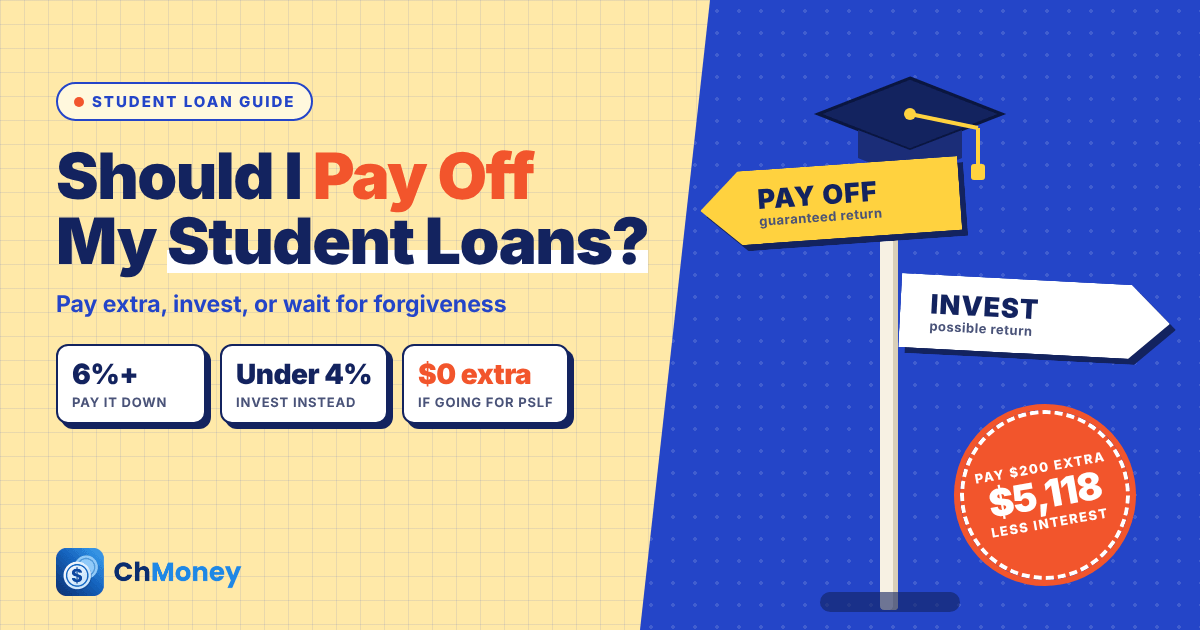
Pay off your student loans early if the rate is above about 6%, the loans are private, and you are not on track for any forgiveness. Invest instead if your rate is under about 4%, you’re chasing PSLF, or you’re skipping a 401(k) match to make extra payments. Between 4% and 6% it’s close, so splitting the extra money is a fair call.
We all know that one friend who throws every spare dollar at their student loans and talks about the day they’ll be “debt free” like it’s a holiday. And we all know the other friend who pays the minimum, puts everything in the stock market, and says the loans are “cheap money.” Both of them think the other one is doing it wrong.
The truth is that both can be right. It depends on your interest rate, the kind of loans you have, and whether forgiveness is on the table for you. And a lot changed in 2025 and 2026, so advice you read a couple of years ago might be wrong now. SAVE is gone, there’s a new plan called RAP, and forgiveness under income-driven plans got taxable again on January 1, 2026.
This guide walks you through it with real numbers so you can make the call for your own loans.
Should you pay off student loans early or invest?
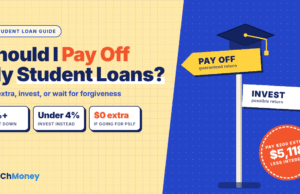
Pay extra on your student loans when the rate beats what you’d safely earn elsewhere. At today’s 6.52% undergrad rate, paying $200 extra a month on $30,000 saves $5,118 in interest. Investing that $200 at 7% instead comes out only about $1,100 ahead after 10 years, and that 7% isn’t guaranteed.
Paying down a loan gives you a guaranteed return equal to its interest rate. Investing gives you a possible return that swings year to year. The S&P 500 dropped about 25% in 2022 and 9.1% by March 2026 before recovering. Your student loan never has a bad year for you; 6.52% saved is 6.52% saved.
Here’s a simple rule of thumb that works for most people:
- Rate under 4%: invest the extra money. Older loans from 2020 to 2022 (2.75% and 3.73%) fall here.
- Rate 4% to 6%: it’s close. Split the extra money, or pick whichever helps you sleep at night.
- Rate over 6%: pay the loan down. That covers every new federal loan made since July 2024 and most private loans.
Two big exceptions sit on top of that rule. If you can get a 401(k) match, take the match first, since a 50% or 100% instant return beats any loan. And if you’re going for Public Service Loan Forgiveness, don’t prepay at all. More on both below.
What are student loan interest rates right now?
Federal Direct Loans first disbursed from July 1, 2026 to June 30, 2027 carry fixed rates of 6.52% for undergrads, 8.07% for graduate unsubsidized loans and 9.07% for PLUS loans. Your rate is locked from the year each loan was paid out, so older loans may be much lower.
| Loan type | 2026-27 rate | 2025-26 rate |
|---|---|---|
| Undergraduate Direct (subsidized and unsubsidized) | 6.52% | 6.39% |
| Graduate or professional Direct unsubsidized | 8.07% | 7.94% |
| Direct PLUS (parent and grad) | 9.07% | 8.94% |
The government sets these each year from the May auction of the 10-year Treasury note. The May 12, 2026 auction came in at 4.468%, and the undergrad rate is that number plus 2.05 points.
If you graduated a few years back, check your actual rates on studentaid.gov or your servicer’s site before you decide anything. Undergrad loans from 2020-21 sit at 2.75%, and 2021-22 loans at 3.73%. Those are cheaper than what a high-yield savings account pays today, so there’s no rush to pay them off.
Private student loans are different. Rates depend on your credit and can be variable, which means your payment can climb. A variable private loan at 12% is the first loan you should go after.
Should you pay off student loans if you could get forgiveness?
No. If you work for a government agency or nonprofit and plan to stay 10 years, Public Service Loan Forgiveness wipes out what’s left after 120 qualifying payments, tax-free. Every extra dollar you pay just lowers the amount that would have been forgiven anyway.
Here’s what that looks like. Say you’re a public school teacher with $60,000 in federal loans and an adjusted gross income of $48,000. On the new RAP plan, you’d pay 4% of your AGI, which is $1,920 a year or $160 a month.
Your monthly interest at 6.52% is about $326. Under RAP, the government waives the interest your payment doesn’t cover and also knocks up to $50 a month off your principal. So your balance drifts down slowly instead of ballooning.
After 120 payments at $160, you’d have paid about $19,200. With raises your payment goes up a bit, but you’d still likely see $40,000 or more forgiven. If you’d thrown an extra $300 a month at those loans, you would have paid about $36,000 more and had less forgiven. That money is just gone.
So before you make any extra payment, ask yourself two questions:
- Do I work full-time for a government employer or a 501(c)(3) nonprofit, and will I stay in public service for 10 years total? If yes, enroll in an income-driven plan, file the PSLF form, and pay the minimum.
- Is my balance bigger than my yearly salary, and am I on an income-driven plan for 20 or more years? If yes, forgiveness may still beat prepaying, but read the tax section first.
Is student loan forgiveness taxable in 2026?
Yes, for most forgiveness under income-driven plans. The federal tax break from the American Rescue Plan ended on December 31, 2025, so forgiveness under IBR, ICR, PAYE or RAP in 2026 or later counts as income. PSLF forgiveness stays tax-free, and so does discharge for death or disability.
This is the “tax bomb” people talk about, and it’s back. If you have $45,000 forgiven after 20 years on IBR and you’re in the 22% bracket, you could owe about $9,900 in federal tax that year, plus state tax in some states.
Some of that can be softened. If your debts are bigger than your assets on the day of forgiveness, you can claim insolvency on IRS Form 982 and exclude part or all of it. But plenty of people won’t qualify.
If you’re on a 20 or 25 year path, a smart move is to put a little money into a savings or brokerage account every month as a tax fund. Even $40 a month at 4% grows to about $14,700 in 20 years, which would cover that $9,900 bill with room to spare.
What happened to SAVE, and what is the new RAP plan?
The SAVE plan ended after a court order in March 2026, and borrowers are being moved off it. The One Big Beautiful Bill Act, signed July 4, 2025, created the Repayment Assistance Plan (RAP), which opened July 1, 2026. It charges 1% to 10% of your AGI, with a $10 monthly minimum.
Here’s how RAP works:
- Payment: a percentage of your AGI based on your income band. AGI of $10,000 or less pays $10 a month. Between $10,001 and $20,000 you pay 1%, between $20,001 and $30,000 you pay 2%, and so on, up to 10% for AGI over $100,000.
- Dependents: your payment drops $50 a month for each dependent.
- Interest: any interest your payment doesn’t cover is waived, so your balance doesn’t grow.
- Principal help: if your payment knocks less than $50 off principal, the government adds a match so your principal drops by up to $50.
- Forgiveness: whatever is left after 30 years of payments. That forgiveness is taxable.
- PSLF: RAP payments count toward PSLF.
A single person with no kids and a $55,000 AGI pays 5%, which is $2,750 a year or about $229 a month. Compare that to the $341 standard 10-year payment on $30,000.
Other changes from the same law:
| Change | What it means for you |
|---|---|
| New loans from July 1, 2026 get two plans only | RAP or Tiered Standard (fixed payments over 10 to 25 years based on how much you owe) |
| ICR and PAYE close by July 1, 2028 | If you’re on one, you’ll need to move to RAP or IBR |
| Grad PLUS closed to new borrowers | Grad students now borrow up to $20,500 a year ($100,000 total), professional students $50,000 a year ($200,000 total) |
| SAVE borrowers moved | Servicers send notices with at least 90 days to pick a plan; miss it and you’re placed in Standard or Tiered Standard |
If you were on SAVE and haven’t picked a new plan, do that before you think about prepaying. Your payment might jump, and you want to know your new number first.
How much do you save by paying extra on your student loans?
On a $30,000 federal loan at 6.52% over 10 years, the standard payment is $340.95 and you’d pay $10,914 in interest. Adding $200 a month pays it off in 67 months, almost 4.5 years early, and cuts interest to $5,796, a saving of $5,118.
Here’s the same $30,000 at different rates, with $200 extra each month:
| Rate | Standard payment | Total interest, 10 years | Paid off with +$200 | Interest with +$200 | You save |
|---|---|---|---|---|---|
| 2.75% (2020-21 loan) | $286.23 | $4,348 | 67 months | $2,382 | $1,966 |
| 6.52% (2026-27 undergrad) | $340.95 | $10,914 | 67 months | $5,796 | $5,118 |
| 8.07% (2026-27 grad) | $365.09 | $13,811 | 66 months | $7,236 | $6,576 |
| 9.07% (2026-27 PLUS) | $381.16 | $15,740 | 66 months | $8,172 | $7,568 |
| 12% (private loan) | $430.41 | $21,650 | 65 months | $10,930 | $10,719 |
A lump sum works too. Put a $10,000 bonus or inheritance on that 6.52% loan and keep paying $340.95, and you’re done in 71 months with $6,766 less interest.
Is it better to pay off student loans or invest the money?
It depends on your rate. If you send $540.95 a month for 10 years either way, investing the extra $200 at 7% beats paying off a 6.52% loan by only about $1,100. At 2.75% investing wins by $4,500. At 8.07% or higher, paying the loan off first wins.
To compare fairly, both plans below spend the exact same $540.95 every month for 10 years on a $30,000 loan:
- Plan A, pay first: pay $540.95 a month on the loan until it’s gone, then invest the full $540.95 for the rest of the 10 years.
- Plan B, invest now: pay the $340.95 minimum for 10 years and invest $200 a month from day one.
Balance after 10 years, assuming 7% average yearly returns:
| Loan rate | Plan A (pay first, then invest) | Plan B (invest now) | Winner |
|---|---|---|---|
| 2.75% | $30,096 | $34,617 | Invest, by $4,521 |
| 6.52% | $33,483 | $34,617 | Invest, by $1,134 |
| 8.07% | $35,747 | $34,617 | Pay first, by $1,130 |
| 9.07% | $36,763 | $34,617 | Pay first, by $2,146 |
| 12% | $40,742 | $34,617 | Pay first, by $6,125 |
Two things to keep in mind with this table. First, 7% is an average, not a promise. A bad stretch in years 8 to 10 could flip the 6.52% result. Second, this ignores taxes. Inside a Roth IRA or 401(k) the investing side keeps all its growth, but in a regular brokerage account you’d owe some tax, which shrinks Plan B’s edge.
So at today’s undergrad rate, you’re getting paid about $9 a month on average to take market risk. Plenty of people decide that isn’t worth it, and that’s a fine choice. If you want to go the investing route, our guide on how to invest in the S&P 500 shows the cheap funds and how to place your first order.
Should you pay off student loans or keep money in a high-yield savings account?
Keep your emergency fund in savings, then send extra money to the loan. A 4.40% APY high-yield account earns about 3.43% after 22% federal tax. That loses to any loan above about 3.5%, so paying a 6.52% loan beats parking extra cash in savings.
Here’s the math on $10,000 for one year:
- In a high-yield savings account at 4.40% APY: $440 interest, about $343 after 22% federal tax.
- On a 6.52% student loan: about $652 in interest you no longer pay.
That’s a $309 difference in the loan’s favor. But don’t drain your savings to get it. If your car dies or you lose your job, you can’t get that money back out of your loan. Three months of expenses in savings first, then extra loan payments.
The math flips for old low-rate loans. A 2.75% loan costs you less than the 3.43% you’d keep from savings, so holding cash there and paying the minimum is the better move. Our explainer on how a high-yield savings account works covers where to find the top rates.
Does the student loan interest deduction change the math?
A little. You can deduct up to $2,500 of student loan interest a year, even without itemizing. In the 22% bracket, that makes a 6.52% loan cost you about 5.09%. The deduction phases out between $85,000 and $100,000 of income for single filers in 2026.
Year-one interest on a $30,000 loan at 6.52% is about $1,956, so most of it fits under the $2,500 cap. As you pay down the loan, the interest and the deduction both shrink.
For 2026, the deduction phases out at $85,000 to $100,000 of modified AGI if you’re single and $175,000 to $205,000 if you’re married filing jointly. Married filing separately gets nothing. Your servicer sends Form 1098-E each January with the interest you paid.
The deduction is a reason to feel a bit less rushed, not a reason to keep a loan. You still pay $1 of interest to save 22 cents of tax.
What should you pay before your student loans?
Pay in this order: minimums on everything, your 401(k) match, a starter emergency fund, credit card debt, private loans, then extra on federal student loans above about 6%. Below 4%, put extra money into retirement or savings instead.
- Make every minimum payment. Missing payments on federal loans can land you in default after 270 days. As of Q2 2026, 10.6% of student loan balances were 90 or more days late, according to the New York Fed.
- Get your full 401(k) match. If your employer matches 50% of the first 6% of pay, that’s an instant 50% return. Our 401(k) vs Roth 401(k) guide helps you pick the account type.
- Save one month of expenses. This is your starter emergency fund.
- Pay off credit cards. The average card charges 21.19% (Fed, Q3 2026). That’s more than triple your student loan rate.
- Pay down private student loans, especially variable-rate ones. They have no RAP, no PSLF, and fewer hardship options.
- Build your emergency fund to three to six months.
- Pay extra on federal loans above about 6%, starting with the highest rate (grad and PLUS loans first).
- Max out retirement accounts and invest, if your remaining loans are under about 4%.
Should you pay off private student loans first?
Yes, in most cases. Private loans usually charge more, many have variable rates that can rise, and they don’t qualify for RAP, PSLF or income-based payments. If you lose your job, a federal loan can drop to $10 a month; a private loan usually can’t.
Say you have $15,000 in private loans at 11% and $25,000 in federal loans at 6.52%. Every extra dollar should go to the private loan first. You save more interest, and you get rid of the debt with the fewest safety nets.
One thing to check: some private loans were cosigned by a parent. Paying those off first also frees your cosigner, which matters if they’re trying to retire or buy a home.
How do you make extra student loan payments the right way?
Pay extra through your servicer’s site and tell it to apply the extra to principal on your highest-rate loan. Also ask it not to advance your due date. Neither federal nor private student loans charge a penalty for paying early.
- Log in to your servicer’s site (MOHELA, Nelnet, Aidvantage, EdFinancial or CRI for federal loans).
- List your loans by rate. Most people have several loans, one per school year.
- Turn on autopay. Federal servicers take 0.25 points off your rate for it.
- Make the extra payment separately and choose “apply to principal” on the highest-rate loan. Without instructions, servicers often spread it across every loan or treat it as next month’s payment.
- Uncheck “advance due date” or call and ask. If you don’t, your servicer may put you in “paid ahead” status, and the extra money just covers future bills instead of cutting principal.
- Check the next statement to make sure the principal on the right loan went down.
If you’re paid biweekly, splitting your payment in half every two weeks gives you 26 half-payments, which is 13 full payments a year. That’s one extra payment without feeling it much.
Should you refinance to pay off student loans faster?
Only refinance federal loans if you’re sure you’ll never need RAP, PSLF, payment pauses or disability discharge. Refinancing turns them into a private loan and you lose all of those for good. Refinancing private loans to a lower rate has no such downside.
A lower rate can help. Refinancing $30,000 from 9.07% to 6.52% over 10 years drops your total interest from $15,740 to $10,914. But a stable job today doesn’t promise one in five years, and once a federal loan is refinanced, you can’t switch back.
Good candidates for refinancing are people with private loans, high and steady income, a good credit score, and no plans to work in public service.
So, should you pay off your student loans?
Here’s the quick version:
- Going for PSLF? Pay the minimum on RAP or IBR. Don’t prepay.
- Rate above 6% and no forgiveness plan? Pay extra after your match and emergency fund.
- Rate under 4%? Pay the minimum and invest or save the difference.
- Private loans? Pay them first.
- Want the peace of mind? Paying off a 6.52% loan is a 6.52% guaranteed return, and that’s a perfectly good reason.
Look up your exact rates, run your own numbers with the tables above, and pick a plan you’ll actually stick with for the next few years. If you have a question about your situation, send us a message on the Contact Us page.
Frequently asked questions
Is it smart to pay off student loans early?
It’s smart if your rate is above about 6%, you’ve taken your 401(k) match, you have an emergency fund, and you’re not going for forgiveness. Paying $200 extra on a $30,000 loan at 6.52% saves $5,118 and clears it about 4.5 years early.
Is there a penalty for paying off student loans early?
No. Federal law bans prepayment penalties on both federal and private student loans. You can pay any extra amount at any time. Just tell your servicer to apply it to principal so it doesn’t count as an early monthly payment.
Should I pay off my student loans or invest?
Compare your loan rate to a safe return. Under 4%, invest. Over 6%, pay the loan. In between it’s close: at 6.52%, investing $200 a month at 7% beats paying extra by only about $1,100 over 10 years, with market risk.
Should I use my savings to pay off student loans?
Only the part above your emergency fund. Keep three to six months of expenses in savings. Money beyond that does better on a loan above about 3.5%, since a 4.40% savings account earns about 3.43% after 22% tax.
Should I pay off student loans if I’m going for PSLF?
No. PSLF forgives your remaining federal balance tax-free after 120 qualifying payments while working for a government or nonprofit employer. Paying extra only lowers the amount that gets forgiven. Pay the minimum on an income-driven plan like RAP or IBR.
Is student loan forgiveness taxable in 2026?
Forgiveness under income-driven plans is federally taxable again starting January 1, 2026, because the American Rescue Plan exclusion expired. PSLF forgiveness and discharges for death or total and permanent disability stay tax-free.
Does paying off student loans hurt your credit score?
It can dip a few points right after payoff, because a closed installment loan no longer shows active payments. The drop is usually small and temporary. Your years of on-time payments stay on your report.
Should I pay off student loans before buying a house?
Not always. Lenders look at your monthly debt payments compared to income, not your total balance. Lowering a high payment can help you qualify, but draining your down payment to do it usually doesn’t. Keep enough for the down payment and closing costs.