
Yes, a mortgage is debt. It is a secured installment loan, so it shows up on your credit report, lenders count the monthly payment in your debt-to-income ratio, and the balance counts against your net worth. It’s usually called “good debt” because it has a lower rate than most loans and it’s tied to a home that can gain value. That label only holds if the payment fits your income.
We all know that one person who says “I’m debt free” and then mentions their mortgage payment five minutes later. Or the friend who says the house doesn’t count because “everybody has a mortgage.” It’s a fair thing to wonder about. You owe a bank a few hundred thousand dollars, but you also own a house that’s worth something, so is it really debt the same way a credit card is?
The answer changes a little depending on who is asking. A mortgage lender, a credit bureau, your financial planner and your tax return all look at your mortgage in a different way. This guide goes through each one with real numbers so you know exactly where you stand.
Is a mortgage considered debt?
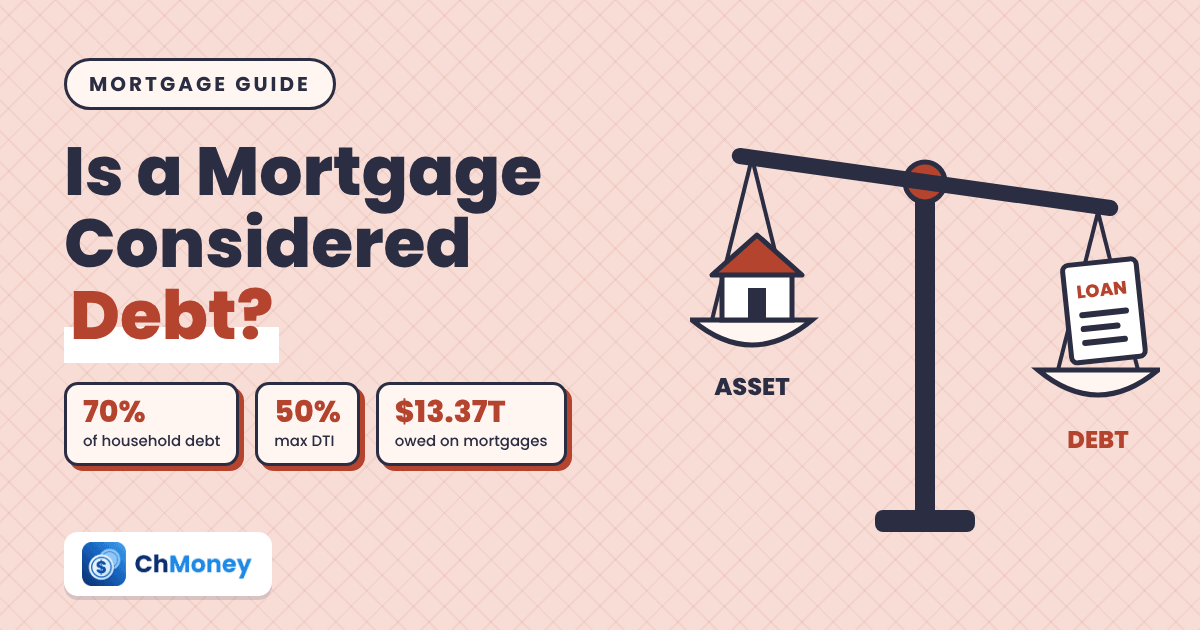
Yes. A mortgage is a loan you have to pay back with interest, which makes it debt in every legal and financial sense. It is a secured installment debt, meaning your home backs the loan and you pay a fixed amount each month. Lenders, credit bureaus and net worth statements all treat it as a liability.
Here’s what makes it debt:
- You borrowed money and you owe it back, usually over 15 or 30 years.
- You pay interest on it. At today’s 7.11% average rate, a $300,000 loan costs about $426,500 in interest over 30 years if you never pay extra.
- If you stop paying, the lender can foreclose and take the house.
- It’s reported to Equifax, Experian and TransUnion every month.
The reason people get confused is the house. A credit card balance from last year’s vacation has nothing behind it. A mortgage has a home behind it, and that home is an asset. So you have a big debt and a big asset at the same time. Both are real.
How is a mortgage different from other debt?
A mortgage differs from credit cards and personal loans in four ways: it’s secured by your home, it carries a lower rate, it runs for 15 to 30 years, and its interest can be tax deductible. Credit card debt is unsecured, revolving and costs about three times as much in interest.
| Mortgage | Credit card | Auto loan | Federal student loan | |
|---|---|---|---|---|
| Type | Secured installment | Unsecured revolving | Secured installment | Unsecured installment |
| Typical rate (late 2026) | 7.11% (30-year fixed) | 21.19% average, 22.36% on balances charged interest | Varies by credit | 6.52% (new undergrad loans) |
| Term | 15 or 30 years | No end date | 3 to 7 years | 10 years standard |
| What backs it | Your home | Nothing | Your car | Nothing |
| Asset value over time | Can go up | None | Goes down | None |
| Interest tax deductible | Yes, if you itemize | No | No (limited exception from 2025 for new US-built cars) | Up to $2,500 a year |
| Counts in credit utilization | No | Yes | No | No |
So a mortgage is debt, but it behaves differently. That’s why lenders and credit scoring models treat it differently, which the next few sections cover.
Does a mortgage count in your debt-to-income ratio?
Yes. Your monthly mortgage payment, including property tax, homeowners insurance, mortgage insurance and HOA dues, is the biggest number in most people’s debt-to-income ratio. Fannie Mae allows up to 50% total DTI for loans run through its automated system, and 36% to 45% for loans a person underwrites by hand.
The CFPB defines your debt-to-income ratio (DTI) as “all your monthly debt payments divided by your gross monthly income.” Gross means before taxes come out.
Lenders look at two versions:
- Front-end DTI: only your housing payment divided by your income.
- Back-end DTI: your housing payment plus every other monthly debt payment, divided by your income. When people say “DTI” they usually mean this one.
Fannie Mae’s Selling Guide says the housing payment it counts is “PITIA.” That’s principal, interest, property taxes, insurance (homeowners, flood and mortgage insurance) and association dues. So it’s a lot more than the loan payment your bank quotes you.
Here are the common limits by loan type:
| Loan type | Front-end (housing only) | Back-end (all debts) | Source |
|---|---|---|---|
| Conventional, automated (Fannie Mae Desktop Underwriter) | No set limit | Up to 50% | Fannie Mae B3-6-02 |
| Conventional, manually underwritten | No set limit | 36%, up to 45% with stronger credit score and cash reserves | Fannie Mae B3-6-02 |
| FHA | 31% | 43% (higher with compensating factors) | HUD benchmark |
| VA | No set limit | 41%, plus a residual income test | VA benchmark |
If you already own a home and you’re applying for a second mortgage, a car loan or a credit card, your current mortgage payment goes into the DTI for that new loan too.
How do you calculate DTI with a mortgage?
Add your full monthly housing payment to all your other monthly debt payments, then divide by your gross monthly income. For example, $3,318 in monthly debts on $8,000 of income gives a 41.5% DTI. That passes Fannie Mae’s 50% automated limit but misses the 36% manual limit.
Let’s run a real example. Say you earn $96,000 a year, which is $8,000 a month before taxes. You want to buy a home with a $300,000 mortgage at 7.11%.
- Work out the loan payment. $300,000 at 7.11% for 30 years is $2,018 a month in principal and interest.
- Add taxes, insurance and HOA. Say property tax is $375 a month and homeowners insurance is $150. No HOA, and you put 20% down so there’s no PMI. Your housing payment is $2,543.
- Find your front-end DTI. $2,543 ÷ $8,000 = 31.8%.
- List your other debts. Car loan $450 (14 payments left), student loan $250, credit card minimum $75. That’s $775.
- Find your back-end DTI. ($2,543 + $775) ÷ $8,000 = $3,318 ÷ $8,000 = 41.5%.
What that 41.5% means:
- Fannie Mae’s automated system can approve it, since it’s under 50%.
- A manually underwritten conventional loan wouldn’t, since it’s over 36% and you’d need a good score and reserves to go up to 45%.
- An FHA loan would need compensating factors, since 31.8% is just over the 31% housing benchmark.
Now here’s a trick most guides skip. Fannie Mae’s guide says installment debts like car loans and student loans only count “if there are more than ten monthly payments remaining.” If you pay that car loan down to 10 payments or fewer before you apply, the lender can leave the $450 out (unless it would still strain your budget).
Your new back-end DTI: ($2,543 + $325) ÷ $8,000 = 35.9%. That’s under 36%, so you’d now qualify even under the strict manual limit. Ask your loan officer before you do this, because a lender can still count a short-term debt if the payment is large.
What debts don’t count toward DTI?
Lenders count only debts that show up on your credit report or in your loan file: housing, car loans, student loans, credit card minimums, personal loans, child support and alimony. Rent, utilities, phone bills, insurance, groceries and installment loans with 10 or fewer payments left are usually left out.
Things that usually do count:
- Your new mortgage payment (PITIA)
- Other mortgages, like a rental property or second home (rental income can offset it; a net rental loss gets added)
- HELOC and home equity loan payments
- Car loans and leases (leases count no matter how few payments are left)
- Student loans, even in deferment
- Credit card minimum payments
- Personal loans, buy now pay later plans that report to credit, timeshares
- Child support and alimony you pay
Things that usually don’t count:
- Your current rent, because the new mortgage payment replaces it
- Utilities, phone, internet and streaming
- Car insurance, health insurance and life insurance premiums
- Groceries, gas and childcare
- Installment loans with 10 or fewer payments left
Two rules from Fannie Mae’s guide catch people off guard:
- Credit cards with no minimum on the report: the lender uses 5% of the balance. A $3,000 balance becomes a $150 monthly debt, even if your actual minimum is $35.
- Student loans in deferment or forbearance: the lender uses 1% of the balance or a fully amortized payment. A $40,000 deferred loan counts as $400 a month, even though you’re paying $0 right now. If you’re on an income-driven plan with a documented $0 payment, the lender can use $0.
If student loans are pushing your DTI too high, our guide on whether you should pay off your student loans runs the numbers on paying them down versus saving for a down payment.
Does a mortgage hurt your credit score?
A mortgage usually helps your credit score over time. It adds an installment loan to your credit mix, and every on-time payment builds your payment history. The balance doesn’t count toward credit utilization the way card balances do. Your score can dip a few points right after closing because of the hard inquiry and the new account.
Here’s what happens to your score at each stage:
- When you apply: the lender pulls your credit, which is a hard inquiry. FICO counts multiple mortgage inquiries within a short window (14 to 45 days, depending on the score version) as one, so you can shop rates without stacking up dings. Keep your rate shopping inside two weeks to be safe.
- Right after closing: a brand new account lowers the average age of your accounts, and the large new balance shows up. Expect a small drop for a few months.
- Over the years: on-time payments make up the largest share of a FICO score (35%). Twelve months of on-time mortgage payments is one of the strongest things you can have on your report.
- When you pay it off: the account closes in good standing and stays on your report for up to 10 years. Some people see a small dip because they no longer have an open installment loan.
The danger is a late payment. A mortgage payment 30 or more days late gets reported, and a foreclosure stays on your credit report for 7 years. That’s why a mortgage you can’t comfortably afford hurts your credit more than almost any other debt.
One thing worth knowing: a big mortgage balance does not hurt your score the way a maxed-out credit card does. Credit utilization, which is a big part of the “amounts owed” category, looks mainly at revolving accounts like credit cards, not at installment loans like your mortgage. So a $400,000 mortgage won’t drag your score down just because the number is large.
Is a mortgage counted in your net worth?
Yes. Your mortgage balance is a liability that you subtract from your assets. Your home’s market value is the asset. The difference, your home equity, is what actually adds to your net worth. A $400,000 home with a $300,000 mortgage adds $100,000.
Net worth is simple math: everything you own minus everything you owe. The mortgage goes on the “owe” side, and the house goes on the “own” side.
Here’s a sample household:
| Assets | Value | Liabilities | Balance |
|---|---|---|---|
| Home (current market value) | $400,000 | Mortgage | $300,000 |
| Savings | $25,000 | Car loan | $12,000 |
| 401(k) | $40,000 | Student loans | $20,000 |
| Car | $18,000 | Credit card | $1,500 |
| Total assets | $483,000 | Total liabilities | $333,500 |
Net worth: $483,000 − $333,500 = $149,500.
Notice that $100,000 of that net worth is home equity. You can’t spend it without selling, borrowing against it or downsizing, but it’s real.
The Federal Reserve’s 2025 Survey of Consumer Finances, released October 9, 2026, shows how much this adds up. The median homeowner had a net worth of $458,900. The median renter had $10,600. Part of that gap is age and income (homeowners in the survey earned a median $108,900 versus $50,300 for renters), so buying a house won’t magically give you $448,000. But paying down a mortgage every month works like forced savings, and most renters don’t have anything that does that for them.
Two cautions. Use a realistic home value, like a recent appraisal or nearby sales, not the high estimate from a home value website. And if your home is worth less than you owe, you’re “underwater,” and the house is pulling your net worth down, not up.
Is a mortgage good debt or bad debt?
A mortgage is usually considered good debt because it has a lower rate than most loans, it pays for an asset that can gain value, and it can cut your taxes. It turns into bad debt when the payment is more than you can handle, when you owe more than the home is worth, or when you borrow against the house to pay for spending.
“Good debt” usually means debt that helps you build wealth or earn more over time. “Bad debt” pays for things that lose value or get used up, at a high rate. Here’s how common debts compare right now:
| Debt | Typical rate (late 2026) | What you get | Usual label |
|---|---|---|---|
| Mortgage | 7.11% | A home that can gain value | Good |
| Federal student loan | 6.52% (undergrad) | A degree that can raise income | Usually good |
| Auto loan | Varies | A car that loses value every year | Neutral to bad |
| Credit card carried month to month | 21.19% to 22.36% | Whatever you bought | Bad |
| Payday loan | Often 300%+ APR | Short-term cash | Bad |
Some pages say a mortgage is “always” good debt. It isn’t. Here’s when it goes wrong:
- You’re house-poor. If your housing payment eats 40% of your gross pay, you have little left for savings, repairs or emergencies. A new roof or a dead furnace doesn’t wait for a good month.
- You’re underwater. Home prices fell about 27% nationally from 2006 to 2012 (S&P CoreLogic Case-Shiller National Index), and millions of owners owed more than their homes were worth. You can’t sell or refinance easily in that spot.
- Your rate resets. An adjustable-rate mortgage can jump after the fixed period ends. A $300,000 balance going from 6% to 8% adds about $400 a month.
- You borrow against the house for spending. Using a HELOC to pay for vacations or to pay off cards you then run up again turns good debt into secured bad debt, and now your home is on the line.
Taxes are part of the “good debt” argument, but they matter less than people think. You only get the mortgage interest deduction if you itemize, and for 2026 the standard deduction is $16,100 for single filers and $32,200 for married couples filing jointly. If your mortgage interest plus state and local taxes and charity don’t beat that number, the deduction saves you nothing. The deduction is capped at interest on $750,000 of mortgage debt for loans taken out after December 15, 2017.
How much mortgage debt do Americans have?
Americans owed $13.37 trillion on mortgages at the end of Q3 2026, according to the New York Fed. That’s about 70% of all $19.1 trillion in household debt. Mortgage balances rose $257 billion in the quarter, and lenders made $595 billion in new mortgages.
From the New York Fed’s Household Debt and Credit Report for Q3 2026, released November 10, 2026:
| Debt type | Balance (Q3 2026) | Change from Q2 2026 |
|---|---|---|
| Mortgages | $13.374 trillion | +$257 billion |
| Home equity lines of credit | $481 billion | +$23 billion |
| Auto loans | $1.734 trillion | +$21 billion |
| Student loans | $1.656 trillion | +$5 billion |
| Credit cards | $1.285 trillion | +$22 billion |
| Other | $575 billion | +$7 billion |
| Total | $19.105 trillion | +$334 billion |
A few things stand out. HELOC balances jumped $23 billion, which the New York Fed called the largest increase since 2005. That makes sense: many owners are locked into low first-mortgage rates and would rather borrow against their equity than refinance at 7%.
Mortgage delinquencies are still low but rising. The annual rate of mortgage balances moving into serious delinquency (90+ days late) was 1.60% in Q3 2026, up from 1.28% a year earlier. Overall, 5.0% of all household debt was in some stage of delinquency.
Is a HELOC or home equity loan also mortgage debt?
Yes. A HELOC or home equity loan is a second mortgage secured by your home. It counts as debt in your DTI and net worth, and a missed payment can lead to foreclosure just like your first mortgage. Some scoring models treat a HELOC as revolving credit, so a large drawn balance can raise your utilization.
The difference between the two:
- Home equity loan: a lump sum with a fixed rate and fixed monthly payment. It works like a second regular mortgage.
- HELOC: a credit line you draw from as needed, usually with a variable rate. You often pay interest only during a 10-year draw period, then the payment jumps when principal kicks in.
Lenders add both payments to your DTI. If you have a HELOC with a $0 balance, it usually doesn’t add a payment, but a lender may still look at the open line.
Should you pay off your mortgage early?
Pay extra on your mortgage if your rate is above what you can safely earn in savings and you already have an emergency fund and your retirement match. At 7.11%, an extra $200 a month on a $300,000 loan saves about $119,700 in interest and cuts the loan by over 7 years. At 3%, investing usually wins.
The math on a $300,000, 30-year loan:
| 7.11% rate | 3.00% rate | |
|---|---|---|
| Monthly principal and interest | $2,018 | $1,265 |
| Total interest, no extra payments | $426,523 | $155,332 |
| Total interest with $200 extra a month | $306,856 | Lower, but each extra dollar saves only 3% |
| Payoff time with $200 extra | 22 years 10 months | n/a |
If you locked in a 3% rate in 2020 or 2021, a high-yield savings account paying around 4.4% beats your mortgage rate, so there’s no rush. If your rate is 7% or higher, every extra dollar earns a guaranteed 7%. That’s hard to beat without taking stock market risk. Just don’t drain your emergency fund to do it, because home equity is hard to get back out quickly if you lose your job.
What about special cases?
A paid-off mortgage is no longer debt. A co-signed mortgage usually counts in your DTI even if someone else pays it. A rental property mortgage counts, but rental income can offset it. Your current mortgage also counts when you apply for a car loan, credit card or personal loan.
- Paid-off mortgage: once the lien is released, it’s not debt anymore. Your property taxes and insurance still have to be paid, but they’re not loan payments and don’t go in your DTI on a new loan.
- Co-signed mortgage: if your name is on the loan, it’s your debt. Many lenders will leave it out of your DTI only if you can prove the other borrower has made the payments on their own, usually for the last 12 months.
- Rental property mortgage: it counts. Fannie Mae lets lenders use rental income to offset it, and if the property loses money each month, that net loss gets added to your debts.
- Divorce: if you moved out but your name is still on the mortgage, it’s still your debt until the loan is refinanced or paid off. A divorce decree doesn’t change what the bank can collect.
- Applying for other credit: car lenders, card issuers and personal loan lenders all see your mortgage on your credit report and count the payment in their own DTI check.
Frequently asked questions
Is a mortgage considered debt?
Yes. A mortgage is a secured installment loan you repay with interest. It shows up on your credit report, counts in your debt-to-income ratio, and goes on the liability side of your net worth.
Is a mortgage good debt or bad debt?
It’s usually called good debt because rates are lower than most loans and it pays for a home that can gain value. It becomes bad debt if the payment strains your budget, you owe more than the home is worth, or you borrow against the house for spending.
Does a mortgage count in debt-to-income ratio?
Yes. Lenders count your full monthly housing payment, including principal, interest, property tax, insurance, mortgage insurance and HOA dues. Fannie Mae allows up to 50% total DTI on loans run through its automated system.
Is rent considered debt on a mortgage application?
No. Rent is not counted as debt in your DTI for a mortgage, because the new mortgage payment replaces it. Lenders may still look at your rent payment history to judge how reliably you pay housing costs.
Does paying off a mortgage hurt your credit score?
It can cause a small dip right after payoff because you lose an open installment account. The account stays on your report in good standing for up to 10 years, and the effect usually fades quickly.
Do you include your mortgage in net worth?
Yes. Subtract your mortgage balance from your home’s current value. Only the difference, your home equity, adds to your net worth. A $400,000 home with a $300,000 mortgage adds $100,000.
Is a HELOC considered mortgage debt?
Yes. A HELOC is a second mortgage secured by your home. Its payment counts in your DTI, the balance counts against your net worth, and missing payments can lead to foreclosure.
What debts are not included in DTI?
Rent, utilities, phone bills, insurance premiums, groceries, childcare and installment loans with 10 or fewer payments left are usually not counted. Car leases count no matter how many payments are left.
The bottom line
A mortgage is debt, and a big one. It’s also the kind of debt most people can’t buy a home without, and it’s the one that’s most likely to leave you with something valuable when it’s paid off. What matters is whether the payment fits your income. Run your own DTI using the steps above before you talk to a lender, and aim for a number under 36% if you want room to breathe.