
We all know that moment. You swipe your card for groceries, and later that night the bank app shows a negative balance and a $35 fee next to a $4 coffee. You call the bank, and the person on the phone says something like “well, you have overdraft coverage but not overdraft protection.” And you are thinking, wait, aren’t those the same thing?
They are not. And the difference can cost you $34 or $35 every time it happens, up to three times a day at some banks.
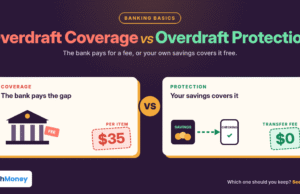
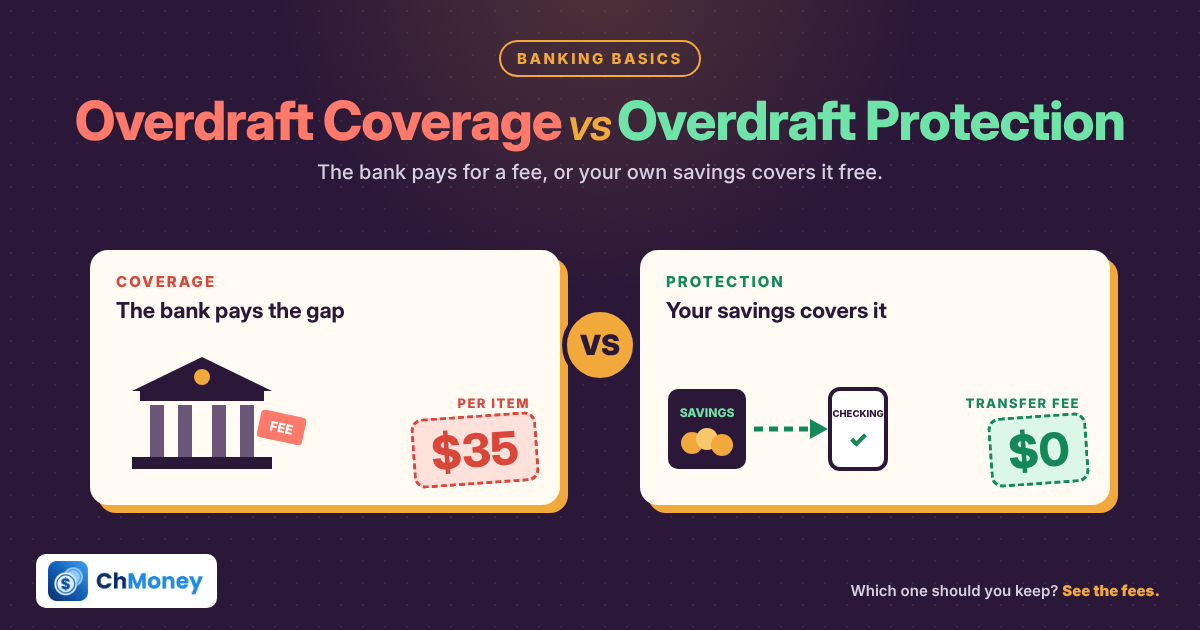
Here’s the short answer. Overdraft coverage means your bank pays a transaction you don’t have money for and charges you a fee, usually $34 to $36 at big banks. Overdraft protection means your bank pulls money from another account you own, like savings, to cover the gap. At Chase, Wells Fargo and Bank of America that transfer is free.
The rest of this guide shows you how each one works, what the big US banks charge, and which setting you should keep.
Overdraft coverage vs overdraft protection at a glance
| Overdraft coverage | Overdraft protection | |
|---|---|---|
| Who pays the shortfall | The bank, out of its own money | You, from your own linked account |
| Cost per overdraft | Usually a flat fee: $34 at Chase, $35 at Wells Fargo, $10 at Bank of America | Often $0 from savings (Chase, Wells Fargo, Bank of America, Regions). Interest and fees if the backup is a credit card or credit line |
| What it covers | Checks, ACH and recurring payments by default. ATM and one-time debit purchases only if you opt in | Whatever would overdraw the account, up to the money in the linked account |
| Do you need to sign up? | Not for checks and autopay. Yes for ATM and debit card purchases | Yes, you link the account yourself |
| Credit check | No | Only for an overdraft line of credit |
| Hurts your credit score? | No, unless an unpaid negative balance goes to collections | No for savings. A credit card advance raises your balance and utilization |
| Other names | Standard overdraft, courtesy pay, Debit Card Coverage | Balance Connect (Bank of America), linked account transfer |
What is overdraft coverage?
Overdraft coverage is a bank service where the bank pays a transaction even though your account doesn’t have enough money, then charges you a flat fee for doing it. The bank decides whether to pay each item. At Chase that fee is $34 and at Wells Fargo it is $35, and both banks charge up to three fees a day.
Here’s the part almost every other article gets wrong. Overdraft coverage comes in two pieces, and the rules are different for each one.
- Standard coverage (checks, autopay and recurring card payments). This one is usually on by default. If your rent check, your car insurance autopay or your Netflix charge hits an empty account, the bank can pay it and charge you a fee. You didn’t sign up for anything. U.S. Bank and Regions both say so on their own help pages.
- ATM and one-time debit card coverage. This one needs your permission. Since 2010, a federal rule (Regulation E, 12 CFR 1005.17) says a bank can’t charge you an overdraft fee on an ATM withdrawal or a one-time debit card purchase unless you opted in first. If you never said yes, the bank just declines the card at the register. No fee.
So when someone says “I turned off overdraft and still got a fee,” this is usually why. They turned off the debit card part. The check or the autopay still went through standard coverage.
Banks name this setting differently. Chase calls it Debit Card Coverage, Wells Fargo calls it Debit Card Overdraft Service, and U.S. Bank calls it ATM & Debit Card Overdraft Coverage. If you choose off at Chase, its page says plainly that the transaction “will be declined and you won’t be charged an Overdraft Fee.”
What is overdraft protection?
Overdraft protection is an optional service that links your checking account to another account you own, usually savings, and moves money over automatically when a payment would overdraw your checking. The payment goes through and you pay no overdraft fee. Chase, Wells Fargo, Bank of America and Regions charge nothing for transfers from a linked account.
You can link four kinds of backup accounts. Each one costs you something different:
- A savings account. The cheapest option. The money just moves from your savings to your checking. Your savings shrinks a bit, that’s all.
- A second checking account. Works the same way as savings.
- A credit card. The bank takes the money as a cash advance. Cash advances usually have no grace period, so interest starts the same day, and many cards charge a cash advance fee (5% of the amount is common). Check your card agreement before you link it.
- An overdraft line of credit. A small loan the bank sets up for this. It needs a credit check and charges interest on whatever you use.
Some banks move money in set amounts instead of the exact shortfall. Regions, for example, transfers in $10 steps. So if you are $23 short, $30 comes over.
Which one does the bank use first?
At most banks, overdraft protection runs first. The bank tries to pull from your linked account. If the linked account doesn’t have enough money either, then overdraft coverage can kick in and the bank decides whether to pay the item and charge a fee. Regions lays out this order on its help page.
That means protection doesn’t make you fee-proof. If your savings has $15 and you are $60 short, you can still end up with a fee. Keep a little buffer in the linked account, even $100 helps.
One $60 shortfall, four different results
Say you have $40 in checking. Your $100 electric bill comes out by autopay. You are $60 short. Here is what happens under each setup:
| Your setup | What happens | What it costs you |
|---|---|---|
| Overdraft coverage only, at Wells Fargo | The bank pays the bill. Your balance goes to minus $60 | $35, unless you deposit enough during the Extra Day Grace Period |
| Overdraft coverage only, at Chase | The bank pays the bill. You’re over Chase’s $50 no-fee limit | $34, unless you bring the balance back to $50 or less overdrawn by 11 p.m. ET the next business day |
| Overdraft protection from savings | $60 moves from your savings. The bill gets paid | $0 at Chase, Wells Fargo, Bank of America and Regions |
| Overdraft protection from a credit card | The card makes a $60 cash advance | Often a $10 minimum fee plus cash advance interest from day one |
| Both turned off (decline) | The bank may return the payment unpaid | No bank fee at Chase or Wells Fargo, but the electric company can charge its own late or returned payment fee |
Now swap the electric bill for a $100 grocery run on your debit card. If you never opted in to debit coverage, the card just gets declined at checkout. Embarrassing, yes. But it costs nothing.
What do the big US banks charge?
In November 2026, Wells Fargo charges $35 per overdraft, Chase $34, Bank of America $10 and Capital One nothing. Chase, Wells Fargo, Bank of America and Regions all move money from linked savings for free. Here are the figures from each bank’s own fee page, read November 14, 2026:
| Bank | Overdraft fee | Max fees per day | When you pay no fee | Linked-account transfer fee |
|---|---|---|---|---|
| Chase | $34 | 3 ($102) | Items of $5 or less; overdrawn by $50 or less at end of day; back within $50 by 11 p.m. ET next business day | $0 |
| Wells Fargo | $35 | 3 | Items of $10 or less; overdrawn by $10 or less; deposit during Extra Day Grace Period | $0 |
| Bank of America | $10 (goes to $15 on Feb. 19, 2027) | 2 | Items of $1 or less, or overdrawn by $1 or less | $0 (Balance Connect) |
| Regions | $36 | Not stated on the help page | Overdrawn by $5 or less after end-of-day processing | $0 |
| Capital One | $0 on consumer checking | n/a | Always | $0 |
Citi and Capital One both dropped overdraft fees, according to the CFPB’s April 2024 report. Bank of America also has accounts with no overdraft fees at all, like Advantage SafeBalance. Chase has the same with Chase Secure Banking.
For the bigger picture, the CFPB found that US banks made $5.83 billion from overdraft and NSF fees in 2023. That’s down from $11.96 billion in 2019. Bankrate’s 2025 survey put the average overdraft fee at $26.77, but that average includes small banks and credit unions. The big banks you probably use still charge $34 to $36.
Which one should you use?
For most people, the best setup is overdraft protection linked to savings, with ATM and debit card coverage turned off. You pay no fee when savings covers the gap, and your card gets declined instead of charging you $35 for a $4 coffee. Only standard coverage for checks and autopay stays on.
Here’s a quick guide by situation:
- You have some savings: link savings for overdraft protection and keep $100 or more in it as a buffer. Turn off debit card coverage.
- You live paycheck to paycheck with no savings: turn off debit card coverage so your card gets declined instead of costing you a fee. Think about an account with no overdraft fees, like Capital One checking or Chase Secure Banking.
- You have only a credit card: don’t link it unless you would rather pay a cash advance fee than an overdraft fee. A $10 advance fee beats a $35 overdraft fee, but the interest adds up if you don’t pay it off fast.
- Your rent, insurance or loan payments run on autopay: keep standard coverage on. A returned rent payment can cost you a late fee from your landlord and a bigger headache than a $35 bank fee.
- You almost never overdraft: link savings anyway. It’s free and you’ll forget about it until the day it saves you.
How to check, turn on or turn off each setting
You can change both settings in your bank’s app, in online banking, at a branch, or by calling the number on your card. Turning debit card coverage off usually takes effect right away or within a business day. Linking savings for protection takes a few minutes in most apps.
Here’s how to do it step by step:
- Open your bank’s app and go to your checking account settings. Look for “Overdraft services,” “Overdraft settings” or “Debit card coverage.”
- Check your debit card coverage. If it says on, opted in or enrolled, switch it off to stop fees on ATM and one-time card purchases. At Bank of America, look for the Decline All overdraft setting.
- Link a backup account. Choose your savings account for overdraft protection. At Bank of America this is called Balance Connect.
- Ask about standard coverage. Some banks let you turn it off, some don’t. If you call, ask: “Can you decline checks and ACH items instead of paying them with a fee?”
- Turn on low balance alerts. Set one at $100 or $50 so you get a text before you hit zero.
What happened to the CFPB overdraft rule?
The CFPB finalized a rule in December 2024 that would have limited overdraft fees at banks with more than $10 billion in assets, with $5 as the benchmark. Congress repealed it under the Congressional Review Act, and the President signed the repeal on May 9, 2025. No federal cap on overdraft fees exists today.
So if you read somewhere that overdraft fees are now illegal or capped at $5, that’s out of date. The rule was set to start October 1, 2025, and it never took effect.
Fees did come down over the last few years, but banks did that on their own. Capital One and Citi dropped overdraft fees. Bank of America cut its fee to $10. Most big banks dropped NSF fees (the fee for a payment the bank returns unpaid). By October 2023, 81 of 125 banks with over $10 billion in assets had stopped charging NSF fees, according to the CFPB.
Already got an overdraft fee? What to do now
Call your bank, ask for a one-time courtesy refund, and bring your balance back above zero the same day. Banks refund first-time or rare overdraft fees often, especially if you have direct deposit and a long history with them. It takes five minutes and costs nothing to ask.
Here’s what you can say on the phone:
“Hi, I got a $35 overdraft fee on [date]. I don’t usually overdraw and I’ve already deposited money to fix it. Can you waive this fee as a one-time courtesy?”
If they say no, ask once more nicely, then ask them to turn off your debit card coverage and link your savings so it doesn’t happen again.
Don’t leave the account negative. Banks can close an account that stays overdrawn for weeks, and a closed account with money owed can go to ChexSystems, a consumer reporting agency banks check before letting you open a new account. ChexSystems keeps records for up to five years. If you think a fee broke your bank’s own rules, you can file a complaint with the CFPB at consumerfinance.gov/complaint.
Frequently asked questions
Is overdraft protection free?
Overdraft protection from a linked savings or checking account is free at Chase, Wells Fargo, Bank of America and Regions. Protection from a credit card or line of credit costs money because you pay interest, and credit card advances usually carry a cash advance fee.
Can you have both overdraft coverage and overdraft protection?
Yes. Most banks let you have both. Protection runs first and pulls from your linked account. If that account is short, overdraft coverage can pay the rest and charge a fee.
Does overdraft protection affect your credit score?
Not if it pulls from savings or checking. An overdraft line of credit needs a credit check and shows up as a credit account. A credit card advance adds to your card balance, which can raise your credit utilization.
What happens if I opt out of overdraft coverage?
Your ATM withdrawals and one-time debit card purchases get declined when you don’t have the money, and you pay no fee. Checks, autopay and recurring payments can still be paid with a fee under standard coverage, or returned unpaid.
Do recurring payments still overdraft if I opt out?
Yes, they can. The debit card opt-in rule covers only ATM and one-time debit card transactions. Recurring card payments, checks and ACH autopay fall under standard coverage, which most banks turn on by default.
Are overdraft fees illegal now?
No. The CFPB’s 2024 rule that would have limited fees at big banks was repealed in May 2025. Banks can still charge overdraft fees, but they need your opt-in for ATM and one-time debit card overdrafts.
Which banks don’t charge overdraft fees?
Capital One charges no overdraft fees on consumer checking, and Citi dropped them too. Bank of America’s Advantage SafeBalance and Chase Secure Banking accounts have no overdraft fees. Many online banks also skip them.
Are Chime SpotMe and similar apps overdraft coverage or protection?
They work more like coverage, because the company fronts the money, but without a fee. Chime’s SpotMe starts at $20 and can go higher, and you need qualifying direct deposits to use it. Check each app’s limit and rules before you count on it.
The bottom line
Overdraft coverage is the bank lending you money for a $34 or $35 fee. Overdraft protection is you lending yourself money from your own savings, usually for free. Turn off debit card coverage, link your savings, and keep a small buffer there. That one setup stops most overdraft fees before they happen.