
We all know that sinking feeling. You hit “send” on a wire, and a minute later you notice the account number had one digit wrong. Or worse, the title company calls to ask where your down payment is, and you realize the email with the “updated wire instructions” didn’t come from them at all. Now you are on Google typing “can wire transfers be reversed” with your heart going fast.
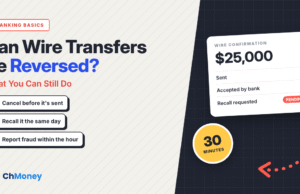
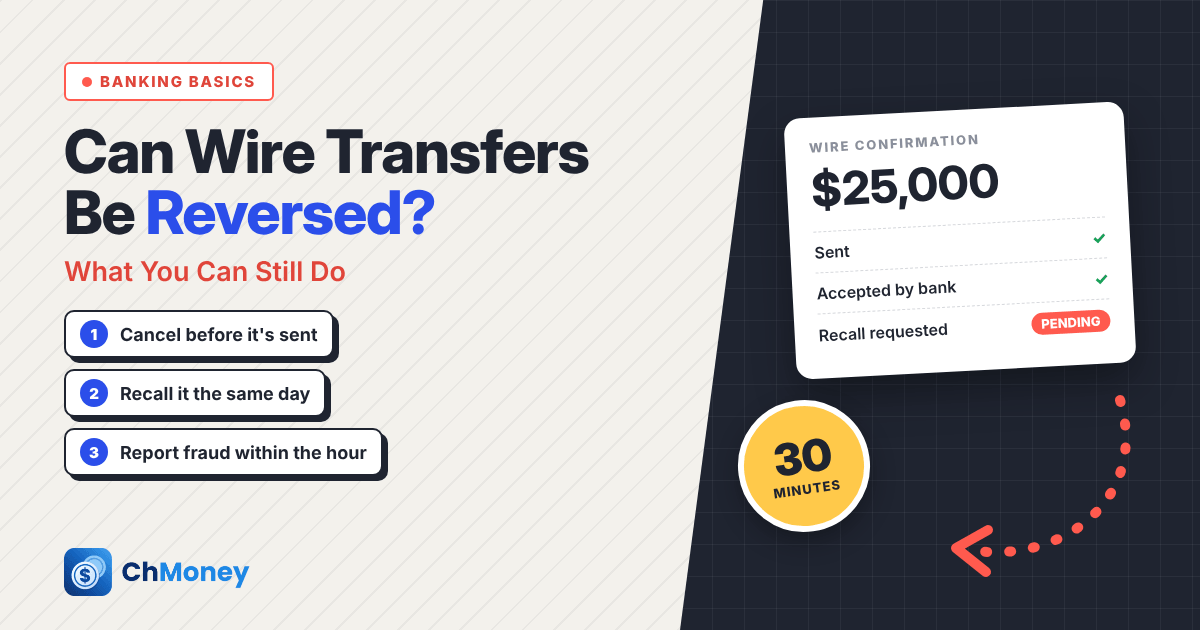
Here’s the short answer. Usually no. Once the receiving bank accepts a wire, you can’t cancel it on your own, and no dispute right forces the money back. You can still get it back in three cases: you catch it before your bank sends it, you sent an international transfer as a consumer and cancel within 30 minutes, or the receiving bank freezes the money and agrees to return it. Speed decides almost everything.
The rest of this guide tells you what to do in the next hour, what the law actually gives you, and what your odds look like in each situation.
Can you get your wire back? Your odds by situation
| What happened | Can you stop or reverse it? | Who decides | What to do |
|---|---|---|---|
| You caught it before your bank sent it | Yes, usually | Your bank | Call now and cancel. Online “pending” wires can often be cancelled in the app |
| You sent money abroad through a bank or money transfer service, less than 30 minutes ago | Yes, by federal rule, if the money hasn’t been picked up or deposited | Federal law (Reg E) | Call the provider and say “I’m cancelling under the 30-minute rule.” You get a full refund within 3 business days |
| Wrong account number, money already sent | Sometimes | Receiving bank, then the account holder | Ask your bank for a recall today. If the money is gone, the person who got it still has no right to keep it |
| Wrong amount or sent twice | Often, if caught the same day | Receiving bank and recipient | Ask for a recall of the extra amount and contact the recipient directly |
| You were tricked into sending it (scam) | Sometimes, if the money is still sitting in the scam account | Receiving bank, often with FBI help | Call your bank’s fraud line, file at ic3.gov the same day |
| Someone sent a wire from your account without permission | Often yes, the bank may owe you a refund | Your bank, under UCC 4A | Report it right away in writing. The bank usually carries the loss unless it followed security steps you agreed to |
| Business wire to a fake vendor account | Sometimes | Receiving bank, FBI | Same as a scam. Report within hours, not days |
Can a wire transfer be reversed after it is sent?
Not by you, and not automatically. A wire is final once the receiving bank accepts it. Your bank can send a recall request, but the receiving bank decides whether to return the money, and it usually needs the account holder’s OK or a fraud freeze. There’s no chargeback for wires like there is for credit cards.
That’s the whole reason scammers love wires. The money lands in minutes, and the person at the other end can move it again before you even notice something is off.
Three words get mixed up a lot on other sites, so here’s what each one means:
- Cancel: you stop the wire before your bank sends it. Your bank just doesn’t process it. This is easy, but only for a short time.
- Recall: the wire already went out, so your bank asks the receiving bank to send it back. The receiving bank can say no.
- Reverse: the money actually comes back to you. This only happens if a recall works, a court orders it, or the bank made the error itself.
What to do in the first hour after a bad wire
Call your bank’s fraud or wire department by phone, right now, and ask for a recall and a fraud hold. Then report to the FBI at ic3.gov the same day. Banks and the FBI can only freeze money that’s still in the receiving account, and scammers usually move it within hours.
Here’s the order to go in:
- Call your bank, don’t email. Use the number on the back of your debit card or your bank’s website. Say “I need to recall a wire and report fraud.” Ask for the wire department if the first person can’t help.
- Give them the wire details. Amount, date and time, receiving bank, account number, and the wire reference number. For domestic wires that’s the Fedwire reference (often called the IMAD or OMAD) on your confirmation. For international wires ask for the UETR.
- Ask your bank to contact the receiving bank directly and request a freeze on the funds. Write down the name of everyone you talk to and the time.
- File a complaint at ic3.gov. The FBI’s Recovery Asset Team works with banks to freeze stolen money. It only works when you report fast.
- Report to the FTC at ReportFraud.ftc.gov.
- Call your local police and get a report number. Your bank and any insurer may ask for it.
- If it was a home purchase, call your title company or real estate agent at a number you already had, not one from the email.
- Change your email password and turn on two-step login if the scam started with a hacked or spoofed email.
Every hour counts here. The FBI’s numbers below show why.
What are your chances of getting money back after a wire scam?
Better than most people think, if you report fast. In 2025 the FBI’s Recovery Asset Team worked 3,900 cases involving $1.16 billion and froze $679 million, a 58% success rate. Those were cases reported quickly to the FBI and the banks. Wait a week and the money is usually gone.
Here’s what the FBI’s 2025 Internet Crime Report shows:
| FBI IC3 figure (2025) | Number |
|---|---|
| Total reported losses to online fraud | $20.9 billion, up from $16.6 billion in 2024 |
| Total complaints | 1,008,597 |
| Business email compromise losses | $3.05 billion across 24,768 complaints |
| Recovery Asset Team cases | 3,900, with $1.16 billion in attempted theft |
| Money frozen in US accounts | $507 million across 3,574 cases |
| Money frozen in overseas accounts | $172 million across 326 cases |
| Success rate | 58% (66% in 2024) |
Look at that last split. Domestic cases got frozen far more often than international ones, because once the money leaves the US the FBI has to work through foreign banks.
Business email compromise is the scam where someone fakes or hacks an email from a person you trust, like your title company, a vendor or your boss, and sends “new” wire instructions. It’s the reason so many home buyers lose their down payment.
A real example: Aaron Fisher, a home buyer, wired more than $900,000 for his home to an account he got from a spoofed email, as CNBC reported. Title agents get hit too. CertifID, a wire fraud company, describes a title agent named Sarah who lost $168,000 the same way. In both cases the warning sign was the same: wire instructions that came by email instead of a phone call.
The 30-minute rule: when you can cancel an international transfer
If you’re a consumer sending money to another country, federal law lets you cancel for free within 30 minutes of paying, as long as the money hasn’t been picked up or deposited. The provider must refund you, fees included, within three business days. This rule does not cover domestic wires.
A lot of websites get this one wrong. They say “you have 30 minutes to cancel any wire.” You don’t. The rule is in Regulation E (12 CFR 1005.34), and the CFPB lists four conditions:
- You used a remittance transfer provider (a bank, credit union or money transfer company) to send money abroad for personal reasons.
- The money hasn’t been picked up or deposited yet.
- You paid less than 30 minutes ago.
- You give enough details for the provider to find the transfer.
Two more rules help you:
- Scheduled transfers: if you set up an international transfer for a future date, you can cancel up to three business days before it goes.
- Errors: if the money never arrives or the wrong amount shows up, you have 180 days from the promised delivery date to report it. The provider has 90 days to investigate and three business days after that to tell you the result.
Your receipt should say how long your cancellation window is. Some states and some companies give you longer.
Can you dispute a domestic wire transfer?
Not the way you dispute a debit card charge. Regulation E, the rule that protects debit card and ACH users, excludes wires sent through Fedwire. Domestic wires fall under UCC Article 4A, state law that treats a wire you authorized as final once the receiving bank accepts it, even if a scammer tricked you.
This is the part nobody tells you. If someone steals your debit card, federal law caps your loss at $50 if you report it within two days. Wires don’t get that protection.
What Article 4A does give you:
- You can cancel before the bank accepts the order. Your request has to reach the bank in time to act on it (UCC 4A-211). After the receiving bank accepts it, a cancellation only works if that bank agrees.
- Unauthorized wires are different from tricked ones. If someone hacks your online banking and sends a wire you never approved, the bank generally has to refund you unless it followed a security procedure you agreed to, like a code sent to your phone (UCC 4A-202 and 4A-204). If you sent the wire yourself because a scammer lied to you, it counts as authorized, and the bank usually doesn’t owe you anything.
- You have to speak up. Report an unauthorized wire as soon as you see it. If you wait more than a year after your bank tells you about it, you lose the right to get it back from the bank (UCC 4A-505).
Business accounts work under the same rules, but companies usually sign wire agreements with extra security steps. If your company followed them and the bank didn’t, push back hard.
What if you sent a wire to the wrong account?
Ask your bank for a recall the same day. The receiving bank can credit a wire using the account number alone, even if the name doesn’t match, so one wrong digit can send your money to a stranger. That person has no legal right to keep it, but getting it back may take their consent or a court.
That rule is in UCC 4A-207. Banks process wires by machine, and if the receiving bank doesn’t know the name and number don’t match, it can pay the account number. So check the number twice. A name match won’t save you.
If the recall fails, here’s what you can do:
- Ask your bank for the result in writing, including whether the receiving bank froze the money or the account holder refused.
- Contact the recipient if you know who it is. Ask them to return it through their bank.
- Send a demand letter. Money paid by mistake isn’t the recipient’s to keep. A short letter with the date, amount and a deadline often works.
- File in small claims court if they still refuse. Limits run from $2,500 to $25,000 depending on the state, so check yours.
How long does a wire recall take?
A same-day cancellation takes minutes. A recall of a domestic wire usually takes a few days to a few weeks, and an international SWIFT recall can take weeks or months. The speed depends on the receiving bank, not yours. Your bank can’t force a faster answer.
| Wire type | How fast the money lands | How long a recall usually takes |
|---|---|---|
| Domestic wire (Fedwire) | Minutes to a few hours, same business day. Fedwire runs 9 p.m. to 7 p.m. ET on business days | Several days to a few weeks |
| International wire (SWIFT) | 1 to 5 business days | Weeks to months, sometimes no answer at all |
| International transfer you cancel within 30 minutes | Not sent yet | Refund within 3 business days |
International wires can pass through one or two middle banks before they arrive. Your bank sends a recall through SWIFT, and each bank in the chain has to respond. Some foreign banks never answer.
Does a wire recall cost money?
Often, yes. Many banks charge a recall or trace fee on top of the original wire fee, and you pay it whether or not the recall works. For reference, an outgoing domestic wire costs $30 at Bank of America and $30 online or $40 at a branch at Wells Fargo, and Bank of America charges $45 for an international wire sent in US dollars. Ask about the recall fee when you call, and ask whether your bank waives it for fraud.
What to do if your bank says no
Ask for the decision in writing, then file a complaint with the CFPB at consumerfinance.gov/complaint. Banks must respond to CFPB complaints, usually within 15 days. If you think the bank broke the rules on an unauthorized wire, talk to a lawyer about UCC Article 4A.
A few more steps you can take:
- Ask who refused. Was it your bank, the receiving bank, or the account holder? That tells you who to go after next.
- Complain to the bank’s regulator. For national banks like Chase or Wells Fargo, that’s the OCC at helpwithmybank.gov.
- Check your insurance. Some homeowners, title and business crime policies cover wire fraud. Read the policy before you assume.
- Watch out for recovery scams. After a big loss, you may get calls from “fund recovery” companies or fake lawyers who promise to get your money back for an upfront fee. The FBI logged 10,516 complaints about recovery scams in 2025 with $1.4 billion in losses, and the FTC says real government agencies never ask for money to help you get a refund. Real recovery goes through your bank, the FBI and the courts, and none of them charge you to start.
Wire transfers vs other payments: which ones can you dispute?
Credit cards give you the strongest dispute rights. Wires, cashier’s checks and peer-to-peer apps like Zelle give you the weakest when you send money to a scammer yourself. If you’re paying someone you don’t know well, use a method you can dispute.
| Payment type | Speed | Can you dispute it? | Main protection |
|---|---|---|---|
| Credit card | Instant | Yes, chargeback for fraud, billing errors and items not received | Truth in Lending Act and Fair Credit Billing Act. $50 max liability for unauthorized charges |
| Debit card | Instant | Yes for unauthorized charges | Regulation E. $50 cap if reported within 2 business days |
| ACH transfer | 1 to 3 business days, same day possible | Yes for unauthorized transfers. Senders can reverse duplicates and wrong amounts within 5 banking days | Regulation E and Nacha rules |
| Zelle, Venmo, Cash App | Minutes | Only if unauthorized. Payments you approved, even to a scammer, are usually final | Regulation E (unauthorized only) |
| Domestic wire | Minutes to hours | No | UCC Article 4A |
| International transfer (consumer) | 1 to 5 business days | Cancel within 30 minutes. Report errors within 180 days | Regulation E remittance rule |
| Cashier’s check | Days to clear | Hard to stop once deposited | UCC Article 3 |
For how peer-to-peer apps work and what they charge, read our guide on how Venmo makes money (link). If you’re thinking about a cashier’s check instead of a wire for a big payment, our guide on how to cash a cashier’s check explains hold times and how to spot a fake one.
Can the person who received a wire send it back?
Yes. The recipient can ask their bank to return the money to you at any time. This is how most wrong-account and duplicate mistakes get fixed. The recipient’s bank sends it back as a new wire or a return, and your bank credits your account, sometimes minus fees.
If you’re the one who got money you weren’t expecting, don’t spend it. Call your bank and tell them. Some scams start with a “mistaken” deposit and a polite request to send it back by gift card or another account, so only return it through your bank.
How to avoid a wire you can’t take back
Confirm wire instructions by phone at a number you already have, send a small test amount for big transfers, and never act on wire instructions that arrive by email or text. Most wire scams start with a message that looks real. A two-minute call stops them.
- Call before you wire. For home closings, call your title company at the number in your purchase contract or on their official website. Not the number in the email.
- Treat any change in instructions as a red flag. Real title companies and vendors almost never change bank details at the last minute.
- Check the account number twice, digit by digit, out loud with someone if it’s a big amount.
- Send $1 first for large or new recipients and confirm they got it. It costs one extra fee and can save you thousands.
- Don’t wire money to anyone you’ve only met online, anyone who says they’re from your bank’s “security team,” or anyone who rushes you.
- Use a payment you can dispute when you buy from a stranger. A credit card beats a wire every time.
- Turn on alerts for every outgoing transfer, so you see an unauthorized wire within minutes.
Frequently asked questions
Can a bank reverse a wire transfer without the sender’s permission?
A receiving bank can freeze or return a wire if it suspects fraud or if it made an error itself. It doesn’t need the sender’s permission to return money. It usually does need the account holder’s OK, a fraud freeze or a court order to take money out of the recipient’s account.
Can you cancel a wire transfer after it has been sent?
Only if the receiving bank hasn’t accepted it yet, or if it was an international consumer transfer and you cancel within 30 minutes. After that, your bank can only ask for a recall, and the receiving bank decides.
Can you get your money back if you wired it to a scammer?
Sometimes. Call your bank’s fraud line and file at ic3.gov right away. In 2025 the FBI’s Recovery Asset Team froze money in 58% of the cases it worked. Your chances drop fast after the first day.
How long do you have to reverse a wire transfer?
There’s no set window for domestic wires. You can cancel until the bank sends it. International consumer transfers can be cancelled within 30 minutes. For fraud, report within hours, because scammers move money quickly.
Are wire transfers protected by Regulation E?
International consumer transfers are, under Reg E’s remittance rule. Domestic wires through Fedwire are not. They fall under UCC Article 4A, which gives you no right to dispute a wire you authorized yourself.
Is a wire transfer safer than Zelle?
Neither one protects you if you send money to a scammer yourself. Both are fast and very hard to get back. For buying from someone you don’t know, a credit card is safer than either.
Does it cost money to recall a wire?
Usually. Many banks charge a recall or trace fee on top of the wire fee, and you pay it even if the recall fails. Ask your bank whether it waives the fee for fraud.
What information do I need to recall a wire?
The amount, date, receiving bank, recipient name and account number, and the wire reference number from your confirmation. For domestic wires that’s often the IMAD or OMAD. For international wires, ask for the UETR.
The bottom line
Can wire transfers be reversed? Not on your own, and not once the other bank says no. But you have more options than most sites tell you. Cancel before it goes out, use the 30-minute rule for money you sent abroad, and if a scammer got it, call your bank and file at ic3.gov within the hour. More than half of the FBI’s freeze attempts worked in 2025, and those started with a fast report.