
We all know that moment when your credit card statement shows up and you see three different numbers on it. Statement balance, current balance, minimum payment. And two dates. You paid the bill last month, or you thought you did, and still there is a $22 interest charge sitting there. So which number do you pay, and when, so the bank gets nothing extra from you?
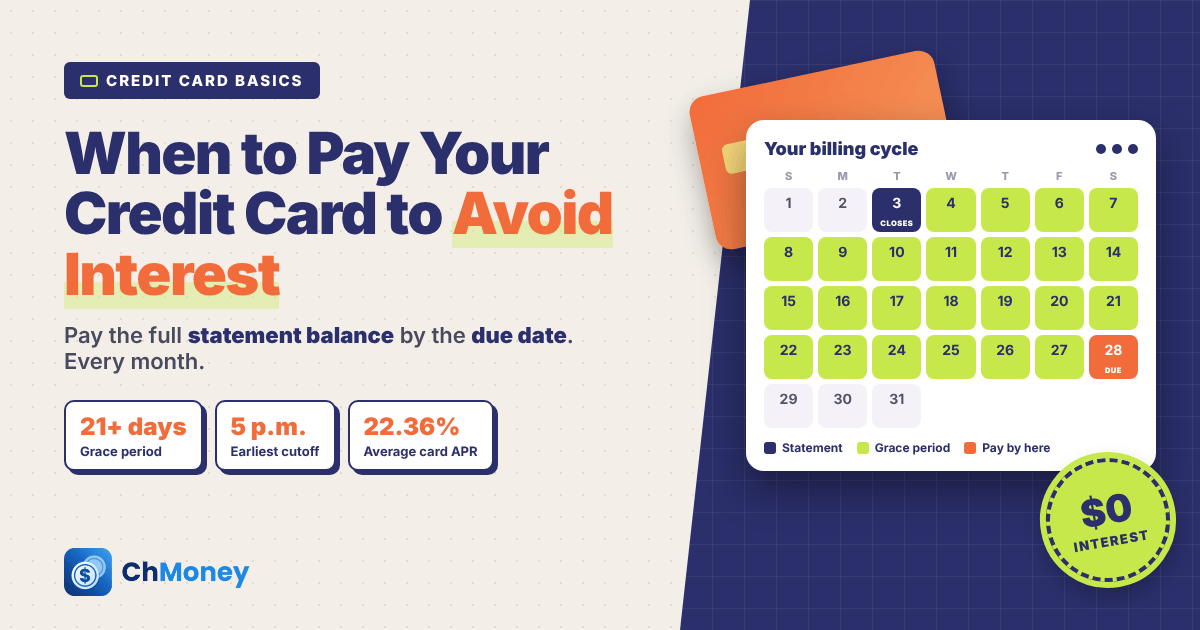
Here’s the short answer. Pay your full statement balance by the due date printed on your bill, before 5 p.m. or whatever later cutoff your card gives. Your bank must send that bill at least 21 days before the due date. Do it every month and your purchases cost you $0 in interest. Leave even $1 unpaid and new purchases start charging interest the day you make them.
The rest of this guide shows you the dates, the math in dollars, and the few cases where paying on time still doesn’t save you.
Credit card payment timing at a glance
| What you pay | When | What happens |
|---|---|---|
| Full statement balance | By the due date, before the cutoff time | $0 interest on purchases. You keep your grace period |
| Full current balance | Any time before the due date | $0 interest, and it wipes out residual interest if you carried a balance last month |
| More than the minimum, less than the statement balance | By the due date | No late fee, but interest on what’s left and on every new purchase from the day you buy it |
| Minimum payment only | By the due date | No late fee. Interest on almost everything. $3,000 takes about 15 years to clear |
| Anything | After the due date | Late fee, interest, and a credit report hit once you’re 30 days late |
| Before the statement closes | A few days before the statement date | Lowers the balance reported to credit bureaus. Doesn’t change interest if you pay in full anyway |
What’s the difference between the statement date and the due date?
The statement date is the last day of your billing cycle. Your card adds up everything you charged and prints your statement balance. The due date is the deadline to pay that balance, and federal rules make your bank deliver the bill at least 21 days before it. The days in between are your grace period, when purchases cost no interest.
Your billing cycle runs 28 to 31 days. Here is a real month on a card with a statement date on the 3rd:
| Date | What happens |
|---|---|
| February 4 | New billing cycle starts |
| March 3 | Statement date. Your statement balance is $1,240 |
| March 3 to March 28 | Grace period (25 days on this card) |
| March 10 | You buy a $300 flight. It goes on next month’s statement |
| March 28, 5 p.m. | Due date and cutoff. Pay $1,240 and you owe $0 interest |
| April 3 | Next statement. The $300 flight shows up here, due April 28 |
| April 27 | If you never paid the March bill, you’re now 30 days late and the bank can report it |
Your due date also has to fall on the same day every month, so you can set a reminder once and leave it.
Should you pay the statement balance or the current balance?
Pay the statement balance to avoid interest. That’s the amount from your last bill, and paying it in full by the due date is all your grace period needs. The current balance adds charges you made after the statement date. Paying it is fine but not required, unless you carried a balance last month and want to stop residual interest.
In the example above, you owe $1,240 on March 28, not $1,540. The $300 flight already has its own grace period that runs to April 28.
The minimum payment is the smallest amount that keeps you from a late fee. It does nothing to stop interest. Many people set autopay to the minimum because it sounds safe, and then pay interest for years without noticing.
What happens if you pay less than the full statement balance?
You lose your grace period. Interest hits the unpaid part of your balance, and every new purchase starts charging interest from the day you make it, not from the due date. That keeps going until you pay the full balance again, usually one or two billing cycles in a row, depending on your card.
Here is what that looks like in dollars. Your statement balance is $2,000 and you pay $1,950. The $50 left over feels like nothing. Over the next month you put $1,500 on the card, spread out evenly. Now your average daily balance is about $800, and at 22.36% APR you owe about $14.70 in interest that month. If you had paid the full $2,000, you’d owe $0.
The rules do protect you a little. Since 2010, Regulation Z bans “double-cycle billing”, so your bank can’t charge interest on the $1,950 you paid on time. It can only charge on the $50 and the new purchases.
Why did you get charged interest after paying in full?
That’s residual interest, also called trailing interest. When you carry a balance, interest builds every day between your statement date and the day your payment posts. Your statement can’t show those days yet, so they show up as a small charge on the next bill, even after you pay the full statement balance.
Say you carried a balance last month. Your new statement shows $2,000, and you pay it 18 days later. At 22.36%, those 18 days add about $22.05 of interest that appears on your next statement.
How to stop it:
- Pay the current balance, not the statement balance, in the month you clear a carried balance.
- Call your card company and ask for the payoff amount. It includes interest up to the day your payment posts.
- Pay early in the cycle. Fewer days means less residual interest.
- Check the next statement. If you see a few dollars, pay that too, or the cycle starts over.
You only get residual interest when you were already carrying a balance. If you pay in full every month, you’ll never see it.
How do you get your grace period back?
Pay your full statement balance by the due date, usually for one or two billing cycles in a row. Each card company sets its own rule in the cardmember agreement. Until you get the grace period back, new purchases charge interest from the day you make them, so pay the current balance if you can to speed things up.
Look up “grace period” or “how to avoid paying interest” in your cardmember agreement, or call the number on the back of your card and ask, “How many full payments do I need to get my grace period back?”
Does paying your credit card early lower your interest?
Only if you carry a balance. Your card charges interest on your average daily balance, so every day a payment sits on your account sooner, the balance and the interest go down. If you pay your full statement balance by the due date every month, paying early saves nothing on interest, though it can help your credit score.
A quick example. You carry $3,000 at 22.36% and plan to pay $1,000 this month in a 30-day cycle:
| When you pay $1,000 | Average daily balance | Interest that month |
|---|---|---|
| Day 5 | $2,167 | About $39.82 |
| Day 28 | $2,933 | About $53.91 |
Same payment, $14.09 less interest, just because you paid it 23 days sooner. Pay early every month while you carry a balance and those savings keep stacking up.
Your card figures daily interest by dividing your APR by 365. At 22.36% that’s about 0.061% a day, or about 61 cents a day for every $1,000 you carry. Want to see how daily compounding pushes a card’s real cost above its APR?
When does a credit card charge interest right away?
Cash advances, balance transfers, convenience checks and some promotional deals usually skip the grace period. Interest starts the day the transaction posts, no matter when you pay. Deferred interest store cards can also charge interest back to the day you bought something if you don’t pay the full amount before the promo ends.
- Cash advances. No grace period, a higher APR than purchases, and a fee that is often 5% or $10, whichever is more. Pulling $400 from an ATM with your card can cost you $20 before a single day of interest.
- Balance transfers. A 0% transfer offer usually lasts 9 to 21 months with a 3% to 5% fee. Watch out for new purchases on that same card. On many cards they lose the grace period while the transferred balance is still there, so you pay interest on groceries while you thought everything was at 0%.
- Convenience checks. Those blank checks your bank mails you count as cash advances or balance transfers, depending on the card. Read the offer before you write one.
- Deferred interest store cards. “No interest if paid in full in 12 months” is not the same as 0% APR. Buy a $1,200 couch, pay $100 a month, and leave $100 unpaid when the 12 months end. The store can charge interest on the whole balance back to day one, which works out to about $200 at a 29.99% APR.
A true 0% intro APR card is different. You pay no interest during the promo, and only what’s left when it ends starts building interest from that point.
What if your due date falls on a weekend or holiday?
Your bank must accept payments until at least 5 p.m. on the due date. If the due date lands on a day the bank doesn’t receive mail, like a Sunday or holiday, a mailed payment that arrives the next business day counts as on time. Online and phone payments don’t get that extra day, so pay them by the due date itself.
A few more timing rules worth knowing:
- Your bank has to credit a payment the day it receives it, as long as it comes in before the cutoff. The cutoff can’t be earlier than 5 p.m. on the due date.
- Online payments from another bank can take 1 to 3 business days to show up as available credit, even though they count on the day you send them through your card’s website.
- Bill pay from your checking account sometimes goes out as a paper check. Schedule it 5 to 7 days early.
- A branch payment counts the same day if you pay before the branch closes.
When should you pay your credit card to help your credit score?
Pay before your statement date. Most cards report your statement balance to the credit bureaus, so a smaller balance on that date means lower credit utilization. This is a separate goal from avoiding interest. To avoid interest you only need to pay the full statement balance by the due date.
| Your goal | When to pay | What to pay |
|---|---|---|
| Avoid interest | By the due date | Full statement balance |
| Lower the balance reported to credit bureaus | A few days before the statement date | Enough to bring the balance down to what you want reported |
You may have seen the “15/3 rule” on TikTok: pay half your balance 15 days before the due date and the rest 3 days before. Some sites count from the statement date instead. Neither version does anything for interest if you already pay in full, and only a payment before the statement date changes what gets reported. One payment a few days before your statement date does the same job.
What happens if you only pay the minimum?
You avoid a late fee, but almost every dollar you owe keeps charging interest. Pay only the minimum on $3,000 at 22.36% and it takes about 15 years and $4,515 in interest to clear. Pay $150 a month instead and you’re done in 26 months with about $789 in interest.
That math assumes a minimum of 1% of the balance plus interest, or $25, whichever is more, which is a common formula. Your statement has to show the same kind of warning: how long minimum payments take and how much you’d pay each month to finish in 3 years.
If you miss the due date completely, here’s what happens:
- A late fee. A federal court in Texas threw out the CFPB’s $8 cap in April 2025, so big banks can still charge about $30 to $32 for a first late payment and $41 to $43 if you’re late again within six billing cycles. The fee can never be more than your minimum payment.
- Interest on the full balance, and you lose your grace period.
- A credit report hit once you’re 30 days past due. It can stay there for 7 years.
- A penalty APR, often near 29.99%, on new purchases. Your bank can only apply it to your existing balance once you’re more than 60 days late. If you then make 6 minimum payments on time in a row, it has to drop the penalty rate on that old balance.
If you can’t pay the full balance this month, pay as much as you can, as early as you can. Federal rules make your bank apply anything above the minimum to the balance with the highest APR first, so extra money goes where it saves you the most.
Can a balance transfer stop the interest?
It can pause it. A 0% balance transfer card moves your balance to a card with no interest for 9 to 21 months, for a fee of 3% to 5%. If you pay the full balance off before the promo ends, you usually save hundreds of dollars over keeping it on a 22% card.
Here’s the math on $3,000. Paying $167 a month at 22.36% takes 23 months and costs about $687 in interest. Move it to an 18-month 0% card with a 3% fee and you pay $90 total, a saving of almost $600. That only works if you pay it off before the 0% ends and you don’t run the old card back up.
How to set up your payments so you never pay interest
- Turn on autopay for the full statement balance. Not the minimum, and not a fixed amount. Most card apps have a “statement balance” option.
- Move your due date to a few days after payday. Most big card companies let you change it online or by phone. If you get paid on the 1st and 15th, a due date around the 20th works well.
- Keep a buffer in savings. One month of card spending in a high-yield savings account means a big bill never forces you to carry a balance.
- Check every statement anyway. Autopay fails if your checking account comes up short or your card number changes after fraud.
- Got charged interest or a late fee for the first time? Call and ask them to remove it. Many banks will waive a first slip if your history is clean. The worst they say is no.
Frequently asked questions
Is it better to pay my credit card early or on the due date?
Both avoid interest if you pay the full statement balance. Paying early lowers interest only if you carry a balance, and paying before the statement date can help your credit score.
Do I pay interest if I pay the statement balance in full?
No, as long as you paid in full last month too. If you were carrying a balance, you may see a small residual interest charge on the next statement.
Can I pay my credit card on the due date?
Yes. Your bank must accept payments until at least 5 p.m. on the due date, and some give you until midnight. Check the cutoff on your statement.
How many days do I have to pay my credit card without interest?
At least 21 days from the time your bill is sent, by federal rule. Most cards give 21 to 25 days between the statement date and the due date.
Does the 15/3 rule work?
Not for interest. It splits your payment into two dates, but paying the full statement balance by the due date already avoids interest. Only payments made before the statement date change your reported balance.
Can I get a late fee or interest charge waived?
You can ask. Call the number on your card, explain it was a one-time slip, and ask for a courtesy waiver. Many card companies agree if your payment history is clean.
Do I pay interest on a 0% APR card?
Not during the promo on the balance it covers. Interest starts on whatever is left when the promo ends. Deferred interest store cards are different and can charge interest back to the purchase date.
What time is a credit card payment due?
No earlier than 5 p.m. on the due date, in the time zone your card company names. Some cards accept payments until 11:59 p.m. Eastern.
To avoid credit card interest, pay your full statement balance by the due date, every month, before the cutoff. That’s the whole rule. If you’re carrying a balance right now, pay the current balance once to stop residual interest, then go back to statement-balance autopay. And keep cash advances and deferred interest deals off your card unless you know exactly what they’ll cost.